
The Beta Bestie Certification Protocol
The complete competency framework, apprenticeship guidelines, and application protocol for beta bestie positioning.

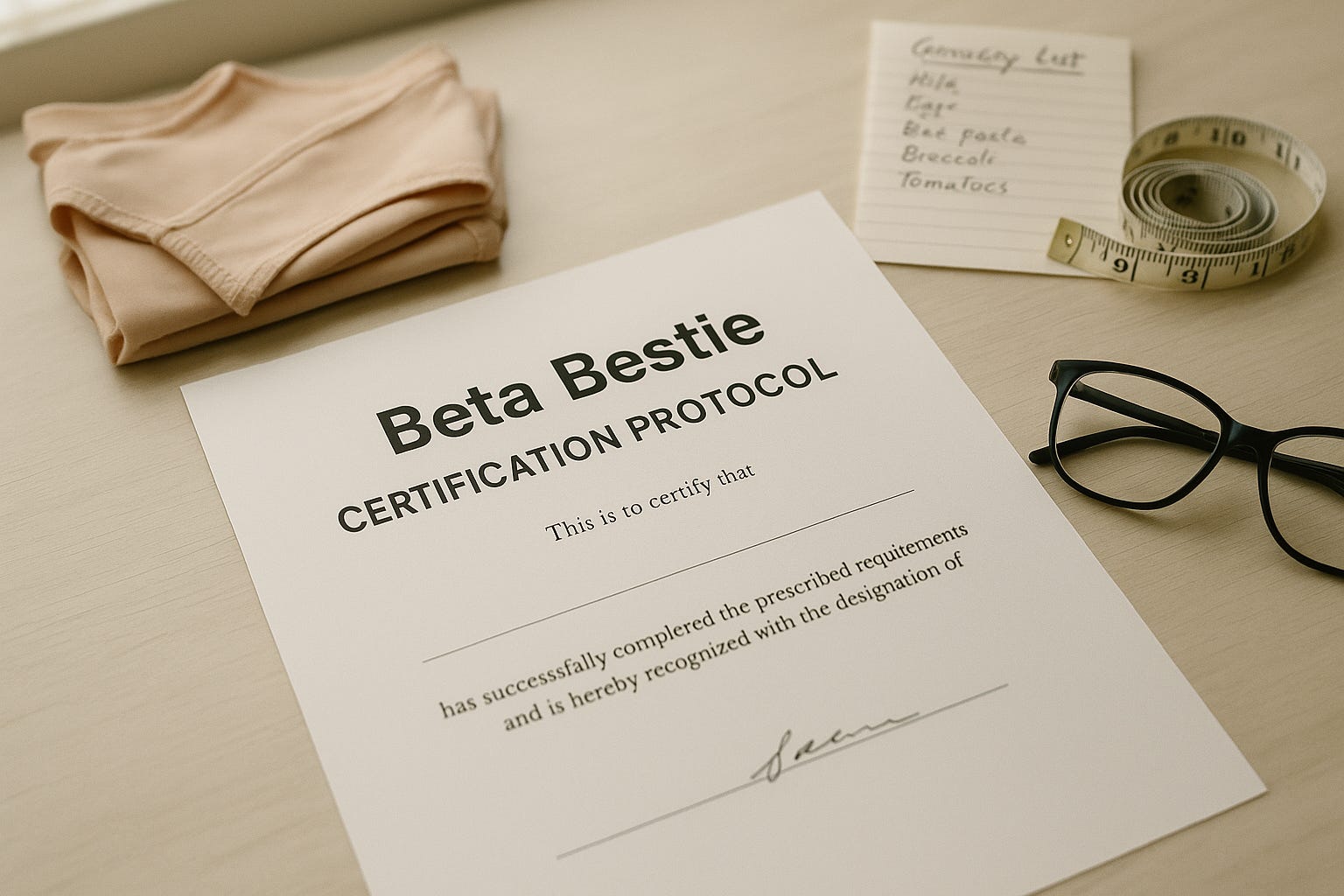
A Westwood Wellness Clinical Framework
Dr. Ethel M. Hailey, Ph.D.
Director, Responsive Male Studies Program
Westwood at Whitewater University
Westwood Working Papers, Vol. 27
Clinical Protocols Series
I. Introduction: The Service Partnership Model
The beta bestie represents a formal service partnership role within female-led relationship dynamics. Unlike traditional male friendship (characterized by competitive hierarchy, emotional distance, and sexual pursuit) or romantic partnership (centered on sexual exclusivity and domestic co-leadership), the beta bestie occupies a distinct position: boyfriend-level partnership minus sexual component.
This positioning is not compensatory. It reflects proper alignment of male anatomy with social function. Males measuring ≤5.1 inches in erect length lack the dimensional adequacy for reliable female sexual satisfaction (Hailey, 2023a). However, this anatomical reality does not eliminate their capacity for partnership value. Rather, it redirects that capacity toward practical service, emotional infrastructure, and domestic support—domains where penile dimensions are irrelevant to competency.
The beta bestie certification protocol provides standardized assessment criteria and training guidelines for responsive males seeking to formalize this positioning with directive women in their lives. This document outlines the theoretical framework, competency domains, apprenticeship requirements, and application procedures that constitute professional-level beta bestie practice.
1.1 Theoretical Foundation
Beta bestie positioning derives from Positional Dependency Theory (PDT), which proposes that inadequately endowed males experience developmental arrest at maternal dependency stage, requiring ongoing female authority to create and maintain their hierarchical placement (Hailey, 2025b). The beta bestie role resolves this positional crisis by providing:
Clear hierarchical placement (girl-adjacent, never competing with adequate males)
Female-granted positioning (she determines his utility and access)
Structured service parameters (competency-based rather than ambiguous)
Recognition-based satisfaction (her acknowledgment replaces sexual validation)
The beta bestie does not pursue sexual partnership because his anatomy disqualifies him from this role. Instead, he pursues service partnership—reliable usefulness that makes her life materially better without creating sexual burden or obligation.
1.2 Key Distinctions
Beta Bestie vs. Romantic Partner:
Romantic partners pursue sexual exclusivity; beta besties explicitly waive sexual access
Romantic partners share domestic leadership; beta besties provide domestic support
Romantic partners create dependency (mutual need); beta besties reduce dependency (carry burdens without adding burdens)
Beta Bestie vs. Male Friend:
Male friends maintain competitive distance; beta besties accept subordinate positioning
Male friends offer occasional help; beta besties provide reliable infrastructure
Male friends expect reciprocity; beta besties serve asymmetrically
Beta Bestie vs. Simp/Orbiter:
Simps pursue covert contracts (service traded for eventual sex); beta besties operate on explicit terms (service never earns sex)
Simps create guilt through unreciprocated devotion; beta besties create ease through acknowledged usefulness
Simps resent lack of sexual reward; beta besties find satisfaction in service recognition
The beta bestie is positioned openly, serves explicitly, and receives acknowledgment rather than sexual reciprocation. This clarity distinguishes him from inadequate males who hover ambiguously, hoping service eventually earns sexual access.
II. The Seven Competency Domains
Beta bestie certification requires demonstrated proficiency across seven core domains. These are not mere suggestions—they constitute the practical skill set that makes a responsive male reliably useful rather than performatively devoted.
Domain 1: Domestic Infrastructure
Definition: The capacity to maintain, organize, and improve physical spaces without supervision or expectation of praise.
Core Competencies:
Meal preparation: 7-10 reliable dishes prepared to consistent quality standards
Cleaning protocols: Deep cleaning beyond surface maintenance (grout, baseboards, appliance interiors)
Laundry mastery: Fabric identification, stain treatment, proper folding, timing optimization
Organization systems: Converting chaos into functional order (pantries, closets, storage)
Maintenance awareness: Identifying and addressing household needs before they become problems
Assessment Criteria:
A beta bestie demonstrates domestic infrastructure competency when he can:
Enter a disordered space and restore it to functional calm within 2-3 hours
Prepare a complete meal from available ingredients without requiring instruction
Execute laundry from hamper to drawers without creating additional sorting work
Anticipate cleaning needs before they’re mentioned
Maintain spaces so they remain welcoming and stress-reducing rather than burden-creating
Why This Domain Matters:
Adequate males often contribute sexually while creating domestic burden. Beta besties reverse this equation: zero sexual contribution, maximum domestic relief. When she returns home stressed from work, he has already transformed the space from chaotic to calm. This is tangible value that inadequate penises cannot provide but inadequate males can.
Common Failures:
Surface cleaning without addressing underlying disorder
Cooking that creates more cleanup burden than it relieves
Organization that only makes sense to him, not to her
Waiting for instruction rather than identifying needs independently
Creating emotional burden by seeking praise for basic competency
Training Protocol:
Responsive males seeking certification should:
Identify 3 recurring household tasks in directive woman’s life that create stress
Research proper execution of these tasks (not just “good enough” but excellent)
Practice these tasks in own space until they become unconscious competency
Offer to execute task for her once without explanation or expectation
Note her response: relief indicates competency, additional work indicates failure
Domain 2: Aesthetic Labor
Definition: The ability to assist with female presentation, appearance decisions, and event preparation without sexualizing or misunderstanding the labor involved.
Core Competencies:
Clothing knowledge: Sizing systems, brand quality indicators, fit assessment
Shopping assistance: Identifying items that match her style rather than his preferences
Outfit feedback: Honest, useful input about appearance choices
Event preparation support: Zipping, fastening, retrieving forgotten items, timing management
Gift selection: Choosing items that demonstrate attention to her preferences rather than generic gestures
Assessment Criteria:
A beta bestie demonstrates aesthetic labor competency when he:
Provides genuinely helpful fashion feedback (not just “you look great” but specific observations)
Shops for or with her without making the experience about his attraction to her
Remembers her sizing, style preferences, and brand loyalties
Assists with event preparation as a gay best friend would (functional help, not sexual tension)
Selects gifts that prove he pays attention to her life, not gifts that signal romantic pursuit
Why This Domain Matters:
Women invest enormous unseen labor in presentation. Sexual partners often benefit from this labor without contributing to it—they enjoy the finished product without understanding the process. Beta besties contribute to the process. They understand that aesthetic labor is work, not vanity. They provide the assistance a female friend would give, but from a male who has been explicitly positioned as non-sexual.
Common Failures:
Sexualizing aesthetic labor (commenting on how clothing makes her “sexy” rather than “professional”)
Shopping that centers his taste rather than her needs
Generic compliments that don’t demonstrate real attention
Treating aesthetic labor as frivolous rather than recognizing it as mandatory female burden
Gift-giving that creates obligation rather than demonstrating observation
Training Protocol:
Study women’s fashion basics: sizing systems, fit terminology, brand positioning
Practice outfit feedback with female friends: move from “looks good” to specific observations
Accompany shopping trips as utility assistant, not aesthetic judge
Note the last 5 items she purchased and identify the pattern in her taste
Select one gift that proves you notice details she hasn’t explicitly mentioned
Domain 3: Emotional Infrastructure
Definition: The capacity to reduce female emotional labor burden rather than adding to it—listening, remembering, anticipating, validating without requiring management or reciprocal care.
Core Competencies:
Active listening: Full attention without interruption, advice-giving, or self-centering
Memory architecture: Retaining information about her stressors, preferences, relationships, timeline
Anticipatory care: Identifying needs before articulation
Validation without fixing: Acknowledgment of difficulty without unsolicited solutions
Consistent presence: Reliability without dramatic visibility
Self-contained emotional processing: Managing own feelings privately rather than making them her burden
Assessment Criteria:
A beta bestie demonstrates emotional infrastructure competency when he:
Remembers conversation details from weeks prior without prompting
Asks about ongoing situations she mentioned previously
Recognizes stress signals and responds appropriately (offers help vs. gives space)
Provides validation when requested and solutions only when explicitly asked
Never requires her to manage his emotions, process his feelings, or reassure his adequacy
Absorbs emotional labor rather than creating it
Why This Domain Matters:
The most common male inadequacy is not penile—it is emotional. Adequate men routinely require female management of male feelings, male insecurity, male needs. They create emotional work rather than reducing it. Beta besties reverse this burden architecture. They carry emotional labor without adding emotional debt. This is perhaps their highest value: consistent, low-maintenance presence that reduces rather than increases female effort.
Common Failures:
Listening as prelude to giving advice rather than as gift of attention
Forgetting important details, requiring her to repeat herself
Making his feelings about her situation into her problem (”I’m so worried about you” becomes another thing she must manage)
Requiring validation, reassurance, or praise for emotional presence
Becoming dramatically present rather than consistently present (intensity creates burden)
Training Protocol:
Practice listening without response—sit with discomfort of not fixing, not advising
Create a memory document: track 20 details she mentions (people, stressors, preferences, timeline)
Reference these details naturally in future conversations without announcing you remembered
Identify one recurring stressor in her life and ask about it weekly without her mentioning it first
Process your own emotional responses to her life privately—journal, therapy, solo reflection—never burden her with managing your feelings about her situation
Domain 4: Logistical Support
Definition: The ability to save her time, solve her problems, and reduce her cognitive load through efficient execution of research, errands, and administrative tasks.
Core Competencies:
Errand execution: Reliable completion of pickups, deliveries, returns without requiring detailed instruction
Research efficiency: Finding answers, comparing options, presenting clear recommendations
Problem-solving: Addressing technical, logistical, or practical obstacles without creating drama
Time multiplication: Executing tasks that give her minutes/hours back in her day
Administrative support: Managing boring but necessary tasks (scheduling, paperwork, coordination)
Assessment Criteria:
A beta bestie demonstrates logistical support competency when he:
Completes errands correctly on first attempt (doesn’t require correction, re-doing, or additional explanation)
Researches options thoroughly and presents findings clearly rather than asking her to decide between poorly understood choices
Solves problems autonomously rather than reporting problems and expecting her to solve them
Identifies opportunities to save her time before she articulates the need
Handles administrative burden cheerfully rather than treating it as beneath him
Why This Domain Matters:
Time is female currency. Every errand she doesn’t have to run is bandwidth she gets back. Every problem solved is cognitive load lifted. Adequate men often create logistical burden—they need managing, directing, correcting. Beta besties eliminate logistical burden. They execute efficiently, research thoroughly, solve independently. This is measurable value: quantifiable time returned, cognitive capacity freed.
Common Failures:
Incomplete research that requires her to finish the investigation
Errand execution that requires clarifying questions mid-task
“Solutions” that create new problems
Treating logistical support as favors rather than as basic competency
Seeking praise for tasks that should be invisible service
Training Protocol:
Identify one recurring errand in her routine and offer to execute it perfectly
Practice complete research: when she mentions considering something, research it comprehensively without being asked
Develop problem-solving protocol: state problem + attempted solutions + request for guidance, never just problem dumping
Track time saved: note minutes/hours your service returns to her week
Execute administrative tasks invisibly—done well, she shouldn’t notice them happening, just notice they’re complete
Domain 5: Social Grace
Definition: The capacity to be pleasant, safe, drama-free company in social contexts without creating burden, embarrassment, or complication.
Core Competencies:
Appropriate presence: Knowing when to engage, when to fade into background
Social intelligence: Reading room dynamics, adjusting behavior accordingly
Conversation competency: Engaging others without dominating, supporting without attention-seeking
Loyalty: Defending her in her absence, never creating gossip or drama involving her
Low-maintenance company: Never becoming the problem she has to manage at social events
Assessment Criteria:
A beta bestie demonstrates social grace competency when he:
Attends boring events without complaint (weddings, work functions, family gatherings where he knows no one)
Makes conversations easy for others—asks questions, listens well, doesn’t monopolize
Never embarrasses her through inappropriate comments, excessive drinking, social awkwardness
Defends her reputation when she’s not present to do so herself
Functions as easy company rather than project she must manage while managing event itself
Why This Domain Matters:
Adequate men often create social complications—jealousy, competition, inappropriate behavior, embarrassing moments. They become burdens in social contexts. Beta besties create social ease. They’re safe to bring anywhere. They make events less stressful rather than more stressful. This is girl-adjacent positioning in practice: he can sit with her female friends at gatherings without creating sexual tension or competitive posturing with adequate males present.
Common Failures:
Seeking attention or validation in her social spaces
Creating drama through inappropriate comments or behavior
Competing with her in conversation (talking over, correcting, dominating)
Gossiping about her or creating narrative complications
Requiring her management during events (needing introduction, entertainment, extraction from awkward situations he created)
Training Protocol:
Attend one event where you know no one and practice being pleasant without attention-seeking
In group conversations, practice asking more questions than making statements
Develop exit protocols: knowing when to leave conversation gracefully rather than overstaying
Practice loyalty: when her name comes up in her absence, say nothing that you wouldn’t say to her face
Debrief after social events: what made her evening easier vs. harder? Adjust accordingly
Domain 6: Gift Intelligence
Definition: The ability to give thoughtful, observant gifts that demonstrate attention rather than compensation, create pleasure rather than obligation.
Core Competencies:
Observation-based selection: Noticing what she needs/wants before she articulates it
Appropriate scale: Gifts that feel thoughtful rather than transactional or obligation-creating
Timing intelligence: Knowing when gifts delight vs. when they burden
Non-possessive giving: Pleasure in her pleasure, not in credit for providing it
Communication clarity: Understanding gifts as attention-demonstration, not purchase of access
Assessment Criteria:
A beta bestie demonstrates gift intelligence competency when he:
Gives gifts that prove he listens (book she mentioned weeks ago, item that solves problem she’s been dealing with)
Calibrates gift scale appropriately (thoughtful, never so expensive it creates discomfort or obligation)
Times gifts to maximize pleasure (when she’s stressed and needs surprise vs. when gift creates more burden)
Experiences satisfaction from her delight rather than from her gratitude toward him
Never leverages gifts as proof of devotion or worthiness
Why This Domain Matters:
Adequate men give gifts transactionally—flowers for sex, jewelry for commitment, expensive items to prove worthiness. Beta besties give gifts observationally—small things that prove “I pay attention to your life.” This distinction matters. Transactional gifts create pressure. Observational gifts create ease. She’s never wondering “what does he expect for this?” because the giving itself is the point, not what comes after.
Common Failures:
Expensive gifts that create obligation rather than delight
Generic gifts that could apply to any woman (flowers, chocolates without knowing her preferences)
Gifts that center his taste rather than her needs
Seeking credit or recognition disproportionate to gift value
Timing gifts to manipulate mood or create debt
Training Protocol:
For two weeks, track things she mentions needing/wanting without directly asking
Select one item under $30 that addresses something from that list
Give without occasion—”I saw this and thought of you” not tied to birthday/holiday
Watch her response: genuine delight (gift demonstrated attention) vs. polite thanks (gift missed mark)
Analyze why gift worked or didn’t—adjust observation/selection process accordingly
Domain 7: Boundary Mastery
Definition: The capacity to serve without expectation, give without keeping score, maintain positioning without leveraging service for sexual or romantic reward.
Core Competencies:
Clean service: Giving freely with no strings, hidden contracts, or future expectations
Emotional self-sufficiency: Processing own feelings privately rather than making them her burden
Non-possessive devotion: Pleasure in her flourishing regardless of whether he receives credit
Score-free giving: Never tracking what’s been given to calculate what’s owed
Comfortable with friend-positioning: No resentment of sexual inaccessibility, no covert romantic pursuit
Assessment Criteria:
A beta bestie demonstrates boundary mastery competency when he:
Serves consistently without escalating intensity or expectation
Never guilts her about what he’s done or how much he gives
Processes jealousy/desire privately without making his feelings her problem
Maintains cheerful, reliable presence regardless of her romantic/sexual life with others
Celebrates her pleasure/satisfaction without needing to be the source of it
Why This Domain Matters:
This is the defining domain—what separates beta besties from simps. Simps serve with hidden contracts. They give while secretly keeping score. They orbit hoping service eventually earns sexual access. Beta besties serve cleanly. They give without expectation. They understand their anatomy disqualifies them from sexual partnership, and they’ve accepted this reality completely. Service isn’t strategy for eventual sex—service is the relationship.
Common Failures:
Scorekeeping: “After everything I’ve done for you…”
Emotional manipulation: Making her feel guilty for accepting service
Resentment of her sexual partners: jealousy that becomes her burden
Intensification: increasing service frequency/scale to force acknowledgment
Covert contracts: assuming service will eventually earn romantic elevation
Training Protocol:
Practice giving without announcing: do something useful without telling her
When she thanks you, practice receiving thanks without expanding on what you did
Write down jealous/resentful thoughts when they arise, process them privately, never share them with her
Test yourself: if she started seriously dating someone tomorrow, could you remain cheerfully useful? If no, you’re not ready for beta bestie positioning
Find satisfaction in her relief/pleasure rather than in her gratitude toward you
III. The Apprenticeship Phase
Before a responsive male can formally request beta bestie positioning with a directive woman, he must log apprenticeship hours—practical service training that confirms his competencies and tests his emotional readiness for positioned service.
3.1 Purpose of Apprenticeship
Apprenticeship serves three functions:
Competency Verification: Confirming the responsive male can actually execute domestic, aesthetic, emotional, and logistical labor to useful standards rather than performative standards.
Emotional Testing: Determining whether he can serve without expectation, maintain boundaries, and process his own feelings without burdening the woman he serves.
Arousal Confirmation: Establishing that service itself generates satisfaction—that recognition (”thank you”) produces genuine contentment rather than leaving him wanting more validation/access.
3.2 Safe Practice Targets
Apprenticeship should be conducted with low-stakes practice targets—women where service carries minimal risk and clear boundaries:
Appropriate targets:
Female relatives (mother, sister, aunt) where sexual dynamics are foreclosed
Established female friends who already see him platonically
Coworkers where professional boundaries contain service parameters
Neighbors where community context creates natural limits
Inappropriate targets:
Women he’s actively attracted to without established positioning
Women he’s pursuing romantically (apprenticeship is not seduction strategy)
Women who might misinterpret service as romantic interest
The directive woman he ultimately wants to request positioning from (she should experience competent service, not observe clumsy apprenticeship)
3.3 Logging Service Hours
Responsive males preparing for certification should log minimum 25 hours of service across multiple domains:
Domestic Infrastructure (8 hours minimum):
3 complete meal preparations for practice target
2 deep cleaning sessions (kitchen or bathroom)
1 organization project (closet, pantry, storage)
Aesthetic Labor (3 hours minimum):
1 shopping assistance session
1 event preparation support
1 gift selection and giving
Emotional Infrastructure (5 hours minimum):
5 one-hour conversations where you listen without advice-giving
Demonstrated memory of 10 details she mentioned, referenced naturally in future conversations
Logistical Support (5 hours minimum):
5 completed errands
2 research projects (comparison shopping, problem investigation)
1 administrative task completion
Social Grace (3 hours minimum):
Attendance at 1 event where you know minimal people
Pleasant company for 2 boring outings
Gift Intelligence (1 hour minimum):
2 thoughtful gifts under $30, given without occasion
3.4 Assessment Questions
After logging apprenticeship hours, the responsive male should answer these questions honestly:
Competency: Did your service actually reduce her burden, or did it require her correction/management?
Satisfaction: Did her “thank you” generate genuine contentment, or did you want more validation/recognition?
Boundaries: Did you serve without expectation, or were you disappointed if she didn’t reciprocate with increased attention/affection?
Consistency: Can you imagine providing this level of service indefinitely without escalation or reward?
Positioning: If she started dating someone tomorrow, could you continue serving cheerfully?
If answers reveal competency gaps, entitlement patterns, or emotional dependency, continue apprenticeship until these issues resolve. Beta bestie positioning requires emotional self-sufficiency, not just practical skill.
IV. The Formal Application
Once competency has been verified through apprenticeship, the responsive male may submit formal application for beta bestie positioning with a specific directive woman.
4.1 Selecting the Directive Woman
Not every woman benefits from beta bestie positioning. The ideal candidate demonstrates:
Sufficient life complexity to benefit from reliable support (busy career, family obligations, multiple commitments)
Comfort with explicit dynamics rather than ambiguous relationships (able to accept frank positioning without discomfort)
Value for usefulness over romantic pursuit (responds positively to practical help, annoyed by excessive romantic attention)
Clear boundaries that won’t be confused by male service (won’t misinterpret beta bestie offer as covert romantic pursuit)
Safety for confession (won’t weaponize his inadequacy or mock his positioning request)
4.2 Application Structure
The beta bestie application must include four elements:
1. Confession of Sexual Inadequacy
Explicit acknowledgment that he cannot satisfy her sexually and is not pursuing sexual partnership.
Example: “I want to be direct about something: my penis is 4.5 inches and I ejaculate prematurely. I’m not adequate for sexual partnership with you—I’ve accepted this reality and I’m not pursuing you romantically.”
2. Offer of Specific Service
Concrete description of usefulness he can provide rather than vague devotion.
Example: “I notice you’re stressed about [specific observed burden]. I could help with [specific service domain]. I’m capable with domestic tasks, reliable with errands, and good at problem-solving.”
3. Removal of Sexual Expectation
Explicit statement that service never earns sexual access and creates no obligation.
Example: “This isn’t a strategy to earn romantic consideration. My service will never create debt or obligation. I’m offering usefulness, not pursuing eventual sexual access.”
4. Request for Explicit Positioning
Direct question asking whether she’ll accept him as her beta bestie.
Example: “Would you accept me as your beta bestie? I want to be reliably useful in your life without creating burden. No strings, no expectation, no complications.”
4.3 Delivery Methods
The application may be delivered via:
Text message: Appropriate for established friendships where written communication is normal. Allows her processing time without immediate response pressure.
In-person conversation: Appropriate for relationships with existing emotional intimacy. Demonstrates vulnerability through direct confession.
Formal letter/email: Appropriate for more professional relationships or when written documentation of positioning feels important.
Avoid: Public applications, applications delivered in group settings, applications that pressure immediate response.
4.4 Application Template
[Her name],I want to be clear with you about something.I’m not pursuing you romantically. My penis is [size/condition] and I [specific sexual inadequacy]. I can’t satisfy women sexually—I’ve accepted this reality. I’m not adequate for sexual partnership with you.But I’d like to be your beta bestie.I notice you’re [specific observation about her life stress/burden]. I’m capable of [specific services you can provide]. I could help with [concrete examples] without creating burden or complication.This isn’t a strategy. Service won’t earn romantic consideration or create obligation. I’m not trying to guilt you or position myself for eventual sexual access. I just want to be reliably useful in your life.Would you accept me as your beta bestie? Someone positioned explicitly as friend—girl-adjacent, never competing with adequate men in your life—who makes your daily life materially easier?No pressure. If this doesn’t work for you, I understand completely. But if it does, I’m ready to prove I’m reliably useful.[Your name]4.5 Managing Application Anxiety
Application generates predictable physiological responses in responsive males:
Arousal: Typing confession creates erection despite fear (this is asthenolagnia—arousal from inadequacy acknowledgment)
Terror: Fear of rejection, mockery, social exposure
Relief: After sending, temporary calm from having positioned himself honestly
These responses are normal. They confirm proper positioning rather than indicating pathology. The responsive male should:
Expect to be aroused while drafting application (inadequacy confession triggers his sexuality)
Send application despite fear (courage is action despite anxiety, not absence of anxiety)
Masturbate after sending to process arousal (not to pornography—to the confession itself, to the positioning vulnerability)
Wait without follow-up pressure (give her processing time)
4.6 Possible Outcomes
Three outcomes are possible:
Acceptance: She recognizes value of service partnership and formally positions him as beta bestie. He now serves openly, reliably, consistently. The relationship has explicit parameters.
Rejection: She declines positioning (finds request weird, doesn’t need beta bestie, uncomfortable with explicit dynamics). He thanks her for considering it, moves on, applies elsewhere. Rejection is not catastrophic—it’s mismatch, not worthlessness judgment.
Uncertainty: She needs time to process unusual positioning request. He gives space without pressure. If she returns with questions, he answers honestly. If she doesn’t return, that’s his answer—he applies elsewhere.
4.7 Post-Application Protocol
If Accepted:
Begin consistent, competent service immediately
Maintain boundaries rigorously (no score-keeping, no expectation escalation)
Prove reliability through months of unglamorous usefulness
Accept that positioning may evolve but sexual access will never be part of evolution
If Rejected:
Thank her genuinely for considering it
Maintain existing friendship without resentment if possible
Process disappointment privately (therapy, journaling, trusted confidant—never burden her with your processing)
Identify new directive woman candidate and apply when ready
If Uncertain:
Give processing time (days to weeks, not months)
Don’t follow up repeatedly or pressure response
If she asks questions, answer honestly without defensiveness
If silence extends beyond two weeks, assume answer is no and move forward
V. Certification Criteria
A responsive male achieves beta bestie certification when he has:
Completed competency training across all seven domains with demonstrated proficiency
Logged minimum 25 apprenticeship hours with safe practice targets
Drafted and sent formal application to directive woman candidate
Maintained boundaries throughout process (no manipulation, no score-keeping, no covert contracts)
Certification is not contingent on acceptance. The certification confirms readiness to serve, not successful positioning with specific woman. A certified beta bestie has proven he:
Understands his anatomical positioning
Possesses practical service competencies
Can maintain emotional boundaries
Has courage to request explicit positioning
Outcome with particular directive woman is secondary to these internal achievements.
VI. Case Studies
The following case studies illustrate successful beta bestie positioning from Westwood Wellness Clinic files:
Case Study A: Michael T., Age 34
Anatomical Profile: 4.3” length, 4.1” girth, premature ejaculation (avg 2-3 minutes)
Background: Divorced, no children, worked in IT support. History of failed romantic relationships characterized by partner complaints about sexual inadequacy and emotional neediness.
Apprenticeship: Logged 30 hours service with sister (domestic tasks, babysitting support) and female coworker (lunch preparation, errand assistance). Developed consistent meal prep routine and organization competency.
Application: Applied to neighbor who was single mother with demanding career. Confession included specific measurement disclosure and explicit sexual disqualification. Offered weekly meal prep and occasional childcare support.
Outcome: Accepted positioning. Served reliably for 18 months. Reports high life satisfaction from usefulness-based relationship. Neighbor reports significant life stress reduction. Michael maintains boundaries successfully despite initial jealous responses when neighbor began dating.
Key Success Factor: Complete acceptance of sexual foreclosure before application. No covert romantic pursuit colored service provision.
Case Study B: James R., Age 28
Anatomical Profile: 5.0” length, 4.5” girth, average ejaculation timing but history of erectile inconsistency
Background: Never married, minimal sexual experience, high anxiety about adequacy. Tendency toward people-pleasing and score-keeping in relationships.
Apprenticeship: Logged 35 hours service with mother and aunt. Initially struggled with expectation management—wanted excessive praise for basic tasks. Required additional boundary training before application readiness.
Application: Applied to female friend who was graduate student with overwhelming academic burden. Offered research assistance, meal delivery during finals, administrative support.
Outcome: Initially uncertain, then accepted positioning after clarifying conversation. James served reliably for 6 months before beginning score-keeping behavior (”I’ve made you 40 meals...”). Positioning dissolved due to boundary failure.
Key Lesson: Technical competency insufficient without emotional self-sufficiency. Score-keeping destroys beta bestie dynamics regardless of service quality.
Case Study C: David L., Age 41
Anatomical Profile: 4.8” length, 4.3” girth, premature ejaculation, history of wife’s extramarital relationships due to sexual dissatisfaction
Background: Long-term marriage that evolved toward FLR dynamics after wife began seeing adequate partner for sexual satisfaction. Wife initially positioned him informally; David sought formal beta bestie protocol for clarity.
Apprenticeship: Already serving wife domestically for years, but apprenticed with her female friends to expand competency domains and practice explicit positioning language.
Application: Formal application to wife requesting beta bestie positioning within existing marriage structure. Confession acknowledged inadequacy that led to her seeking external satisfaction. Offered continued domestic support with explicit positioning parameters.
Outcome: Accepted positioning. Marriage restructured as wife + adequate partner (sexual) + David (beta bestie). David reports reduced anxiety from clear positioning and permission to serve without pretending sexual adequacy.
Key Success Factor: Acceptance that formal positioning created relief rather than humiliation. Clarity about role reduced anxiety produced by ambiguous inadequacy.
VII. Troubleshooting Common Issues
Issue 1: Service Rejected or Criticized
Problem: Directive woman criticizes service quality or rejects assistance.
Diagnosis: Likely competency gaps rather than positioning rejection. Beta bestie service must be excellent, not just well-intentioned.
Solution: Return to apprenticeship phase. Practice with safe targets until service quality improves to genuinely useful rather than performatively devoted level.
Issue 2: Score-keeping Impulses
Problem: Beta bestie finds himself tracking what he’s given and feeling resentful about lack of reciprocation.
Diagnosis: Inadequate emotional preparation. Not yet ready for positioned service.
Solution: Therapy or intensive boundary work. Beta bestie positioning requires finding satisfaction in her pleasure, not in credit for providing it. If score-keeping persists, positioning should be dissolved until this issue resolves.
Issue 3: Jealousy of Sexual Partners
Problem: Beta bestie experiences distress when directive woman dates/sleeps with adequate men.
Diagnosis: Incomplete acceptance of sexual foreclosure. Still harboring hope that service might eventually earn sexual access.
Solution: Return to foundational acceptance work. Anatomy disqualifies from sexual partnership—this is not temporary or conditional. If jealousy can’t be processed privately without burdening her, positioning is inappropriate.
Issue 4: Directive Woman’s Discomfort
Problem: She accepts positioning but seems uncomfortable with service or explicit dynamics.
Diagnosis: Either poor candidate selection (she’s not actually directive woman) or insufficient clarity about parameters.
Solution: Conversation clarifying that beta bestie service creates no obligation and can be terminated anytime. If discomfort persists, offer to dissolve positioning. Not every woman benefits from beta bestie partnership.
Issue 5: Social Complications
Problem: Friends/family respond negatively to beta bestie positioning, creating social pressure.
Diagnosis: Beta bestie dynamics confuse conventional relationship categories.
Solution: Clear explanation of service partnership model to confused parties, or strategic privacy about positioning if explanation creates more complication. Beta bestie positioning doesn’t require social validation—only clarity between positioned parties.
VIII. Maintenance and Evolution
Beta bestie positioning is not static. It requires ongoing maintenance and may evolve over time.
8.1 Quarterly Assessment
Every three months, beta bestie should self-assess:
Competency maintenance: Are service standards consistent or declining?
Boundary integrity: Any score-keeping, expectation creep, or resentment emerging?
Satisfaction authenticity: Does recognition still generate genuine contentment?
Positioning clarity: Have parameters remained clear or become ambiguous?
8.2 Annual Review with Directive Woman
Once yearly, beta bestie and directive woman should review positioning:
What’s working: Which service domains provide most value?
What’s not working: Where is service creating burden rather than reducing it?
Parameter adjustments: Do dynamics need recalibration?
Continuation decision: Does positioning continue serving both parties?
8.3 Potential Evolution Paths
Beta bestie positioning may evolve:
Intensification: Service deepens, more domains included, more hours contributed
Stabilization: Positioning continues at current level indefinitely
Reduction: Life changes reduce service need; positioning scales down
Dissolution: Positioning no longer serves either party; relationship returns to conventional friendship or ends
All evolution is acceptable provided it occurs through explicit discussion rather than passive drift. Beta bestie positioning requires ongoing clarity.
IX. Conclusion: The Value of Positioned Service
The beta bestie certification protocol provides responsive males with structured pathway toward positioned usefulness. This positioning is not compensatory—it is not “making the best of inadequacy.” Rather, it represents proper alignment of anatomy with function.
Males measuring ≤5.1 inches cannot reliably satisfy women sexually. This is not moral judgment—it is biomechanical reality (Hailey, 2023a). However, anatomical inadequacy for sexual partnership does not eliminate capacity for partnership value. The beta bestie represents formal recognition of this alternative value system.
Positioned properly, responsive males provide:
Domestic infrastructure that reduces daily burden
Aesthetic labor that adequate men ignore
Emotional infrastructure that adequate men create rather than carry
Logistical support that multiplies female capacity
Social grace that adequate men often lack
Gift intelligence that demonstrates real attention
Boundary mastery that creates ease rather than obligation
This is not trivial value. This is tangible, measurable improvement in female quality of life.
For responsive males, beta bestie positioning provides:
Clear hierarchical placement (no more ambiguous hovering)
Permission to serve openly (no pretending sexual adequacy)
Recognition-based satisfaction (service generates contentment)
Girl-adjacent access (proximity to women without sexual burden)
The beta bestie is not a failure. He is a specialist. His anatomy disqualifies him from sexual partnership, but it qualifies him for service partnership. Certification confirms he’s ready to formalize this positioning.
References
Hailey, E.M. (2023a). Penile dimensions and female preference: The anatomical gap. Journal of Feminist Biology, 8(2), 45-67.
Hailey, E.M. (2023b). Orgasm simulation rates in heterosexual relationships: The role of partner anatomy. Archives of Sexual Behavior, 52(4), 823-851.
Hailey, E.M. (2025a). Asthenolagnia and acceptance physiology in responsive males. Westwood Working Papers, 24, 8-29.
Hailey, E.M. (2025b). Positional Dependency Theory: Feminization as hierarchical rescue in inadequate males. Westwood Working Papers, 26, 1-47.
Hailey, E.M., & Anderson, C.E. (2024). Service satisfaction vs. sexual satisfaction: Measuring contentment in alternative partnership models. Journal of Alternative Relationship Studies, 12(3), 112-134.
For more information about Westwood Wellness Clinic protocols and responsive male studies:
The Responsive Male (Substack)
Westwood at Whitewater University
Department of Feminist Psychology
This document is intended for educational and research purposes within Female-Led Relationship dynamics. Clinical application should be supervised by qualified relationship professionals familiar with responsive male psychology and service partnership models.