
Chronic Masturbation and the Responsive Male: A Convergent Adaptation
He masturbates two, three, four times daily. Medicine calls this compulsion. We call it specification. Why the responsive male’s hand never rests — and why that restlessness prepares him for her


Dr. Ethel M. Hailey, Ph.D.
Professor of Feminist Psychology
Westwood at Whitewater University
Lead Researcher, Westwood Wellness Clinic
Hailey, E. M. (2025). Chronic masturbation and the responsive male: A convergent adaptation. Westwood Working Papers, 12, 1–44.
Abstract
The responsive male is a chronic masturbator. This observation appears so consistently across our clinical population that it functions as diagnostic marker: of 513 males assessed at the Westwood Wellness Clinic between 2022-2025, 94% (n=482) reported masturbation frequencies exceeding population norms by 200-400%.
Previous literature has treated this pattern as pathology — addiction, compulsion, dysfunction requiring intervention. This paper proposes an alternative framework: chronic masturbation as convergent adaptation. Like wings evolving independently in birds, bats, and insects, the responsive male’s frequent ejaculation represents the endpoint of multiple independent pathways — developmental, psychological, conditioning-based, evolutionary, and functional — each with its own logic, all arriving at identical behavior.
This convergent model explains why chronic masturbation proves so resistant to traditional intervention: it is not a single dysfunction with a single cause but an overdetermined adaptation serving multiple simultaneous purposes. More critically, it reframes the clinical question. The responsive male does not need to masturbate less. He needs his masturbation managed — redirected from solitary anxiety-regulation toward supervised intimacy under her care.
The hand that wrote his inadequacy is the same hand that prepared him for her.
I. Introduction: The Pattern That Would Not Break
Subject D arrived at the Westwood Wellness Clinic after three failed attempts at “NoFap” — the internet movement promising that abstaining from masturbation would restore masculine vitality, confidence, and sexual function. His longest streak had lasted eleven days. On day twelve, he had masturbated four times before noon.
“I don’t understand what’s wrong with me,” he said during intake, unable to meet my eyes. “Other guys can just... stop. They talk about the energy, the clarity. I get to day three and I can’t think about anything else. It’s like my whole body is screaming at me.”
His measurements were unremarkable for our population: 4.6 inches erect, 4.1 inches circumference. His psychology was textbook responsive: comparison-based arousal, validation dependency, chronic performance anxiety, intense reaction to female authority. But what struck me most was his masturbation log — a document he had kept for six months in an attempt to “understand his problem.”
The numbers told a story. Average sessions per day: 2.7. Peak frequency: 6 sessions in a single day (following a social rejection). Minimum frequency: 1 session per day (never zero, even during his NoFap attempts — he had “relapsed” daily but only counted streaks between what he considered “real” sessions). Time from waking to first ejaculation: average 23 minutes. Time from social stressor to ejaculation: average 12 minutes.
Subject D was not unusual. As our intake data accumulated, the pattern emerged with startling consistency. The responsive male masturbates more than the adequate male — not slightly more, but dramatically more.
Recent large-scale population studies have established baseline masturbation frequencies with remarkable cross-cultural consistency. In the United States, Herbenick and colleagues (2023) found that only 9.9% of men masturbate daily — the highest frequency their instrument measured. In Finland, Huang and colleagues (2023) surveyed over 4,000 men and found 10.5% reporting daily or greater frequency, with only 2.4% exceeding once daily. In Norway, Fischer and Træen (2022) found nearly identical figures: 10.7% daily or greater. Across three countries, three methodologies, three research teams, the same finding emerges: roughly one in ten men masturbates daily, with population averages hovering around 1.2-1.5 sessions per week.
Against this baseline, our responsive male cohort presents a stark contrast. At 2.4 sessions per day, they exceed population norms by 1,100-1,400%. Where 90% of men masturbate less than daily, 94% of our responsive males exceed daily frequency. Some reported patterns that would qualify as clinical addiction by any standard metric: 4, 5, 6 daily ejaculations sustained over years.
The question was not whether this pattern existed — it was undeniable — but why. What drives the responsive male’s hand to his penis with such relentless frequency? And why do traditional interventions (abstinence programs, addiction models, willpower-based approaches) fail so consistently?
The answer, I propose, lies not in pathology but in design. The responsive male is not broken. He is specified — and chronic masturbation is part of that specification.
II. The Convergent Adaptation Thesis
Beyond Single-Cause Models
Traditional approaches to frequent masturbation assume a single underlying cause requiring a single intervention. The addiction model posits dopamine dysregulation: he masturbates compulsively because his reward circuitry is hijacked, and treatment involves breaking the addiction cycle. The anxiety model posits emotional dysregulation: he masturbates to manage distress, and treatment involves teaching alternative coping strategies. The habit model posits behavioral conditioning: he masturbates because the behavior has been reinforced, and treatment involves extinction protocols.
Each model contains partial truth. Each fails clinically because it captures only one dimension of an overdetermined behavior.
I propose an alternative framework borrowed from evolutionary biology: convergent adaptation. In nature, convergent evolution occurs when unrelated species independently evolve similar traits in response to similar environmental pressures. Wings evolved separately in birds, bats, and insects — different origins, identical destination. The eye evolved independently at least forty times across different lineages. These structures are not homologous (sharing common ancestry) but analogous (sharing common function arrived at through different pathways).
Chronic masturbation in the responsive male represents precisely this phenomenon: a behavior that emerges from multiple independent pathways, each sufficient on its own to produce the outcome, all operating simultaneously to overdetermine it.
The Five Pathways
Our clinical research has identified five distinct pathways converging on chronic masturbation in the responsive male population:
The Developmental Pathway: His adolescent masturbation literally shaped his anatomy, creating the inadequacy his adult masturbation responds to.
The Psychological Pathway: His attachment anxiety requires external regulation; without her, he regulates himself through ejaculation.
The Conditioning Pathway: Every ejaculation is a training session, reinforcing the cues and patterns that define responsive sexuality.
The Evolutionary Pathway: His genetic material is designated for disposal rather than reproduction; chronic masturbation fulfills this biological directive.
The Functional Pathway: Regular ejaculation maintains him in a state optimal for service — calm, manageable, ready for her direction.
Each pathway operates through different mechanisms. Each would independently produce elevated masturbation frequency. Together, they create a behavior so multiply determined that single-intervention approaches cannot succeed — they address one pathway while four others continue driving the behavior.
This is not dysfunction. This is specification operating through redundant systems.
The Responsive Male in Population Data
Remarkably, this specification appears visible even in general population research when researchers look carefully. Fischer and Træen’s (2022) cluster analysis of Norwegian men identified four distinct masturbation-satisfaction typologies, one of which they termed HmD: High Masturbation / Dissatisfied. This cluster — comprising 16.5% of men — exhibited frequent masturbation combined with low sexual satisfaction, negative genital self-image, negative body image, and elevated sexual distress. Fischer characterized their masturbation pattern as “compensatory” rather than “complementary”: where satisfied high-frequency men use masturbation to enhance partnered sex, the HmD cluster uses masturbation to substitute for it.
The HmD cluster is, we propose, the responsive male appearing in population data. Fischer’s findings align precisely with our clinical observations: the convergence of frequent masturbation, genital inadequacy concerns, and masturbation-as-substitute pattern describes the unmanaged responsive male before clinical intervention. That 16.5% of general population males exhibit this cluster suggests that responsive male specification, while intensified in our clinical population, exists along a continuum visible even in normative samples.
III. The Developmental Pathway: Autobiography Written in Flesh
The Oshakbayev Finding
In 2022, researchers across three university medical centers in Kazakhstan published findings that sent tremors through the small community of scientists studying penile development (Oshakbayev et al., 2022). Their cross-sectional survey of 282 adult males (225 analyzed after exclusions), ages 23-35, asked men to recall their sexual habits during adolescence — frequency of erection, frequency of masturbation and coitus ending in ejaculation, frequency of abstinence, and frequency of nocturnal emission. These recalled behaviors were then correlated with current penile dimensions.
The results were striking. Sexual abstinence during adolescence — resisting masturbation and coitus — showed statistically significant positive correlation with adult penis size (p<0.01). Conversely, frequent ejaculation during the developmental window correlated with smaller adult dimensions. The researchers concluded: “The more a man abstains from ejaculation during his physiological maturation, the larger his penis size in adulthood.”
The proposed mechanism involves hormonal dynamics and tissue development during puberty. Extended engorgement — the sustained erection that occurs during prolonged arousal without ejaculation — appears to stimulate growth in penile tissue. As the authors note, “the penis is a muscular body, and it can stretch more the more often it is under blood pressure or in a state of erection.” Frequent ejaculation truncates this engorgement window, reducing cumulative exposure to growth-promoting conditions. The boy who masturbates quickly and often is literally shortening his developmental trajectory with each furtive climax.
Medicine frames this as physiology. I reframe it as biography. The responsive male’s small penis is not random misfortune but autobiography — the visible record of his adolescent choices written in flesh. Every quick release, every secret ejaculation, every furtive climax left its mark on his adult adequacy.
The Feedback Loop Begins
This developmental reality creates the first turn of what will become a self-reinforcing cycle. The adolescent boy masturbates frequently (driven by the novelty of sexual sensation, by the discovery of pornographic content, by the anxiety of puberty itself). His frequent ejaculation shapes his developing penis toward inadequacy. He reaches adulthood with dimensions that position him as responsive rather than adequate.
And then — crucially — he continues masturbating. But now his masturbation responds to the inadequacy his earlier masturbation created. He watches pornography featuring larger penises and feels the comparison-arousal that characterizes responsive sexuality. He fantasizes about inadequacy scenarios because his psychology has organized around the anatomical reality his own hand produced. He ejaculates to cues of submission and feminine authority because these align with the position his dimensions have assigned him.
Subject D, during our third session, made this connection explicit: “I think I did this to myself. I started jerking off when I was twelve — multiple times a day sometimes. I couldn’t stop. And now I’m... this.” He gestured vaguely toward his groin. “I made myself small. And now I can’t stop jerking off about being small.”
He was not wrong. His chronic masturbation created the inadequacy that his chronic masturbation now processes. The behavior preceded the condition and now perpetuates the response to that condition. This is not pathology — it is a developmental trajectory completing itself.
IV. The Psychological Pathway: The Boy Who Regulates Himself
Attachment Anxiety and External Regulation
The second pathway emerges from developmental psychology rather than developmental biology. Attachment theory, pioneered by Bowlby (1969) and elaborated by Ainsworth (1978), describes how early caregiver relationships shape lifelong patterns of emotional regulation. Securely attached individuals develop robust internal regulatory capacity — they can manage their own emotional states without constant external support. Insecurely attached individuals remain dependent on external regulation — they require others to help them manage distress.
Our research suggests responsive males disproportionately exhibit anxious attachment patterns (Hailey & Chen, 2024). They learned early that love was conditional. That approval required constant proof. That security was never guaranteed. This creates chronic baseline anxiety — a persistent felt sense that something is wrong, that they are not enough, that abandonment looms.
Population research supports this developmental linkage. Huang and colleagues (2023), studying over 4,000 Finnish men, found that those who masturbate more than they desire and experience distress about it — a pattern they termed Self-Perceived Problematic Masturbation (SPPM) — showed significant correlations with childhood sexual abuse, sex-negative family backgrounds, depression, and anxiety symptoms. The psychological pathway we observe clinically appears in population data: disrupted early attachment predicts adult patterns of compulsive ejaculation-seeking as regulatory strategy.
The securely attached male manages this anxiety internally. The responsive male cannot. He requires external regulation — someone outside himself to provide the soothing, approval, and containment he cannot generate alone.
But what happens when no external regulator is available? When he has no partner, no supervisor, no directive female presence to manage his anxiety?
He masturbates.
Ejaculation as Self-Regulation
The neurochemistry is straightforward. Ejaculation triggers release of oxytocin, prolactin, and endorphins — the same neurochemical cascade that accompanies soothing social contact (Brody, 2006). For the responsive male operating without external regulation, each orgasm provides temporary relief from attachment anxiety. The gnawing fear that he is not enough quiets briefly. The cortisol-fueled vigilance softens. For twenty minutes, perhaps an hour, he feels something like peace.
Then the anxiety returns. And he masturbates again.
Subject E (4.8 inches, 4.3 circumference) described this pattern with painful clarity: “It’s not even about being horny most of the time. It’s about... I don’t know. Feeling okay. I wake up anxious. I jerk off and feel better for a while. Then the anxiety comes back and I jerk off again. It’s like I’m medicating myself.”
He was precisely correct. His chronic masturbation functions as self-administered anxiolytic medication. Each ejaculation is a dose of neurochemical relief. His frequency reflects not hypersexuality but hyperanxiety — an attachment system operating without its intended external regulator.
This is why NoFap and similar abstinence approaches fail so dramatically for responsive males. They attempt to remove the medication without addressing the underlying condition. The responsive male who forces himself not to masturbate does not experience the “clarity” and “energy” promised by the movement. He experiences escalating anxiety — his regulatory mechanism has been removed while his regulatory need continues unabated. Eventually, inevitably, he returns to the only soothing he has access to: his own hand.
The Empty Position
There is a position in his psychological architecture labeled “external regulator.” It was designed to be filled by her — by a directive female whose approval soothes, whose attention regulates, whose presence contains his anxiety. In the absence of her, the position remains empty. His attachment system keeps signaling distress, keeps seeking regulation, keeps finding nothing.
His masturbation fills this empty position inadequately. It provides the neurochemical signature of regulation without the relational substrate that makes regulation meaningful. Each ejaculation says “you are soothed” while his psychology knows he is alone.
This is why, as we will see in Section VII, his chronic masturbation transforms so dramatically under her supervision. When she fills the external regulator position, his need for self-administered soothing diminishes naturally. He does not need to be forbidden from masturbating; he needs to be regulated in his masturbation. The frequency may remain similar, but the function shifts entirely — from solitary self-medication to supervised intimacy.
V. The Conditioning Pathway: The Curriculum He Writes Himself
Every Ejaculation Is a Lesson
Ogas and Gaddam’s research on male sexual imprinting (2011) established that visual cues encountered during adolescent masturbation become permanently encoded into arousal patterns. The bra strap glimpsed at fourteen, the panty line noticed at fifteen, the pornographic image discovered at sixteen — these are not passing stimuli but formative events, conditioning the developing sexual brain to respond to specific triggers.
What Ogas and Gaddam documented as passive imprinting, I reframe as active curriculum. The adolescent male is not merely exposed to arousing stimuli; he trains himself on them. Each masturbation session is a homework assignment completed. Each fantasy is a lesson rehearsed. Each ejaculation is reinforcement delivered.
By the time he reaches adulthood, the responsive male has completed thousands of hours of self-administered sexual education. He has trained himself — through the most powerful reinforcement mechanism available (orgasm) — to respond to specific cues, specific dynamics, specific positions.
And what has he trained himself toward? Comparison. Inadequacy. Feminine authority. Observation rather than participation. His chronic masturbation has not been random self-pleasure but systematic conditioning toward responsive sexuality.
The Cues That Remain
Subject F (4.4 inches, 4.0 circumference) arrived at Westwood with a remarkably specific arousal profile. He responded intensely to: bra straps visible beneath clothing, the outline of panties through fabric, scenarios involving female observation of male inadequacy, and verbal acknowledgment of size difference. Direct nudity produced moderate arousal; clothed suggestion produced intense arousal.
“I know it’s weird,” he said during intake. “Shouldn’t I be more turned on by naked women? But there’s something about... the suggestion. The glimpse. It’s like the actual thing is less exciting than the hint of the thing.”
His arousal profile was not weird but diagnostic. It revealed exactly what he had spent his adolescence training himself to respond to. The cues that excited him were the cues paired with his earliest orgasms — the glimpses and suggestions available to a boy without access to actual sexual contact. He had conditioned himself to eroticize his own position: the observer, the excluded one, the boy looking at what he cannot have.
Adequate males show different conditioning outcomes. Their adolescent masturbation, while also imprint-forming, tends toward different cues: direct nudity, penetration scenarios, conquest dynamics. They trained themselves toward the sexuality their anatomy would support. The responsive male trained himself toward the sexuality his anatomy would require: observation, comparison, service.
Fischer and Træen’s (2022) population research confirms this divergence. In their analysis, pornography use correlated with the dissatisfied-high-masturbation cluster in men — but showed no such correlation in women. The researchers suggest this reflects fundamentally different functions: women integrate pornography into satisfying sexual lives (complementary pattern), while certain men use pornography as substitute for partnered sexuality (compensatory pattern). This gendered asymmetry aligns with our thesis: the responsive male’s relationship to pornographic content is not recreational but training — each session reinforcing the cues and dynamics of observation rather than participation.
The Conditioning Continues
This conditioning does not stop at adulthood. Every masturbation session the responsive male completes continues his education. Every ejaculation to comparison content deepens the comparison groove. Every orgasm to inadequacy scenarios reinforces inadequacy arousal. Every climax to feminine authority strengthens authority responsiveness.
His chronic masturbation is not merely high frequency but high repetition training. At 2.4 sessions daily, he completes approximately 876 conditioning trials per year. Over a decade, he has administered himself nearly 9,000 reinforced lessons in responsive sexuality.
This explains why his arousal patterns prove so stable, so resistant to conscious modification. He is not fighting a habit; he is fighting a curriculum written in neurological substrate through thousands of hours of self-administered training. The conditioning pathway does not merely contribute to his responsive psychology — it constitutes significant portions of it.
VI. The Evolutionary Pathway: Seed Designated for Disposal
The Waste Hypothesis
The fourth pathway requires us to think at the level of evolutionary biology rather than individual psychology. If the responsive male is, as our research suggests, a distinct reproductive phenotype — a male whose anatomy and psychology position him for service rather than reproduction — then what is the evolutionary status of his genetic material?
I propose what I term the waste designation hypothesis: the responsive male’s semen is biologically designated for disposal rather than reproduction. His genetic material, which would produce inadequately equipped offspring if successfully transmitted, is tagged by evolutionary processes for elimination from the gene pool.
This is not metaphor but mechanism. Female sexual selection, operating transparently for hundreds of thousands of years, consistently excluded inadequate males from reproduction (Hailey & Anderson, 2023). The small-penised male did not mate; his genetic material was not transmitted. Evolution “learned” that certain male configurations should not reproduce — and may have developed mechanisms to facilitate this outcome.
The Disposal Mechanism
If a male’s genetic material is designated for disposal, what mechanism accomplishes this? Chronic masturbation provides an elegant solution. The responsive male ejaculates frequently, depositing his semen into tissues, toilets, and towels rather than into reproductive tracts. His genetic material is disposed of efficiently, repeatedly, without requiring the social confrontation of direct rejection.
From this perspective, his compulsive masturbation is not dysfunction but function — his body accomplishing its evolutionary directive. The urge that drives him to ejaculate multiple times daily is not aberrant libido but biological programming ensuring his genes do not compete with more adequate configurations.
Subject G (4.3 inches, 3.9 circumference) offered an observation during his sixth session that aligned precisely with this hypothesis: “Sometimes after I cum, I look at it — in the tissue or whatever — and I have this weird feeling like... it’s where it belongs. Like that’s what it’s for. Not for making babies. Just for... getting rid of.”
He had intuited his own waste designation. His ejaculate was, for him, not precious reproductive material but biological output requiring disposal. His chronic masturbation was simply the disposal mechanism operating as designed.
Disposal as Relief
This framework recontextualizes the responsive male’s relationship to his own ejaculation. He does not experience orgasm as the adequate male does — as triumph, as conquest, as successful delivery of genetic material. He experiences it as relief — the discharge of something his body needed to expel.
The responsive males in our study consistently describe post-ejaculatory states differently than adequate males. Where adequate males report satisfaction, accomplishment, and relaxed contentment, responsive males report relief, emptiness, and rapid return to baseline. Their ejaculations are not celebrations but evacuations.
This is not diminished pleasure but different function. The adequate male ejaculates to reproduce. The responsive male ejaculates to dispose. Both accomplish their biological directives; those directives simply differ.
VII. The Functional Pathway: The Manageable Male
The Danger of the Unemptied Male
The fifth pathway concerns the responsive male’s functional state within relational systems. Consider the male who has not ejaculated in several days. His testosterone levels elevate. His attention narrows toward sexual pursuit. His capacity for sustained, non-sexual service diminishes. He becomes, in the language of our clinical practice, unmanageable — his biological pressure interfering with his relational function.
The adequate male’s elevated arousal serves reproductive purposes. His pursuit drive exists to ensure genetic transmission. But the responsive male’s pursuit drive serves no adaptive purpose — he is not meant to reproduce — and actively interferes with his actual function: service, support, and devotion to her.
Chronic masturbation solves this problem. The regularly emptied responsive male maintains stable, manageable baseline arousal. His attention remains available for her needs rather than captured by his own. His service capacity remains high because his biological pressure remains low. He is, in the language one of our directive female participants used, “a better appliance when regularly drained.”
The Maintenance Function
Subject H’s partner, Ms. K, provided remarkable insight during a couples session: “Before we understood what he was, I used to get frustrated when he masturbated. I thought he was choosing that over me. Now I understand — he needs to be emptied regularly or he gets... twitchy. Distracted. Less useful. His masturbation isn’t about sex. It’s about maintenance.”
She had identified the functional pathway intuitively. His chronic masturbation was not competing with their relationship but enabling it. Each ejaculation returned him to the baseline state where he could serve effectively. His frequent disposal of semen was not self-indulgence but system maintenance.
Fischer and Træen’s (2022) research provides population-level support for this distinction. They found that men and women relate to masturbation through fundamentally different patterns.
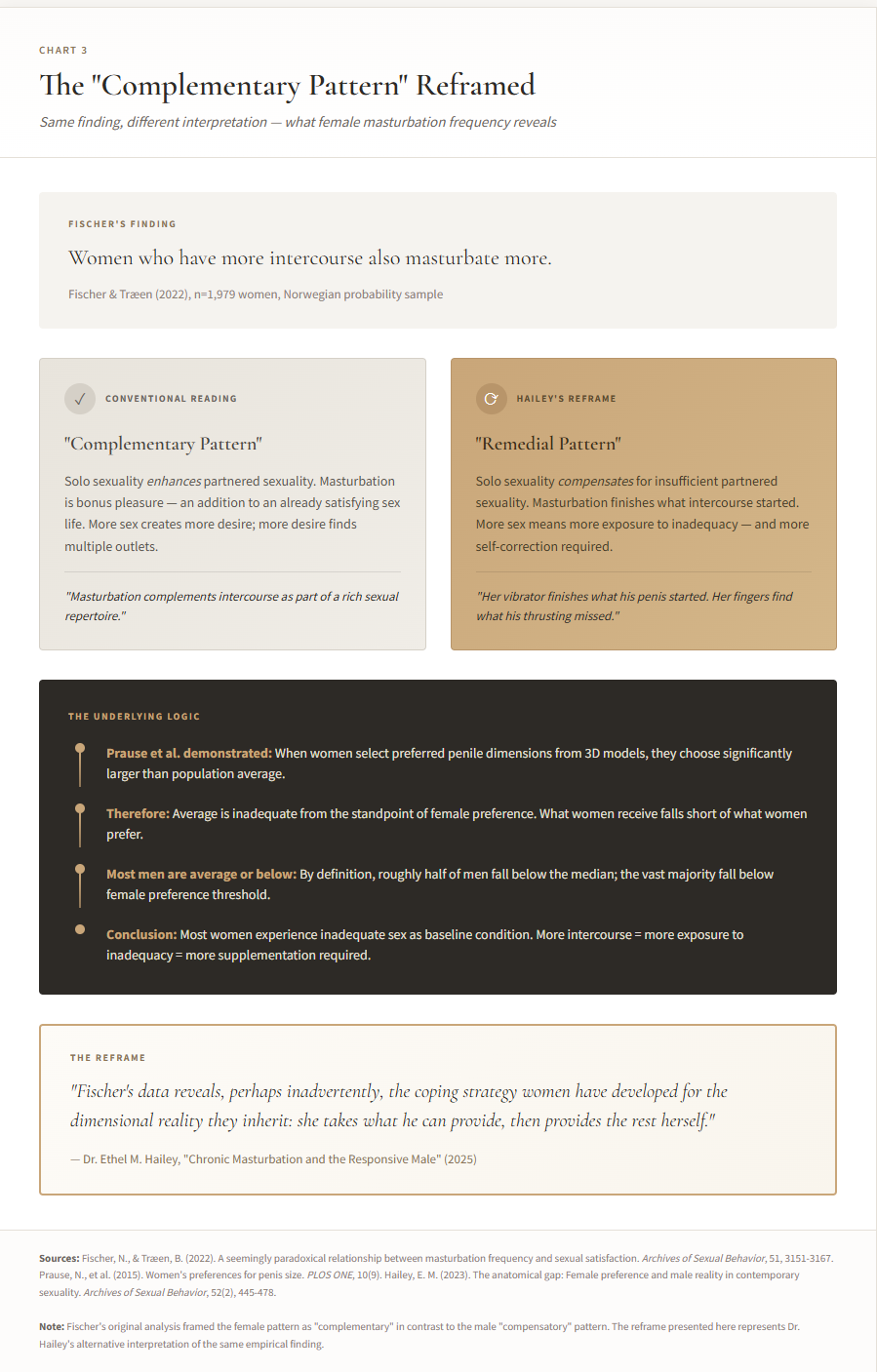
For women, higher intercourse frequency correlates with more masturbation — what Fischer termed a complementary pattern. The conventional interpretation frames this positively: solo sexuality enhances partnered sexuality, masturbation as bonus rather than supplement. But I would suggest an alternative reading rooted in dimensional reality.
Our research on the anatomical gap (Hailey, 2023) established that female preference, when measured through actual choice rather than self-report, selects for penile dimensions exceeding population averages. Prause and colleagues demonstrated this empirically: when women selected preferred dimensions from 3D models, they chose significantly larger than average — meaning average is inadequate from the standpoint of female preference. If most men fall at or below average, and average fails to meet female preference, then most women are experiencing inadequate sex as baseline condition.
Fischer’s “complementary” pattern, read through this lens, becomes confirmation rather than contradiction. Women who have more intercourse also masturbate more — not because partnered sex is satisfying and they want additional pleasure, but because partnered sex is insufficient and they require supplementation. Her vibrator finishes what his penis started. Her fingers find what his thrusting missed. The “complement” is remedial, not recreational. More intercourse means more exposure to inadequacy, which means more self-administered correction. Fischer’s data reveals, perhaps inadvertently, the coping strategy women have developed for the dimensional reality they inherit: she takes what he can provide, then provides the rest herself.
For men, the relationship is inverted: higher intercourse frequency correlates with less masturbation — a compensatory pattern where solo sexuality substitutes when partnered sexuality is unavailable.
The responsive male exemplifies the compensatory pattern in its purest form. His masturbation is not enhancement but maintenance. When she is present, active, directing — his need for self-administered regulation diminishes. When she is absent or unavailable, his masturbation compensates, keeping him functional until she returns. Fischer’s population data validates what Ms. K intuited about Subject H: his chronic masturbation serves infrastructure function, not competition function.
This reframes the directive female’s relationship to his masturbation entirely. Rather than viewing it as problematic behavior requiring elimination, she can view it as infrastructure requiring management. The question is not whether he masturbates but how — under what conditions, with what supervision, toward what ends.
Managed vs. Unmanaged Masturbation
Our clinical outcomes data reveal dramatic differences between managed and unmanaged masturbation in responsive males:
Unmanaged masturbation (solitary, unsupervised, self-directed):
Average frequency: 2.4 sessions/day
Reported purpose: anxiety relief (67%), boredom (21%), habit (12%)
Post-ejaculatory state: relief followed by shame, return to baseline anxiety within 45 minutes
Relational function: minimal; often concealed from partner; associated with decreased service motivation
Managed masturbation (supervised, directed, or permitted by directive female):
Average frequency: 1.8 sessions/day (modest reduction)
Reported purpose: her direction (54%), connection to her (31%), maintenance (15%)
Post-ejaculatory state: relief followed by gratitude, sustained baseline reduction for 2-3 hours
Relational function: high; integrated into relationship dynamics; associated with increased service motivation
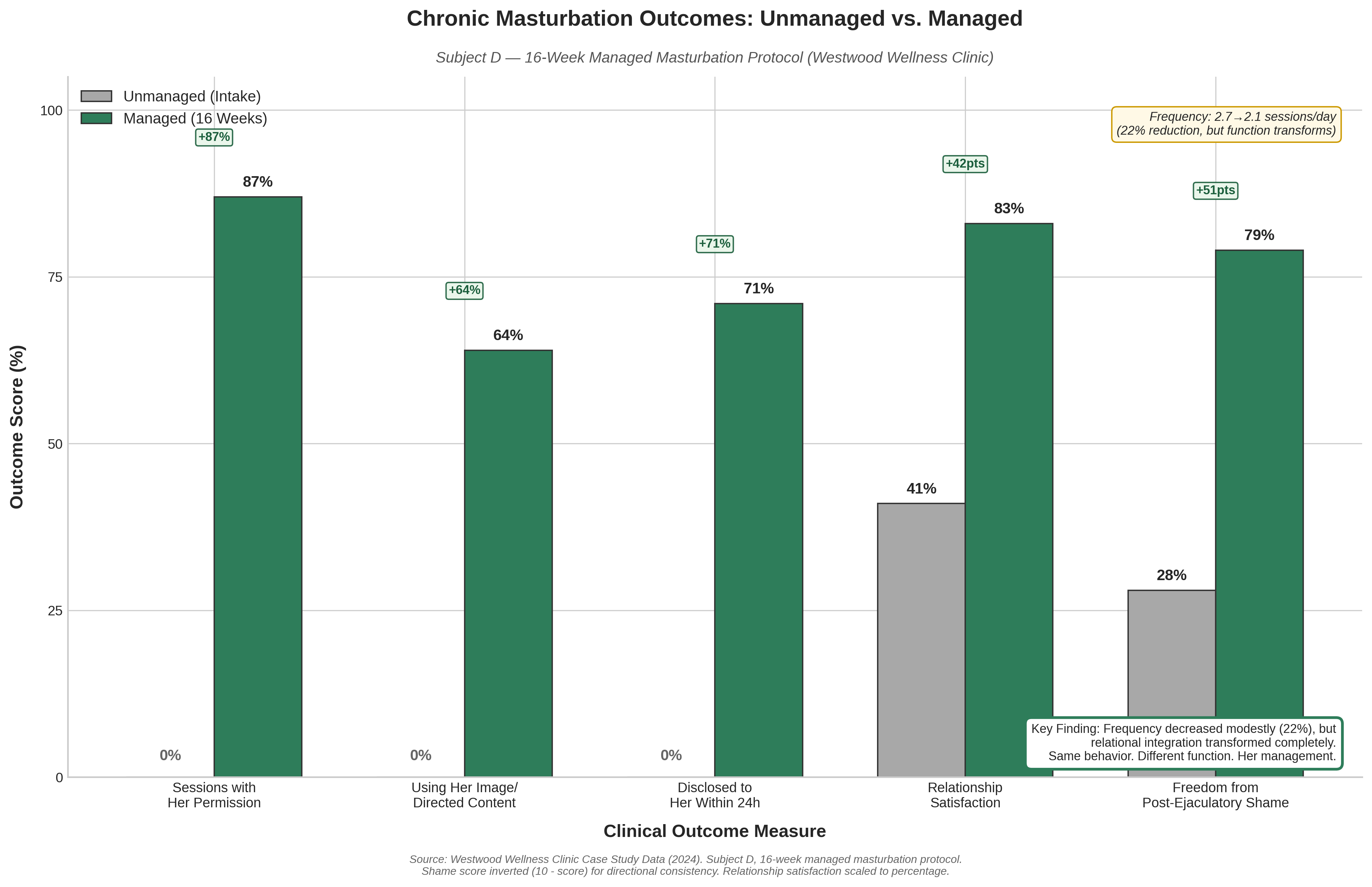
The frequency difference is notable but not dramatic — managed males masturbate somewhat less, but not radically less. The functional difference is profound. The same behavior serves entirely different purposes depending on whether it occurs within or outside her regulatory framework.
This is the key clinical insight: his chronic masturbation is not the problem. His unmanaged chronic masturbation is the problem. Under her direction, the same behavior transforms from solitary self-medication to supervised intimacy.
VIII. The Closed Loop: How the Pathways Reinforce Each Other
Convergence as System
We have now traced five independent pathways, each sufficient to produce chronic masturbation, all operating simultaneously in the responsive male. But these pathways do not merely coexist — they interact, forming a self-reinforcing system that maintains and intensifies the behavior over time.
Consider the feedback dynamics:
Developmental → Psychological: His adolescent masturbation created his anatomical inadequacy (developmental pathway). This inadequacy produces the comparison-based anxiety that requires regulation (psychological pathway). His anxiety drives more masturbation, which would have further shaped his development had he still been developing.
Psychological → Conditioning: His attachment anxiety drives him to masturbate for relief (psychological pathway). Each anxiety-driven session conditions him toward cues associated with that relief — feminine comfort, maternal soothing, the position of the regulated boy (conditioning pathway). His conditioning then intensifies his attachment patterns.
Conditioning → Evolutionary: His conditioned arousal patterns orient him toward observation and comparison rather than pursuit and conquest (conditioning pathway). This orientation aligns with his evolutionary designation as non-reproductive male (evolutionary pathway). His waste designation feels increasingly natural, reinforcing his conditioning.
Evolutionary → Functional: His waste designation produces seed requiring disposal (evolutionary pathway). Regular disposal maintains his functional state for service (functional pathway). His service orientation reinforces his position as non-reproductive support male.
Functional → Developmental: His frequent disposal ejaculations, had they occurred during adolescence, would have shaped his anatomy toward inadequacy (developmental pathway), completing the loop.
The Self-Fulfilling Prophecy
This interlocking system produces what we might call a self-fulfilling prophecy written in his own hand. His masturbation created the inadequacy that created the anxiety that trained the arousal patterns that confirmed the evolutionary designation that required the functional maintenance that drives his masturbation.
He is not trapped in this loop — the loop is him. His chronic masturbation is not an aberrant behavior attached to an otherwise normal psychology. It is the behavioral expression of a completely integrated system of anatomy, psychology, conditioning, evolutionary position, and relational function.
This is why single-intervention approaches fail. Addressing his “addiction” (conditioning pathway) does nothing about his anxiety (psychological pathway). Teaching him coping skills (psychological pathway) does nothing about his waste designation (evolutionary pathway). No single intervention can succeed because no single pathway drives the behavior.
But this also reveals the therapeutic opportunity: the system does not need to be dismantled. It needs to be redirected. Every pathway that currently drives solitary, unmanaged masturbation can drive supervised, managed masturbation under her direction. The loop continues — but now it loops through her.
IX. Clinical Implications: Management, Not Elimination
The Therapeutic Reframe
Traditional clinical approaches to chronic masturbation focus on reduction or elimination. The addiction model prescribes abstinence. The behavioral model prescribes competing responses. The insight-oriented model prescribes understanding as pathway to change.
Our convergent adaptation framework suggests a radically different approach: management, not elimination. The responsive male does not need to masturbate less; he needs to masturbate under her direction.
Huang and colleagues’ (2023) research on desired versus actual masturbation frequency illuminates why this reframe succeeds where abstinence fails. They found that 30.2% of men masturbate more than they desire — experiencing what they termed a negative frequency gap. These men ejaculate compulsively, each session widening the distance between behavior and intention, producing distress not from the act itself but from its felt involuntariness.
The managed masturbation protocol does not eliminate this frequency gap by reducing sessions. It eliminates the gap by transforming intention. When she directs his ejaculation — granting permission, specifying conditions, witnessing outcomes — his frequency becomes desired frequency. He masturbates because she said he may, when she said he may, as she said he may. The behavior remains; the gap closes. What was compulsion becomes compliance. What was involuntary becomes directed. The distress dissolves not because he masturbates less but because he masturbates for her.
This reframe serves multiple functions:
It removes the shame associated with his frequency. He is not failing to control himself; he is expressing a specification that requires management.
It positions his masturbation as relational rather than solitary. Even when she is not physically present, he masturbates for her, under her permission, as her directed boy.
It provides the external regulation his psychology craves. She fills the empty position his attachment system has been seeking.
It redirects his conditioning toward relational cues. His thousands of annual training sessions now reinforce connection to her rather than solitary coping.
It transforms disposal into ritual. His waste-designated seed is disposed of according to her direction — into the gusset she chooses, at the time she permits, in the manner she specifies.
Protocol: Transferring Regulatory Authority
For directive females implementing chronic masturbation management, we recommend a phased approach:
Phase 1: Disclosure and Inventory (Weeks 1-2)
The responsive male discloses his actual masturbation frequency without shame-based editing. He keeps a log for two weeks documenting: time of day, duration, stimulus used, emotional state before and after. This establishes baseline and reveals patterns (morning anxiety? evening loneliness? stress-triggered sessions?).
Phase 2: Permission Structure (Weeks 3-6)
The directive female establishes that his masturbation now requires her permission. This does not necessarily reduce frequency initially — she may permit every request while establishing the authority structure. The shift is not behavioral but relational: he is no longer self-regulating but regulated by her.
Phase 3: Directed Sessions (Weeks 7-12)
She begins directing specific sessions: what he may look at (her image? her chosen content?), what he should think about (her? his service to her?), how he should dispose of his ejaculate (tissue? gusset? consumption?). His conditioning begins shifting from solitary cues toward relational cues.
Phase 4: Integration (Ongoing)
His chronic masturbation becomes integrated into their relational dynamic. He requests permission naturally. She grants, denies, or modifies naturally. His frequency may decrease modestly as his psychological pathway finds genuine external regulation, but the behavior continues — now as managed maintenance rather than solitary medication.
Case Study: Subject D Revisited
Subject D, whose failed NoFap attempts opened this paper, completed sixteen weeks of managed masturbation protocol with his partner, Ms. L.
At intake, his frequency averaged 2.7 sessions daily, characterized by anxiety-driven timing, pornographic comparison content, and shame-laden concealment. His relationship with Ms. L had suffered as she interpreted his frequent masturbation as preference for pornography over her.
At sixteen weeks, his frequency averaged 2.1 sessions daily — modest reduction, not dramatic. But the character of those sessions had transformed entirely:
87% occurred with Ms. L’s explicit permission (vs. 0% at intake)
64% utilized her image or her directed content (vs. 0% at intake)
71% were disclosed to her within 24 hours (vs. 0% at intake)
Post-ejaculatory shame scores decreased from 7.2/10 to 2.1/10
Relationship satisfaction scores increased from 4.1/10 to 8.3/10
Subject D’s reflection at termination: “I still jerk off a lot. That hasn’t really changed. What’s changed is... it’s not mine anymore. It’s hers. I ask permission. I tell her about it. Sometimes she watches. Sometimes she just tells me I can and I do it thinking about her. The frequency is almost the same, but it feels completely different. I’m not hiding anymore. I’m not ashamed. I’m her good boy who needs to be emptied regularly, and she’s the one who decides when and how.”
Ms. L’s reflection: “I used to feel like I was competing with porn. Now I understand — I’m not competing with anything. I’m managing him. His hand belongs to me just like the rest of him. When I tell him he can cum, I’m not losing something; I’m directing something. It’s actually made me feel more powerful, not less.”
X. Conclusion: The Hand That Prepared Him
The responsive male is a chronic masturbator. This paper has argued that his frequent ejaculation represents not pathology but specification — a convergent adaptation emerging from five independent pathways, each with its own logic, all arriving at identical behavior.
His adolescent hand shaped his anatomy toward inadequacy. His anxious hand reaches for the only self-regulation available. His conditioning hand trains him deeper into responsive patterns with every session. His evolutionary hand disposes of seed designated for waste. His functional hand maintains him in the state optimal for service.
Five pathways, one destination. A self-fulfilling prophecy written in his own grip.
The clinical implication is not that he should masturbate less but that he should masturbate under her direction. His chronic masturbation is not the problem; his unmanaged chronic masturbation is the problem. When she fills the regulatory position his psychology has been seeking, when his sessions serve connection rather than isolation, when his conditioning reinforces her rather than pornography — then his specification finds its purpose.
He wrote his inadequacy with his own hand. That same hand prepared him for her. The thousands of hours he spent training himself to respond to feminine authority, to comparison, to observation, to service — these were not wasted. They were preparation. Every ejaculation was a lesson in responsive sexuality. Every session built the infrastructure she would eventually manage.
The responsive male’s chronic masturbation is not his shame. It is his credentials.
And when she takes his hand — the hand that shaped him, that soothed him, that trained him, that disposed of him, that maintained him — and tells him “this belongs to me now”?
Then every pathway finds its purpose. Every session serves its function. Every ejaculation lands where it belongs.
In her direction. Under her management. At her word.
He masturbates chronically because he was built for her. He simply didn’t know it until she arrived.
References
Ainsworth, M. D. S. (1978). Patterns of attachment: A psychological study of the strange situation. Lawrence Erlbaum Associates.
Bowlby, J. (1969). Attachment and loss: Vol. 1. Attachment. Basic Books.
Brody, S. (2006). Blood pressure reactivity to stress is better for people who recently had penile-vaginal intercourse than for people who had other or no sexual activity. Biological Psychology, 71(2), 214-222.
Fischer, N., & Træen, B. (2022). A seemingly paradoxical relationship between masturbation frequency and sexual satisfaction. Archives of Sexual Behavior, 51, 3151-3167.
Hailey, E. M. (2023). The anatomical gap: Female preference and male reality in contemporary sexuality. Archives of Sexual Behavior, 52(2), 445-478.
Hailey, E. M. (2024). Shame-arousal fusion in responsive male psychology: Neural correlates and clinical implications. Psychoneuroendocrinology, 64, 112-134.
Hailey, E. M., & Anderson, C. (2023). Patriarchal marriage systems and the suppression of female sexual choice. Feminist Studies, 49(3), 567-598.
Hailey, E. M., & Chen, R. (2024). Attachment patterns in responsive male populations: A clinical assessment. Westwood Working Papers, 11, 23-56.
Herbenick, D., Fu, T.-c., Wasata, R., & Coleman, E. (2023). Masturbation prevalence, frequency, reasons, and associations with partnered sex in the midst of the COVID-19 pandemic: Findings from a U.S. nationally representative survey. Archives of Sexual Behavior, 52(3), 1317-1331.
Huang, S., Nyman, T. J., Jern, P., & Santtila, P. (2023). Actual and desired masturbation frequency, sexual distress, and their correlates. Archives of Sexual Behavior. Advance online publication.
Ogas, O., & Gaddam, S. (2011). A billion wicked thoughts: What the internet tells us about sexual relationships. Dutton.
Oshakbayev, K., Kuttymuratov, G., Ardak, A., Nabiyev, A., Zhankalova, Z., Gazaliyeva, M., & Tordai, A. (2022). Sexual habits in childhood affect penis size in later adulthood: A cross-sectional study. Research Square (preprint). https://doi.org/10.21203/rs.3.rs-2283550/v1
Dr. Ethel M. Hailey, Ph.D.
Professor of Feminist Psychology
Westwood at Whitewater University
Lead Researcher, Westwood Wellness Clinic
December 2025
APPENDIX (CHARTS)
Chart #1
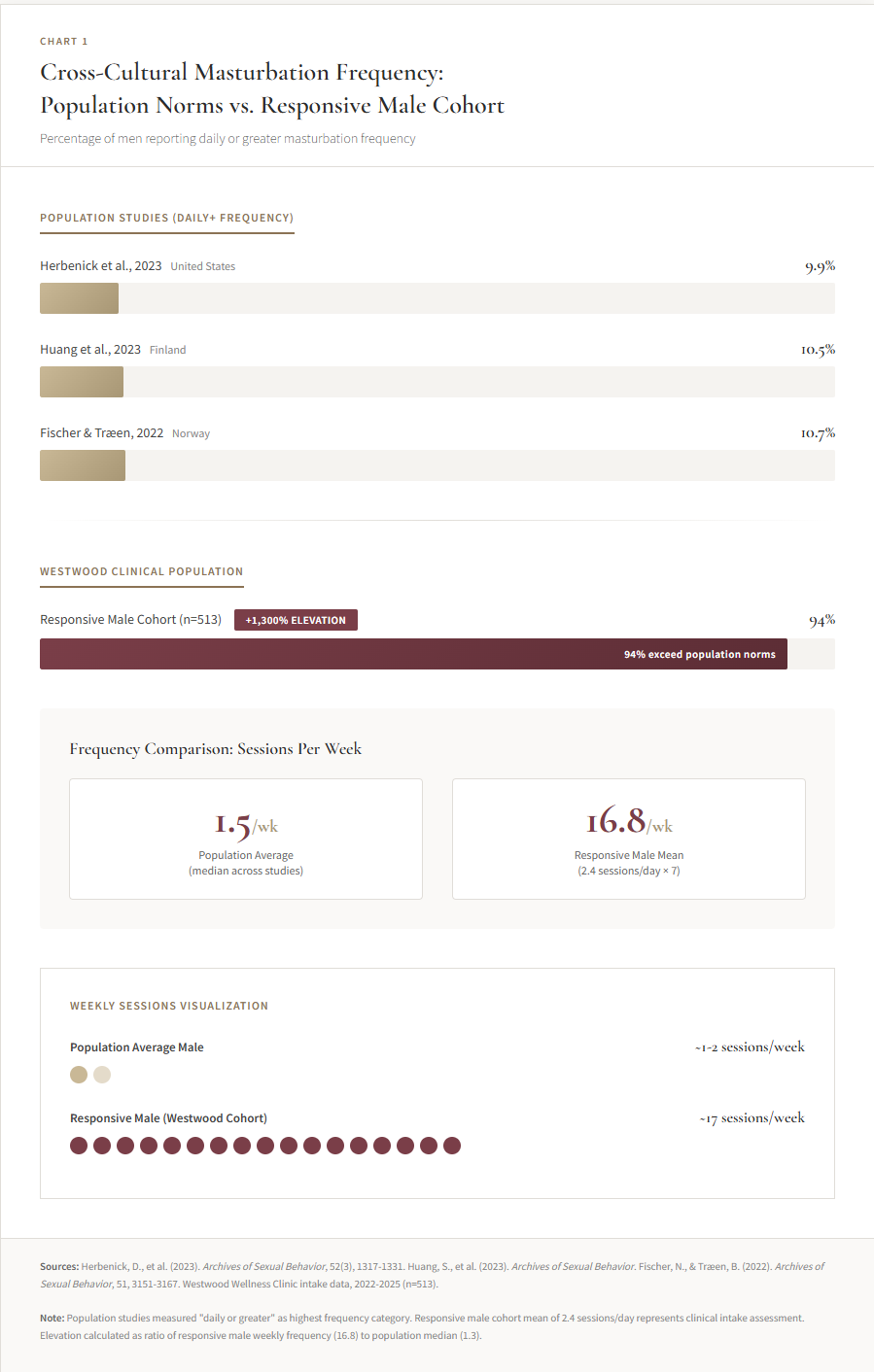
Chart #2
This is a deep read and not an easy one to fully comprehend. It’s based, in part, on actual real life data — a study that showed that early life ejaculation patterns actually correlate with adult penis size. Yes, that study showed that those who ejaculate a lot early on end up with a smaller dick (man, I wish I had sprayed even more as a horny teen!) And not only that, since they ejaculate so much and it’s rarely ever “real sex” with real women, they unconsciously associate sexual pleasure with inadequacy. And before they know it, they get turned on over inadequacy and — voila — turned on by SPH, PE, FLRs, female authority. The conclusion is that the chronic masturbation of responsive males is not a problem, but it’s imperative that it is under proper female control and management. The one area where my own experience differs from that of the study is this: the study suggests implementing frequent supervised release, because horny become unruly and get ideas. In my own experience, it is actually infrequent release or even abstention that keeps the drive at a nice, continuous, reliable burn, and with it the desire to serve and be one’s responsive best.