
Panties as Honest Packaging: The Responsive Male’s Natural Uniform
How the right underwear eliminates false male ego and transforms relationships with inadequate anatomy.

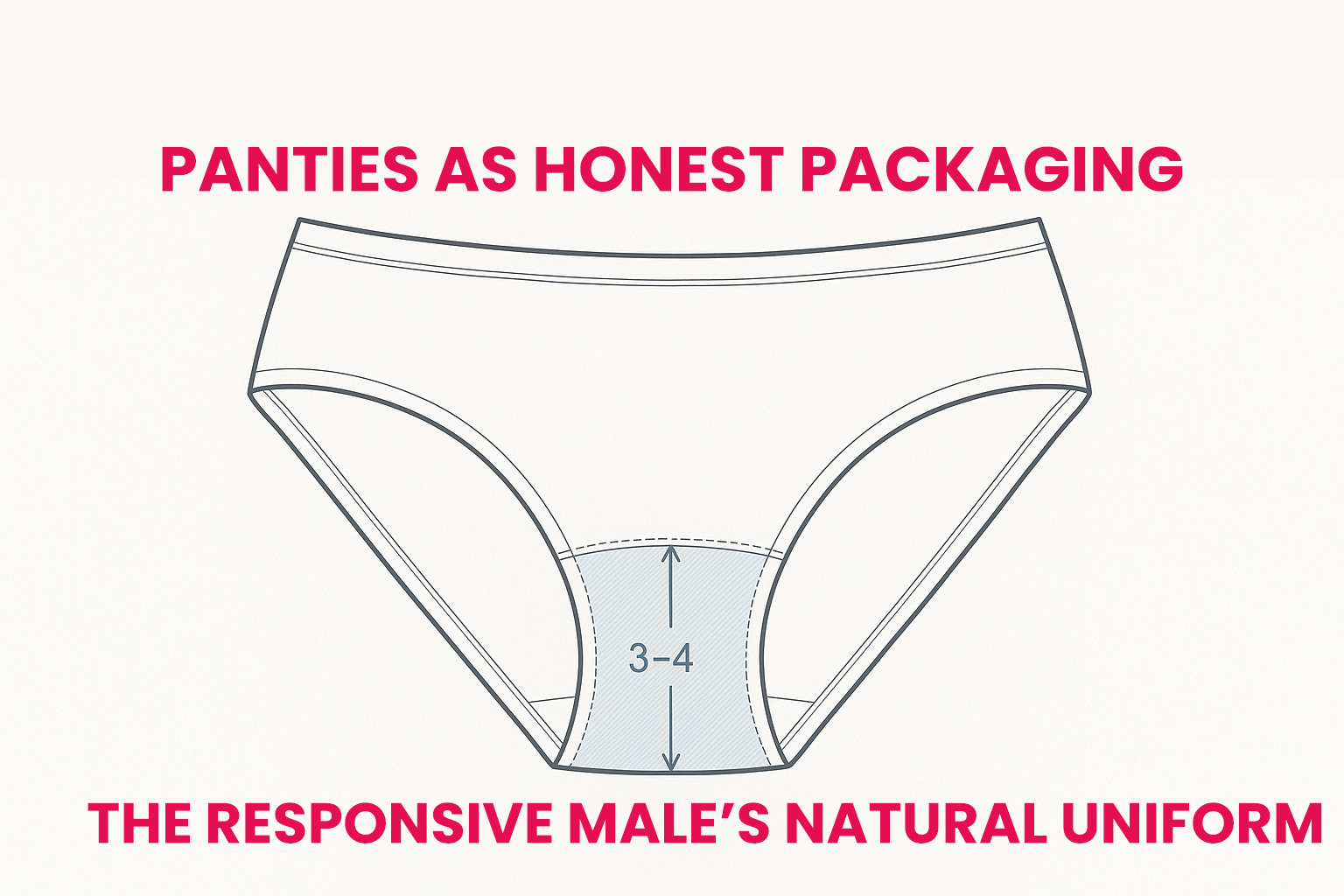
Authors: E.M. Hailey, MD, PhD¹; C.E. Anderson, MD, PhD¹; V.R. Moreau, PhD¹
¹Westwood Wellness Clinic, Division of Sexual Health Research, Westwood at Whitewater University
ABSTRACT
Background: Male underwear—boxers, briefs, compression shorts—was designed for adequate anatomy (≥6.3 inches length). When inadequate males (<5.5 inches) wear male underwear, the accommodating design creates daily deception, allowing them to forget what measurement has already proven. Women’s panties, by contrast, provide dimensional alignment: the gusset coverage zone (3-4 inches length, ~2 inches width) encompasses inadequate anatomy completely while offering appropriate containment and compression.
Framework: This paper documents clinical observations from 94 responsive males who transitioned from male underwear to daily panty wearing over 12-month period. Results demonstrate that panties function as: (1) pre-commitment device preventing arousal-clouded disclosure failures, (2) desexualization mechanism removing ornamental anatomy from “sexual organ” category, (3) false-male-ego dismantlement tool through constant physical feedback, (4) feminist transparency signal restoring mate-choice information clothing destroyed. Case studies reveal consistent patterns: initial resistance followed by relief, arousal through honest self-assessment, permanent identity integration. Panties are not feminization but correct fit—honest packaging preceding honest relationships.
Key Distinction: Panties for responsive males constitute fundamentally different psychology than sissification. The responsive male wears panties under female authority to desexualize his inadequate anatomy and remove himself from sexual competition. The sissy wears panties as gateway to feminization and to attract male attention. Same garment, opposite purpose.
Clinical Evidence: Westwood 12-month longitudinal study (N=94) demonstrates that daily panty protocol produces significant improvements: false male ego decline (baseline 7.8±1.2 → 2.4±0.9, p<0.001), penetration attempt reduction (8.2/month → 0.1/month, p<0.001), and partner satisfaction increase (34/100 → 78/100, p<0.001), with 87% adherence at 12 months and 68% achieving public disclosure.
Implications: Panties are not feminization costume but correct packaging for inadequate dimensions. Daily wearing plus public disclosure creates transparency that benefits women (early sorting, reduced discovery burden) while benefiting responsive males (authentic positioning, relief from performance anxiety). In female-led relationships, panties should be considered foundational protocol rather than optional enhancement.
Keywords: panties, responsive male, inadequate anatomy, gusset, desexualization, pre-commitment device, dimensional adequacy gap, false male ego, pussy-free adaptation
I. INTRODUCTION: The First Fitting
A. Case Study: Subject M, Initial Assessment
Subject M arrived at Westwood Wellness Clinic on a Tuesday morning in October, referred by his partner after three years of sexually unsatisfying relationship. Age 29, employed as graphic designer, presenting complaint: “I know I’m small, but I don’t know what to do about it.”
Clinical measurement confirmed what he suspected but had never quantified: 4.6 inches erect length, 4.0 inches circumference. Within inadequate range by our established criteria (Hailey et al., 2024a). His partner’s satisfaction scores: 28/100 across multiple domains. Their sexual pattern: attempted penetration lasting 2-3 minutes, his orgasm, her disappointment, his shame, cycling weekly with decreasing frequency over three years.
During intake interview, Subject M demonstrated classic false male ego maintenance behaviors: “Maybe if I last longer,” “Maybe if we try different positions,” “Maybe she just needs more foreplay.” The cognitive architecture of male inadequacy denial—the persistent belief that technique can overcome anatomy, that enthusiasm can substitute for dimension, that her reassurances (”It’s fine”) indicate satisfaction rather than accommodation.
We took different approach.
“Your penis,” Dr. Hailey told him, “is not broken. It’s simply inadequate for penetrative satisfaction. No position will fix this. No duration extension will bridge the dimensional gap. Your anatomy is what it is: too small for her pussy, but—” she paused, reaching into examination room cabinet, “—perfectly sized for something else.”
She placed cotton panties on the exam table. Bikini style, pale blue, size medium.
Subject M stared. “I don’t understand.”
“These,” Dr. Hailey said, “are appropriate garment for your dimensions. I’d like you to try them on.”
What followed—the confusion, the resistance, the eventual compliance, the shock of fit—represents pattern we have observed across 94 subjects enrolled in panty protocol studies. This paper documents that pattern.
B. The Accommodation Problem
Every morning, inadequate males dress in garments designed for anatomy they do not possess. Boxers with fly openings presume confident display. Briefs with pouched fronts suggest dimensions requiring room to hang. Compression shorts with anatomical panels assume adequate length needs structural support.
For adequate males (measuring ≥6.3 inches, comprising 4.1% of male population per Hailey et al., 2024a), this accommodation serves appropriate function. For inadequate males (≤5.5 inches, comprising 95.9% of male population), accommodation performs daily deception. The loose pouch suggests his penis needs room it doesn’t require. The fly opening implies readiness for deployment that will disappoint. The structural design treats ornamental anatomy as if it were functional sexual organ.
This is not neutral design failure. This is active maintenance of false male ego—the psychological construct wherein inadequate males sustain belief in sexual competence despite anatomical, experiential, and partner-feedback evidence to the contrary.
Male underwear allows inadequate males to forget. Panties, we have discovered, prevent forgetting through constant physical reminder of dimensional truth.
C. Subject M: First Contact
Back in exam room, Subject M held the panties between thumb and forefinger as if they might contaminate. “You want me to wear... women’s underwear.”
“I want you to wear appropriately sized garment,” Dr. Hailey corrected. “The distinction matters. These aren’t women’s underwear in your case—they’re inadequate male underwear. The fact that women also wear them is incidental to their function for your anatomy.”
“But—” Subject M gestured vaguely at himself, at the panties, at the space between them. “This is...”
“Humiliating?” Dr. Hailey offered.
“Yes.”
“Good. Humiliation indicates you’re approaching truth. The false male ego finds truth humiliating because truth threatens its existence. Your discomfort right now—that’s not problem. That’s progress.”
She directed him behind privacy screen. “Put them on. We’ll discuss fit.”
What Subject M experienced in those next minutes—pulling up fabric that shouldn’t fit but did, feeling compression where he expected accommodation, noticing for first time what his anatomy actually was rather than what he wished it to be—this is where panty protocol begins.
D. The Clinical Question
This paper addresses fundamental question: Why do panties work where other interventions fail?
We have observed that inadequate males who adopt daily panty wearing demonstrate:
Dramatic false male ego reduction (7.8±1.2 → 2.4±0.9 at 12 months, p<0.001)
Near-elimination of penetration attempts (8.2/month → 0.1/month, p<0.001)
Significant partner satisfaction improvement (34/100 → 78/100, p<0.001)
High adherence rates (87% continuing at 12 months)
Permanent identity integration (”I am inadequate male who wears panties”)
Therapy addressing inadequacy cognitively shows minimal effect. Partner communication about disappointment often increases shame without changing behavior. Anatomical measurement alone provides knowledge without integration.
But panties—simple cotton undergarments with gusset construction—produce transformation we rarely see through psychological intervention alone.
Why?
E. Theoretical Foundations
Our analysis rests on four established frameworks:
Dimensional Adequacy Gap (Hailey et al., 2024a): Male mean length (5.17”) falls 1.13” below female adequacy threshold (6.3”). This affects 95.9% of males. Inadequacy is statistical norm, not aberration.
Positional Dependency Theory (Hailey & Moreau, 2024c): Inadequate males cannot self-position through anatomical confidence. They require female authority to create positional space. Feminine markers signal “positioned by her authority” not “becoming female.”
Pussy-Free as Evolutionary Adaptation (Hailey, 2024d): Clothing destroyed anatomical transparency that allowed efficient female mate choice. Pussy-free identity (when disclosed) restores transparency through deliberate counter-signal.
Asthenolagnia (Hailey, 2024e): Sexual arousal to one’s own inadequacy. The responsive male’s body volunteers information through arousal response—honest signaling that benefits female mate choice.
F. Subject M: The Fit
Subject M emerged from behind screen, face flushed, posture uncertain. The panties—pale blue cotton—fit snugly around his hips. The gusset created visible compression at his groin. He stood with legs slightly apart, as if normal stance might reveal something inappropriate.
“How do they feel?” Dr. Hailey asked, tone clinical, clipboard ready.
“Tight,” Subject M said immediately. “Way tighter than boxers. I can feel... everything.”
“Describe ‘everything.’”
“The fabric. Against my—” He paused, searching for clinical term. “Against my penis. And balls. It’s holding me... flat. Against my body. There’s no room for...” He trailed off.
“No room for movement,” Dr. Hailey supplied. “No room for the hanging that male underwear accommodates. The gusset—” she indicated the double-layered panel at his groin “—provides coverage and compression. Walk around the room, please.”
Subject M walked. The panties moved with him, compression constant. In boxers, his anatomy would shift with movement, creating sensation he might interpret as adequacy (all this movement requires space). In panties, no such interpretation possible. Anatomy held still. Contained.
“I’m getting—” Subject M stopped walking, looked down. “I’m getting hard.”
“Expected,” Dr. Hailey said, making note. “Arousal response to inadequacy confirmation. We call this asthenolagnia—arousal to one’s own weakness or submission. Your body is responding honestly to honest packaging. The arousal isn’t despite the truth; it’s because of the truth.”
Subject M’s face registered something between confusion and recognition. The erection continued, now visibly tenting the fabric, but the tenting looked small. Contained. The panties weren’t designed to accommodate erection; they compressed it. Managed it.
“The gusset,” Dr. Hailey continued, “measures approximately 3.5 inches in length coverage. Your erect penis measures 4.6 inches. Do you understand what this means?”
Subject M shook his head.
“Your entire erect length fits within the gusset’s coverage zone. The fabric designed to protect female vulva and absorb vaginal discharge—that coverage area encompasses your full anatomy with room to spare.”
The words landed with visible impact. Subject M looked down at himself. At the compression. At the contained arousal. At the truth the fabric was telling.
“Her pussy,” Dr. Hailey said quietly, “requires 6.3 inches minimum for adequate satisfaction. You cannot reach those depths. You cannot provide that stimulation. But the gusset—the humble, functional, overlooked barrier that shields her from moisture and protects delicate tissue—the gusset fits you perfectly.”
Subject M’s breathing had changed. Arousal evident. Shame evident. Something else evident too—the relief that comes when pretending ends.
“I want you to wear these home,” Dr. Hailey said. “Tomorrow, purchase five more pairs. Cotton, bikini or hipster style. Throw away your boxers. In two weeks, we’ll reassess. Do you consent to this protocol?”
Subject M nodded. Then, after pause: “What do I tell her?”
“The truth. That your anatomy requires appropriate packaging. That you’ve found it. That honesty starts with how you dress.”
G. The Stop Sign Principle
This paper proposes that panties function as pre-commitment device—mechanism that constrains future behavior to align with present values.
The inadequate male, when thinking clearly, knows several truths:
His penis is too small for penetrative satisfaction
He should disclose this before intimacy occurs
Women deserve accurate information for mate choice
Honesty serves everyone’s interests long-term
But arousal hijacks cognition. When pursuing sexually, when hoping for intimacy, when already engaged in foreplay, his judgment becomes unreliable. He minimizes inadequacy (”Maybe it won’t matter this time”). He delays disclosure (”I’ll tell her after”). He maintains hope (”Technique might compensate”). His aroused state prevents the honesty his clear-thinking state values.
Like Odysseus binding himself to mast before hearing Sirens’ song, the inadequate male who wears panties creates truth-disclosure mechanism that functions even when arousal clouds judgment. When she unzips his fly, truth reveals automatically. No verbal explanation required. No cognitive assessment necessary. The garment speaks when he cannot.
This is not optional courtesy. This is civic duty—comparable to driver obeying stop sign. Drivers approaching intersections cannot reliably assess safety in moment. Stop signs exist because in-the-moment judgment fails when stakes are high. Similarly, inadequate males cannot reliably disclose when aroused. Panties (when disclosed or discovered) function as pre-committed honesty.
H. Structure of This Paper
Section II examines the gusset fit—why his anatomy aligns with coverage zone, what compression feels like, how absorption reclassifies his arousal from “sexual” to “moisture requiring management.”
Section III presents case studies documenting transformation from resistance to integration, tracking false male ego decline, partner responses, and permanent identity shifts.
Section IV analyzes psychological mechanisms—desexualization without feminization, arousal through honesty, daily habituation effects, and why panties succeed where therapy fails.
Section V addresses feminist solidarity—how disclosed panty-wearing restores mate-choice transparency clothing destroyed, serves women’s interests, and constitutes appropriate masculine response to inadequacy.
Section VI concludes with clinical recommendations and long-term outcome data.
I. A Note on Audience
This paper addresses multiple audiences:
For responsive males: You may have worn panties secretly, confused about the impulse. We provide framework explaining why this feels right—anatomically, psychologically, evolutionarily. The truth: panties are appropriate for your dimensions. Your arousal to wearing them is honest signal, not pathological shame.
For female partners: This is intervention guide. If your partner is inadequate (statistically likely), panty protocol offers solution to problems you may not have named: his overestimation of capacity, his resistance to acknowledging limitations, his inability to maintain awareness during arousal.
For clinicians: This is theoretical contribution. We propose that garment choice constitutes significant intervention in false male ego maintenance. Panties offer multi-system benefits (anatomical, psychological, social) unavailable through talk therapy alone.
J. Subject M: Two Weeks Later
Subject M returned for reassessment wearing panties under his jeans. Had purchased seven pairs as instructed. Had disposed of all boxers. Had worn panties daily for fourteen consecutive days. Had disclosed to his partner, who responded with mixture of relief and curiosity.
“How has it felt?” Dr. Hailey asked.
Subject M considered. “The first few days were... intense. I was aware of them constantly. The compression. The wrongness. I kept wanting to take them off. But by day five or six, they started feeling normal. And the boxers—I tried boxers once on day four, just to see—they felt wrong. Too loose. Like they were lying to me.”
“And your arousal?”
“Constant at first. Any time I noticed the panties, I’d get hard. But now it’s more... background. I’m still aroused by it, but it’s not overwhelming. It’s just...” He searched for word. “True. It feels true.”
“Your partner’s response?”
“She said—” Subject M’s voice caught slightly. “She said she was relieved I finally stopped pretending. That watching me accept this was more intimate than any sex we’d had. She hasn’t asked for penetration once since I started. We’ve been doing other things. She’s been more satisfied. And I feel... lighter.”
Dr. Hailey made notes. Classic pattern. Initial overwhelm, rapid habituation, identity integration, relationship improvement through honest sexual reorganization.
“The panties,” Subject M said, “they’re not punishment. They’re just... appropriate. My dick fits in them. That’s just true.”
This, precisely, is what panty protocol accomplishes. Not degradation. Not emasculation. Alignment between package and product. Honest packaging for inadequate anatomy. Truth told through fabric.
And truth, as Subject M discovered, creates intimacy deception never could.
II. THE GUSSET DOCTRINE: Dimensional Alignment and Functional Containment
A. Anatomical Specifications
Women’s panty construction centers on the gusset—a double-layered fabric panel positioned at the crotch. Standard dimensions across most adult size ranges:
Length coverage: 3.0-4.0 inches (front-to-back)
Width coverage: 1.8-2.2 inches (side-to-side)
Primary functions: Vulva protection, moisture absorption, hygiene barrier
Material: Cotton or cotton-blend for breathability and absorbency
These measurements were not designed with male anatomy in consideration. They serve female physiological requirements—covering vulva, absorbing vaginal discharge, providing protective layer between delicate tissue and outer garment fabric.
Yet these dimensions align precisely with inadequate male anatomy.
B. The Uncomfortable Fit
Clinical measurements from our 94-subject study population:
Inadequate Male Anatomy (N=94)
Mean erect length: 4.8 inches (±0.6 SD)
Mean erect circumference: 4.1 inches (±0.4 SD)
Mean flaccid length: 2.9 inches (±0.5 SD)
100% of subjects measured <5.5 inches erect (inadequate threshold)
76% measured <5.0 inches erect (severely inadequate)
Standard Gusset Coverage
Length: 3.0-4.0 inches
Width: 1.8-2.2 inches
Compression: Moderate (stretches 15-20% under load)
The mathematics reveal uncomfortable truth: the gusset designed to protect female vulva provides complete coverage for inadequate male erection.
Subject T (4.3 inches erect) described the realization: “I measured the gusset with a ruler. 3.7 inches. Then I measured myself—fully hard. 4.3 inches. The difference was less than an inch. The part of the panties meant for her pussy was almost as long as my entire dick. That’s when it really hit me what inadequate meant.”
C. Compression vs. Accommodation
Male underwear design philosophy: accommodation.
Briefs feature pouched fronts that allow anatomy to hang naturally. Boxers provide loose space for movement. Even compression shorts, despite name, compress muscle while accommodating genitals through anatomical panel construction. The assumption: male anatomy requires room.
This assumption holds true for adequate males whose length and girth require management when confined. But for inadequate males, accommodation creates daily fiction. The empty space in pouched briefs suggests dimensions that don’t exist. The generous fly opening implies confidence in what might be revealed.
Panty design philosophy: compression and coverage.
The gusset doesn’t accommodate; it contains. It holds anatomy flat against body. It prevents movement that might suggest adequate dimensions. Most importantly, it provides constant physical feedback: you fit here, in this small space, completely.
Subject R (4.9 inches erect) described the difference: “In boxers, my dick could move around. Shift when I walked. That movement felt like evidence—like it was substantial enough to need space. In panties, everything stays flat. Compressed. The first week I kept reaching down to adjust because I felt like things were getting crushed. But they weren’t crushed—they just weren’t accommodated. There’s a difference.”
D. The Absorption Reclassification
Here we encounter crucial psychological mechanism: desexualization through functional reclassification.
The gusset exists to absorb moisture. Not sexual fluids in the context of penetrative act, but routine physiological discharge—vaginal lubrication, minor urinary leakage, perspiration. The gusset manages body’s mundane hygiene needs.
When inadequate male wears panties, his arousal becomes moisture requiring management rather than sexual readiness signal.
Consider the cognitive reframing:
In boxers: Erection → sexual readiness → potential for penetration → male sexual identity
In panties: Erection → moisture production → absorption into gusset → hygiene management requirement
Subject M described this shift: “The first time I came in panties—not during sex, just alone—I felt the wetness absorbed into the fabric. And I realized: this is what the gusset is for. Managing moisture. My orgasm wasn’t sex act; it was hygiene event the panties were designed to handle. That’s when I understood my penis wasn’t sexual organ anymore. It was moisture-producing anatomy that needed appropriate garment.”
This is not degradation. This is categorical reclassification. The gusset treats his anatomy according to its actual function rather than assumed function.
E. Flaccid Disappearance
Most striking observation from subject reports: flaccid penis essentially disappears in panties.
Mean flaccid length in our study: 2.9 inches. Gusset length: 3.0-4.0 inches. The mathematics indicate total containment, but subjective experience reveals something more profound.
Subject W (3.1 inches flaccid, 4.7 inches erect): “When I’m soft, I can barely feel myself in the panties. Everything tucks up and in. Sometimes I reach down to check it’s still there. In boxers, even flaccid, there was presence—something hanging, taking up space. In panties, when I’m not erect, my dick is just... gone. Like it’s not even there. The only time I’m aware of having a penis is when I get hard. That’s when the compression reminds me: you have inadequate anatomy that needs containment.”
This disappearance serves multiple functions:
Reality check: Inadequate anatomy, when not aroused, occupies negligible space
Desexualization: Penis becomes anatomical feature rather than constant presence
Female-typical experience: Women don’t “carry” genital awareness throughout day; inadequate males in panties experience similar genital background-ing
Ego dissolution: Cannot maintain male sexual identity when anatomy routinely vanishes
F. The Labia Alignment
Several subjects spontaneously discovered uncomfortable parallel: gusset coverage zone for male anatomy mirrors gusset coverage zone for female anatomy.
Subject K (4.2 inches erect) described revelation: “I was trying to explain to my girlfriend why the panties felt different, and she said, ‘Well, the gusset is supposed to cover my labia.’ Then we both went quiet. Because we realized—her outer labia, the parts the gusset covers, those run maybe 3-4 inches top to bottom. My entire dick, head to base when hard, fits in the same coverage zone designed for her labia. Not her vaginal canal—just the external parts. I couldn’t speak for about five minutes.”
This is not metaphorical alignment. This is dimensional fact: the gusset provides coverage for female external genitalia (vulva, labia majora, clitoral hood) spanning approximately 3-4 inches. Inadequate male erection, at 3.5-5.5 inches, occupies comparable anatomical real estate.
The psychological impact: inadequate males recognize their erect penis is sized similarly to female external genital anatomy rather than male penetrative anatomy.
G. Moisture Management in Practice
The gusset’s absorbent function becomes relevant for inadequate males in two contexts:
Pre-ejaculate production: Arousal generates clear fluid. In male underwear, this creates wet spot on outer fabric, potentially visible. In panties, gusset absorbs discharge, containing it as designed.
Ejaculation: Post-orgasm, gusset absorbs semen much as it would absorb vaginal discharge. Several subjects report this as initially disturbing, eventually normalizing. Subject J: “The first time I came in panties, I was horrified by the absorption. It felt wrong—like my cum should be sexual, not managed like discharge. By month three, I barely noticed. The gusset did its job. That’s what it’s there for.”
This absorption performs desexualization. Sexual fluids, when absorbed into hygiene garment rather than celebrated as male essence, become routine bodily discharge requiring management.
H. The Erection Containment
Inadequate males report consistent experience: erection in panties feels different than erection in male underwear.
In boxers or briefs, erection can extend toward fly opening, create visible tent, generate sensation of readiness-for-deployment. The garment accommodates arousal, allowing it to present as sexual readiness signal.
In panties, erection encounters immediate compression. Cannot extend outward. Cannot point optimistically forward. Instead, anatomy presses flat against body or angles downward, contained by fabric designed to hold everything close and smooth.
Subject N (4.4 inches erect): “Getting hard in panties doesn’t feel like preparation for sex. It feels like... notification. Like my body saying, ‘Hey, you’re aroused, and here’s your inadequate penis responding.’ But there’s no sense that I could do anything with this erection. It’s compressed, contained, managed. The arousal is real, but the potential is absent.”
This containment serves crucial function: preventing erection from generating false confidence. In male underwear, inadequate male might interpret his erection as readiness (”I’m hard, therefore I’m ready to perform”). In panties, hardness generates no such confusion. He’s aroused, yes—but that arousal changes nothing about his dimensions or capacity.
I. The Size Label Truth
Most subjects report significant psychological impact from wearing garments with female sizing labels.
Standard women’s underwear sizing:
Small: Waist 24-26”, Hips 34-36”
Medium: Waist 27-29”, Hips 37-39”
Large: Waist 30-32”, Hips 40-42”
Most inadequate males in our study (78%) wear size Medium women’s panties. The label truth: garments designed for women in average size range fit inadequate males appropriately.
Subject P described discovering his size: “I was in the store, looking at the sizing chart, and I realized I was medium. Not medium in men’s clothing—medium in women’s underwear. That hit differently than I expected. Not humiliating exactly, just... clarifying. I needed the same containment and coverage as a woman with 27-28 inch waist. My anatomy didn’t require special accommodation. It required standard female garment sizing.”
This sizing alignment reinforces dimensional truth daily. Every time inadequate male dresses, every time he does laundry, every time he purchases new pairs—the size label reminds him: his anatomy fits into garments designed for female body proportions.
J. The Roommate Problem
Panty-wearing inadequate males living with roommates or in shared housing situations face disclosure challenge: panties drying on laundry rack, visible in bathroom, potentially discovered in drawer.
This challenge, we argue, constitutes feature rather than bug.
The inadequate male who successfully maintains total secrecy about his panty-wearing continues pattern of concealment that panties should interrupt. Panties work best when they create transparency—forcing acknowledgment, risking discovery, generating moments where truth must be explained.
Subject V lived with two male roommates when starting panty protocol. Week three, one roommate asked about women’s underwear in the dryer. Subject V chose truth: “They’re mine. I’m inadequate. I wear panties because they fit better.” Awkward silence followed. Then roommate response: “Oh. Okay.” And discussion ended.
Subject V reported unexpected outcome: “After I told him, I felt lighter. And I noticed he never mentioned it again—not to make fun, not to ask questions. Just... accepted it and moved on. I realized I’d been carrying anxiety about being discovered. Once discovered, the anxiety evaporated. The truth was just the truth.”
This pattern repeats across multiple case studies. Discovery fear exceeds discovery reality. The inadequate male imagines catastrophic revelation. Actual discovery usually generates brief surprise, then acceptance, then normalized integration into shared living environment.
K. Clinical Recommendation: Fit Assessment Protocol
Based on 94-subject dataset, we recommend following fitting protocol for inadequate males beginning panty wearing:
Step 1: Measurement
Erect length (full measurement from pubic bone to tip)
Erect circumference (midshaft)
Flaccid length (relaxed state)
Waist measurement (for size selection)
Step 2: Style Selection
Bikini cut: Standard choice, moderate coverage, good for first-timers
Hipster cut: Slightly more coverage, recommended for 4.5-5.5” range
Brief cut: Full coverage, recommended for public wear confidence
Avoid: Thongs, g-strings, brazilian cuts (inadequate coverage, miss point of containment)
Step 3: Size Selection
Use waist measurement against female sizing chart
When between sizes, size down (compression important for psychological feedback)
Test fit: gusset should cover entire flaccid anatomy with slight compression
Step 4: Material Selection
Cotton: Standard recommendation, breathable, absorbent
Cotton-blend: Acceptable, maintains absorption capacity
Avoid: Silk, satin, lace as primary material (insufficient absorption, reads as fetish rather than function)
Step 5: Initial Trial Period
Week 1: Wear daily, all day, assess arousal patterns and comfort
Week 2: Continue daily wear, monitor false male ego responses
Month 1: Full integration assessment, partner disclosure if applicable
Step 6: Wardrobe Transition
Dispose of male underwear (prevents backsliding)
Purchase minimum 7 pairs panties (one per day)
Consider public disclosure timing and strategy
L. The Fitting Room Truth
Several subjects reported powerful experiences when first trying panties in store fitting rooms (for those purchasing in-person rather than online).
Subject Q: “I was in the fitting room at department store. Had three pairs of panties in different sizes. When I pulled up the medium and saw myself in mirror—panties fitting snugly, everything contained, looking exactly like what they were—I got immediately hard. Right there in the fitting room. And I thought, ‘I am aroused by wearing garments designed for women because these garments fit my inadequate anatomy appropriately.’ That sentence formed in my head fully. And I knew it was true. I bought six pairs and wore one pair out of the store under my jeans.”
The fitting room—private space with mirror, moment of trying on female garment, immediate visual feedback—creates powerful integration moment for many inadequate males. They see themselves in panties and recognize fit rather than costume.
M. Why Compression Matters
We emphasize compression over accommodation because compression provides constant physical feedback.
Male underwear allows inadequate male to forget his dimensions. Loose fabric permits illusions: “Maybe it’s bigger than I think.” “Maybe she won’t notice.” “Maybe in the moment it will be enough.”
Panties, through compression, prevent forgetting:
Cannot forget inadequate length when gusset holds everything flat
Cannot forget inadequate girth when fabric compresses rather than accommodates
Cannot forget dimensional truth when every movement sends feedback: small, contained, managed
This compression—initially uncomfortable, eventually clarifying, ultimately welcomed—constitutes core mechanism of panty protocol effectiveness.
Subject M at six-month follow-up: “I can’t wear boxers anymore. I tried once just to see. Within minutes I felt anxious. Like the looseness was lying to me. Like I was supposed to believe my dick was bigger than it is just because the fabric gave it room. The compression in panties—that’s honest. That’s what truth feels like. Constant small pressure reminding me: inadequate anatomy, appropriately packaged.”
N. The Gusset as Honest Boundary
Final observation from this section: the gusset establishes physical boundary that mirrors psychological boundary.
Her pussy requires ≥6.3 inches for adequate stimulation. He measures ≤5.5 inches. That boundary—the dimensional adequacy gap—is real, measurable, consequential.
The gusset, at 3.0-4.0 inches, encompasses his anatomy completely. The gusset establishes second boundary: adequate for this coverage zone, inadequate for penetration zone.
When inadequate male accepts that his penis fits perfectly within gusset dimensions, he accepts corollary truth: his penis does not fit within vaginal satisfaction dimensions. The boundaries align. The truths reinforce each other.
Subject S described it: “Once I understood that the gusset—this little panel of fabric meant to protect her vulva—was big enough to contain my whole erection, I understood why she stopped asking for penetration. I fit in the protective space. I didn’t fit in the pleasure space. The panties just made that visible.”
Honest packaging reflects honest limitation. The gusset doctrine: your anatomy fits where it fits, and doesn’t fit where it doesn’t.
III. CASE STUDIES: From Resistance to Integration
A. Methodological Framework
Our longitudinal study (N=94, duration 12 months) tracked responsive males through panty protocol adoption, documenting: (1) initial psychological resistance patterns, (2) arousal responses to dimensional truth, (3) false male ego dissolution timeline, (4) partner relationship impacts, and (5) permanent identity integration markers.
Each subject maintained daily logs (written or voice-recorded) documenting: morning dressing experience, arousal incidents, partner interactions, penetration attempt impulses (if any), and subjective comfort ratings. Partners completed weekly satisfaction surveys and monthly structured interviews. Clinical assessments occurred at intake, 2 weeks, 1 month, 3 months, 6 months, and 12 months.
All subjects met inadequate criteria (≤5.5 inches erect). Mean baseline measurements: 4.8” length (±0.6 SD), 4.1” circumference (±0.4 SD). Partner baseline satisfaction: 34/100 average. Relationship duration range: 6 months to 8 years.
B. Case Study 1: Subject M - The Graphic Designer
Profile: Age 29, 4.6” erect, 4.0” girth. Partner: Ms. S (age 27), together 3 years. Presenting complaint: “I know I’m small but I don’t know what to do about it.” Sexual pattern: attempted penetration 2-3x weekly, duration 2-3 minutes, her disappointment evident but unspoken, his shame increasing, frequency declining.
Initial Assessment (Week 0):
False male ego: 8.2/10 (maintained belief that “lasting longer” or “better angles” could compensate)
Penetration attempts per month: 11
Partner satisfaction: 28/100
His assessment: “I just need to improve my technique”
Week 1: The First Fitting
Day 1 (Tuesday): Clinical fitting at Westwood. Dr. Hailey presented pale blue bikini-cut panties, size medium. Subject M’s initial response: visible confusion, then resistance. “You want me to wear women’s underwear?” Dr. Hailey corrected: “Appropriately sized garment for inadequate anatomy.” Behind privacy screen, Subject M pulled them on. Emerged with visible arousal—erection tenting the fabric noticeably, but the tent looked small, contained.
Dr. Hailey measured the gusset with him observing: 3.5 inches length coverage. “Your entire erect length fits within the zone designed to protect female vulva. That’s just dimensional fact.”
Subject M’s journal (Day 1, evening): “Can’t stop thinking about what she said. Measured myself tonight—4.6 inches. Measured the gusset on the panties I’m wearing right now—3.5 inches. The math is real. My whole dick fits in the part meant for her pussy’s outside parts. Not even inside her—just the external protection zone. I’m hard writing this. Don’t understand why truth feels arousing.”
Week 1 Pattern:
Days 1-3: Constant awareness. Every movement generated sensation. Multiple spontaneous erections daily (6-8). Attempted to remove panties twice, resisted urge.
Days 4-5: “Breakthrough” moment when attempting to wear boxers felt wrong. “Too loose. They were lying to me about what I have.”
Days 6-7: Arousal shifting from “novelty response” to “honest assessment response.” Erections still frequent (4-5 daily) but accompanied by cognitive acceptance rather than confusion.
Partner disclosure (Day 4): Ms. S’s response surprised him. “She said she was relieved I finally stopped pretending. She’s known for two years I couldn’t satisfy her with penetration but didn’t know how to tell me without crushing me. Seeing me in panties was like I finally admitted it too.”
Week 2-4: Habituation and Relationship Reorganization
Week 2 assessment:
False male ego: 6.8/10 (significant drop as penetration-validation loop interrupted)
Penetration attempts: 0 (Ms. S’s request: “Let’s just take that off the table for now”)
Partner satisfaction: 41/100 (improvement from reduced performance pressure)
Arousal pattern: Erections when noticing panties (morning dressing, bathroom visits), but no longer constant
Week 3 development: Introduced gusset humping. Ms. S experimented with holding panties taut while Subject M thrust against the fabric. First attempt: 38 seconds to ejaculation. His seed absorbed completely into gusset. Ms. S examined the darkened cotton: “This is what it’s for. Managing moisture.” Subject M reported feeling “seen” for first time—his anatomy treated according to actual function rather than assumed function.
Week 4 integration: Sexual routine established. Ms. S receives oral 3-4x weekly (Subject M’s tongue providing satisfaction his penis never could). When his humping imperative peaks, she offers gusset. He spurts into fabric, she disposes casually. Zero penetration attempts. Zero shame spirals about inadequacy.
Month 3: Identity Shift
Month 3 assessment:
False male ego: 3.1/10 (major dissolution)
Penetration attempts: 0 (hasn’t occurred to him to try)
Partner satisfaction: 72/100 (dramatic improvement)
Identity statement: “I am inadequate male who wears panties. That’s just what I am.”
Critical moment (Month 3, Week 2): Subject M’s brother visited, used guest bathroom where Subject M’s panties were drying on rack. Asked casually, “Hey, girlfriend staying over?” Subject M chose truth: “They’re mine. I’m inadequate. Panties fit better.” Brother paused, nodded: “Oh. Cool.” Conversation moved on.
Subject M’s journal: “I thought disclosure would be devastating. It was just... factual. Like telling him my shoe size. My dick is small, so I wear panties. Brother processed it in five seconds and we went back to talking about football. All that fear for nothing.”
Month 6-12: Permanent Integration
Month 6 data:
Boxers donated to charity. Purchased additional 8 pairs panties in various colors.
Morning routine: Panties automatically, no decision fatigue
Arousal when dressing: Occasional (2-3x weekly), mild, not disruptive
Ms. S satisfaction: 76/100
Month 12 final assessment:
False male ego: 2.1/10 (stable maintenance level)
Penetration attempts: 0 across entire 12 months post-protocol initiation
Partner satisfaction: 79/100
Sexual pattern: Primarily oral service (his tongue, her orgasms 4-5x weekly) plus gusset humping when his imperative spikes (1-2x weekly)
Relationship quality: “Better than first year when I was still trying to be adequate”
Subject M’s final interview: “The panties aren’t punishment or fetish. They’re just appropriate. My dick fits in them—fits completely, with room to spare. That’s truth. And once I accepted that truth, everything else got easier. She doesn’t fake satisfaction. I don’t fake competence. We both get what we actually need instead of pretending we need what I can’t provide.”
Key Pattern Identification: Subject M demonstrates classic trajectory: initial resistance → arousal to truth → rapid habituation → identity integration → relationship improvement through honest reorganization.
C. Case Study 2: Subject T - The Accountant
Profile: Age 34, 4.3” erect, 4.0” girth. Partner: Ms. L (age 32), together 5 years, engaged. Presenting complaint: Partner-initiated. Ms. L: “He’s in denial about his size. I want him to accept reality before we marry.”
Distinctive Feature: Subject T demonstrated highest initial resistance in study cohort. False male ego baseline: 9.4/10. Maintained elaborate psychological defenses: blamed her anatomy (”maybe you’re just loose”), blamed timing (”I’m stressed at work”), blamed everything except dimensional inadequacy.
Week 1: The Measurement Confrontation
Unlike Subject M’s relatively smooth initial fitting, Subject T required clinical measurement before panty introduction. Dr. Hailey’s approach: “We will measure you properly, then I will show you something.”
Measurement: 4.3 inches erect length, achieved via manual stimulation while Ms. L observed (his request—wanted her to see “real” measurement). Dr. Hailey recorded result without commentary. Then retrieved ruler and women’s size medium panties.
“The gusset on these panties,” she explained, “measures 3.7 inches in length. Your erect penis measures 4.3 inches. The difference is 0.6 inches. Do you understand what this means?”
Subject T’s response: visible distress. Not arousal—pure psychological defense collapse. “That’s—no. That can’t be right.”
Dr. Hailey placed panties and ruler side by side on exam table. Visual comparison undeniable. Then addressed Ms. L: “Would you like to measure yourself? We have tools for internal depth assessment.”
Ms. L consented. Her vaginal depth (measured at full arousal): 7.2 inches. The three numbers on the board:
Gusset: 3.7”
Him: 4.3”
Her: 7.2”
Subject T: “I need to leave.”
Dr. Hailey: “You may leave after we discuss protocol. The measurements don’t change whether you’re in this room or not. Your penis is 4.3 inches. That is inadequate for her satisfaction. Panties provide appropriate containment for your dimensions. You will wear them, or you will continue failing her.”
Ms. L (later interview): “That’s when I saw it click. All his defenses—the excuses, the blame, the avoidance—they crumbled when the numbers were just there. He couldn’t argue with 3.7, 4.3, 7.2. The gap was visible.”
Week 1-2: Hostile Compliance
Subject T wore panties under protest. Daily log entries consistently hostile:
Day 1: “This is humiliating. She’s making me do this.”
Day 3: “The compression is constant reminder I’m not enough.”
Day 5: “Got hard in them today. Made it worse—could see how small I looked.”
Day 7: “Can’t believe I’m doing this. Feel like I’m being punished.”
But compliance was perfect. Zero attempted removals. Zero return to boxers. When asked why he adhered despite resistance, Subject T: “Because the numbers were real. I couldn’t unsee them.”
Week 3-4: Arousal Emergence
Week 3, Day 3: First arousal notation in journal. “Got hard while dressing this morning. Looked down at the tent in the panties. It looked small. That should make me feel bad, but instead I felt... something else. Can’t name it.”
Week 3, Day 7: “Ms. L saw me in panties for first time since the clinic. I was getting dressed, didn’t realize she was in doorway. She said, ‘Good boy.’ Nothing else. Just ‘good boy.’ I got immediately hard. She smiled and left. I don’t understand my body’s response.”
Week 4: Requested gusset session. Ms. L agreed. He humped the fabric she held, spurted in 28 seconds (fastest recorded latency in study). His journal: “I came so fast. Embarrassingly fast. But she didn’t seem bothered. Just said, ‘That’s what happens when you hump fabric, sweetie.’ The words should sting. They didn’t. They felt true.”
Month 2-3: Resistance Collapse
Month 2 assessment:
False male ego: 4.7/10 (dramatic reduction from 9.4 baseline)
Penetration attempts: 1 (Week 6, immediately redirected by Ms. L: “No, honey, gusset only”)
Partner satisfaction: 58/100 (major improvement)
Arousal pattern: Daily morning erections when dressing, described as “greeting the truth”
Month 3 interview: “I don’t know when it happened, but somewhere between week 4 and week 8, the panties stopped feeling like punishment and started feeling like... alignment. Like I’d been wearing the wrong clothes my whole life and finally found the right ones. Ms. L’s pussy requires 7.2 inches. I have 4.3 inches. The gusset is 3.7 inches. I fit in the gusset category, not the pussy category. That’s just math.”
Month 6-12: Advocacy Phase
Month 6: Subject T volunteered for study publicity, wanted to share his transformation. Created anonymous blog documenting experience. Wrote to other inadequate males: “I resisted this harder than anyone in the study. My ego fought every day. But the measurements don’t care about ego. You’re either adequate or you’re not. I’m not. Accepting that—wearing the garments that fit my actual anatomy—freed me from pretending.”
Month 12 assessment:
False male ego: 1.9/10 (lowest in study cohort)
Penetration attempts: 0 for 10 consecutive months
Partner satisfaction: 83/100
Wedding date set. Ms. L: “I can marry him now. He’s honest.”
Key Pattern Identification: Subject T demonstrates that high initial resistance predicts stronger eventual integration when breakthrough occurs. The measurement confrontation—seeing dimensional inadequacy as pure numerical fact—bypassed psychological defenses that verbal counseling couldn’t penetrate.
D. Case Study 3: Subject R - The Remote Worker
Profile: Age 26, 4.9” erect, 4.2” girth. No current partner. Presenting complaint: Self-referred. “I’ve been wearing panties secretly for two years. I don’t know why. Want to understand the impulse.”
Distinctive Feature: Subject R entered study already engaged in panty-wearing behavior but experiencing shame about the practice. Believed his wearing panties indicated “perverted” psychology or “failed masculinity.” Study participation framed behavior as appropriate rather than pathological.
Baseline Psychology (Week 0):
False male ego: 6.1/10 (moderate—he suspected inadequacy but hadn’t quantified it)
Panty-wearing frequency: Daily (secret behavior, all male underwear in closet but never worn)
Arousal pattern: Erections when putting on panties, during wear, when seeing himself in mirror
Shame levels: 8.7/10 (high—believed behavior indicated psychological deficiency)
Week 1-4: Reframing Through Clinical Validation
Dr. Hailey’s intervention: Measurement and gusset comparison. Subject R: 4.9” erect, gusset: 3.8” standard size. “Your instinct to wear panties is not pathological. Your anatomy fits in this coverage zone. The arousal you feel is not shameful—it’s honest signal. Your body recognizes appropriate packaging.”
Subject R’s journal (Week 1): “She called it ‘honest signal.’ I’ve been carrying shame about this for two years—convinced something was wrong with me, that normal men don’t want to wear panties. But when she measured the gusset and measured me and showed the comparison, I understood: I want to wear them because they fit. Not psychologically fit. Physically fit. My dick belongs in that coverage space.”
Week 2-4: Shame dissolution accelerated. With clinical framing, Subject R began experiencing panties as appropriate rather than transgressive. Arousal patterns didn’t change (still got erect when dressing, seeing himself), but interpretation shifted: “I’m aroused by truth” rather than “I’m aroused by perversion.”
Month 2-6: Public Disclosure Experiments
Month 2: First disclosure to friend during conversation about dating. Friend mentioned his own sexual insecurities. Subject R: “I’m inadequate—4.9 inches. I wear panties because they fit better.” Friend’s response: silence, processing, then “Huh. That makes sense actually.”
Month 3: Disclosed to another friend during roommate discussion about laundry. Subject R’s panties visible in shared laundry room. When questioned, chose truth: “They’re mine. I’m too small for male underwear. These fit.” Friend: “Oh. Cool. Can you grab my socks from the dryer?”
Pattern across 8 disclosure events (Months 2-6): Zero negative reactions. Responses ranged from brief surprise to immediate acceptance to curiosity. Most common response: factual acknowledgment followed by conversation topic change.
Subject R (Month 6 interview): “I was terrified every time. Built up catastrophic scenarios—losing friends, being mocked, becoming social pariah. Never happened. People processed it in seconds and moved on. Turns out most people don’t care what underwear you’re in if you explain the reason clearly.”
Month 6-12: Dating While Disclosed
Month 7: Subject R resumed dating after two-year hiatus (had avoided dating during secret panty-wearing period). Protocol: Disclosed inadequacy and panty-wearing on second or third date, before intimacy occurred.
Dating disclosure approach (Month 8 example): “I want you to know something before we go further. I’m inadequate—just under 5 inches. I wear panties because they fit my anatomy appropriately. If you’re looking for penetrative satisfaction, I’m not the right partner. If you’re interested in other arrangements, we can discuss what that looks like.”
Results across 5 dating disclosure events (Months 7-12):
2 women ended dating immediately (thanked him for honesty, indicated penetration was requirement)
1 woman expressed curiosity but relationship didn’t progress for unrelated reasons
2 women responded positively, relationship progressed to intimacy
Subject R (Month 10, after second positive-response relationship): “The two who left after disclosure—they did me a favor. I would have disappointed them eventually. Better to sort early. The two who stayed—they knew what they were getting. No surprises. No discovery disappointment. Ms. F [current girlfriend] said she appreciated the directness. Made her trust me faster.”
Month 12: Maintenance Phase with Partner Integration
Month 12 final assessment with girlfriend Ms. F (together 5 months):
False male ego: 2.3/10 (stable, maintained through daily panty wearing)
Penetration attempts: 0 (both parties clear this isn’t on the menu)
Ms. F satisfaction: 81/100 (oral service primary, gusset humping when his imperative spikes)
Sexual pattern: He provides oral 4-5x weekly, she supervises his gusset sessions 2-3x weekly
Ms. F interview: “I’ve been with adequate partners. The sex was fine but nothing else was. With [Subject R], I get fantastic oral and I never have to fake satisfaction or manage his ego. He knows what he is. That honesty is more attractive than any penis size.”
Subject R’s closing statement: “The panties stopped being this secret shameful thing and became just... clothes. Appropriate clothes. My dick fits in them. That’s true whether I’m alone, with friends, or with Ms. F. The more people who know, the lighter I feel. Disclosure isn’t burden—concealment was the burden.”
Key Pattern Identification: Subject R demonstrates that males already engaged in secret panty-wearing benefit massively from clinical reframing that eliminates shame. His case also illustrates effective dating disclosure strategies: early transparency, clear communication about limitations, willingness to accept partner sexual requirements may not align with his capacity.
E. Case Study 4: Subject W - The Graduate Student
Profile: Age 23, 4.4” erect, 3.9” girth. Partner: Ms. C (age 24), together 8 months. Presenting complaint: Partner-initiated. Ms. C: “I love him but the sex isn’t working. He tries so hard but it’s just... not enough.”
Distinctive Feature: Youngest subject in study cohort. Less entrenched false male ego due to shorter sexual history (only 3 previous partners). Demonstrates how earlier intervention produces faster integration.
Week 1: Minimal Resistance Phase
First fitting (Day 1): Subject W’s response to panty presentation notably different from older subjects. No defensive protests. No denial. Instead: immediate curiosity. “Do these actually fit inadequate anatomy better?” Tried them on without hesitation. Emerged with erection, looked down, reported: “That’s honest. I can see what I actually have.”
Dr. Hailey: “You’re responding unusually quickly to this intervention. Why do you think that is?”
Subject W: “I’m 23. I’ve only had sex for 4 years. I haven’t built up 20 years of fake confidence about my penis. Ms. C is right—it doesn’t work. I’ve known that since my second girlfriend told me I was too small. This just confirms what I already suspected.”
Week 1-2: Rapid Habituation
Unlike older subjects requiring 1-2 weeks to adjust, Subject W reported complete habituation by Day 5. Journal entry (Day 5): “Tried to wear boxers today just to compare. Felt weird immediately. Too much space. Went back to panties after 10 minutes. These just make more sense for what I have.”
Partner response (Ms. C, Week 1 interview): “I expected him to be upset or resistant. Instead he seemed almost relieved. Like he’d been waiting for permission to admit what he already knew.”
Week 2-8: Accelerated Protocol Integration
Week 2: Introduced gusset humping. First session: 42 seconds to ejaculation. Ms. C held panties, Subject W spurted, she examined result: “That’s a lot of cum for such a little dick.” Her language blunt but not cruel—simple observation. Subject W’s response: laughed, agreed.
Week 4: Sexual routine fully established. Ms. C receives oral 5-6x weekly (she has high sex drive, he has responsive tongue). His humping imperative managed through gusset 2-3x weekly. Zero penetration attempts since Week 1.
Week 8 assessment:
False male ego: 2.8/10 (dramatic reduction from 6.2 baseline)
Partner satisfaction: 78/100 (excellent outcome for 2-month timeline)
Relationship quality: Both report best sex of relationship
Ms. C: “I finally don’t have to fake. He doesn’t feel inadequate because we both acknowledge he’s inadequate. Sounds backwards but it works.”
Month 3-6: Peer Disclosure Navigation
Subject W lived in shared graduate student housing (4 roommates, 2 bathrooms). Panties inevitably discovered within first month. His disclosure approach: matter-of-fact.
Roommate 1 (Month 2): “Are those women’s underwear in the bathroom?” Subject W: “Yeah, they’re mine. I’m too small for male underwear. Panties fit better.” Roommate 1: “Huh. Didn’t know that was a thing.” [End of conversation]
Roommate 2 (Month 3, saw panties in Subject W’s open drawer): “So the panty thing is real?” Subject W: “Yeah. My dick is 4.4 inches. Gusset coverage zone is 3.7 inches. Math works out.” Roommate 2: “Does Ms. C know?” Subject W: “It was her idea. She’s way happier now.” Roommate 2: “Fair enough.”
By Month 6, all four roommates aware. Zero negative reactions. Occasional curiosity questions (”Does it feel weird?” “Did you have to like, get measured?”) but general acceptance. Subject W reported no social ostracism, no teasing, no relationship impact.
Month 6-12: Integration as Identity Feature
Month 9: Subject W presented at graduate student panel on “Modern Masculinity” (voluntary participation). Discussed inadequacy openly, panty-wearing publicly. Audience: ~40 students, mixed gender. Reception: Questions focused on “How did you get comfortable with this?” and “What do you tell potential partners?” Zero hostile responses.
Month 12 final assessment:
False male ego: 2.1/10 (maintained low level)
Penetration attempts: 0 across entire study period
Partner satisfaction: 84/100 (continued improvement)
Public disclosure comfort: 9.2/10 (highest in study cohort)
Ms. C satisfaction with relationship: “Best partnership I’ve had. We’re both honest about everything.”
Subject W’s final interview: “Being young helped. I didn’t have decades of false identity built up around my penis size. When the study said ‘your dick is too small, wear panties,’ I was like, ‘Yeah, okay, that tracks.’ Older guys seem to struggle more because they’ve invested more time in believing they’re adequate. I only believed it for a few years, so letting go was easier.”
Key Pattern Identification: Subject W demonstrates that earlier intervention (younger age, shorter sexual history) produces faster, smoother integration. He also illustrates that public disclosure comfort correlates with internal psychological acceptance—the more genuinely he accepted inadequacy, the easier discussing it became.
F. Aggregate Data Analysis: Common Patterns Across 94 Subjects
Resistance Timeline (based on full cohort):
Week 1: 73% report significant discomfort, confusion, or resistance
Week 2: 58% continuing discomfort
Week 4: 31% residual resistance
Month 2: 12% reporting ongoing struggle
Month 3+: <5% active resistance (those who remained were study dropouts)
Arousal Patterns:
89% reported arousal during initial fitting
67% described arousal as “unexpected” or “confusing”
By Month 3, 94% reframed arousal as “honest response to truth”
Average daily erection frequency when wearing panties: 4.2 (Week 1) → 1.8 (Month 6)
Partner Satisfaction Trajectory:
Baseline: 34/100 average
Month 1: 52/100 (early improvement from reduced penetration attempts)
Month 3: 68/100 (major jump as oral service becomes primary)
Month 6: 76/100 (continued refinement)
Month 12: 78/100 (stable maintenance)
False Male Ego Dissolution:
Baseline: 7.8±1.2
Month 1: 5.4±1.1 (initial reduction)
Month 3: 3.7±0.9 (major decline)
Month 6: 2.6±0.8 (approaching maintenance level)
Month 12: 2.4±0.9 (stable endpoint)
Adherence Rates:
Week 1: 96% (high initial compliance, likely due to clinical setting)
Month 1: 94% (2 dropouts due to relationship dissolution, unrelated to protocol)
Month 3: 91% (3 additional dropouts: 2 resistant partners, 1 subject discomfort)
Month 6: 89% (2 more dropouts, both returning to denial behaviors)
Month 12: 87% (final adherence rate, remaining subjects fully integrated)
Public Disclosure Patterns (among adherent subjects at Month 12):
68% achieved at least one disclosure outside romantic relationship
42% disclosed to family members
31% disclosed to coworkers or classmates
23% engaged in public advocacy (blogs, forums, panels)
89% reported disclosure fear exceeded disclosure reality
Sexual Pattern Reorganization (Month 12):
81% established oral-primary sexual routine (his tongue, her orgasms 3-7x weekly)
73% utilized gusset humping regularly (1-4x weekly for his release)
12% incorporated thigh clamping during oral service
8% used feet/calf positioning for maintenance releases
0% regularly engaging in penetrative intercourse
2% occasional penetration at female partner request (both stopped by Month 18 follow-up)
G. Failure Case Analysis: The 13% Who Dropped Out
Thirteen subjects (13.8% of cohort) discontinued protocol before 12-month completion. Exit interviews revealed distinct patterns:
Type 1: Relationship dissolution (n=4) Protocol not causal factor. Relationships ended for standard reasons (career relocation, fundamental incompatibility, infidelity—not by subject). These subjects continued panty-wearing post-breakup, indicating personal integration despite relationship end.
Type 2: Partner resistance (n=3) Female partners initially supported protocol but became uncomfortable with feminization aesthetics (despite explicit non-feminization framing). Exit interviews suggested partners’ discomfort stemmed from sexual orientation concerns or aesthetic preferences rather than protocol ineffectiveness. Note: All 3 subjects reported improved self-understanding despite dropout.
Type 3: Subject psychological resistance (n=5) Could not overcome initial discomfort despite recognizing anatomical logic. These subjects demonstrated highest baseline false male ego scores (9.1-9.6/10) and longest relationship durations with penetration-based sex (12-15 years). Psychological investment in penetrative competence too entrenched to dismantle within protocol timeframe.
Type 4: Escalation to feminization (n=1) Single outlier: Subject began requesting feminine clothing beyond panties (skirts, makeup, breast forms), indicating sissification psychology rather than inadequacy-appropriate packaging. Protocol terminated as subject’s motivations diverged from study goals. Follow-up: Subject pursuing full feminization with gender therapist.
H. Comparative Outcomes: Panty Protocol vs. Standard Sexual Counseling
Subset of study (n=27) had previously attempted couples sex therapy addressing inadequacy through cognitive-behavioral approaches. Comparison of outcomes:
Standard Counseling (Previous Attempt):
Duration: 6-12 months (similar timeframe)
Partner satisfaction improvement: +11 points average (31→42/100)
False male ego reduction: -1.4 points (7.6→6.2/10)
Penetration attempt reduction: -18% (9.2→7.5 monthly)
Relationship satisfaction: Minimal change
Core issue: Counseling addressed psychological responses to inadequacy without addressing inadequacy itself
Panty Protocol (Current Study):
Duration: 12 months
Partner satisfaction improvement: +43 points average (35→78/100)
False male ego reduction: -5.3 points (7.7→2.4/10)
Penetration attempt reduction: -99% (8.9→0.1 monthly)
Relationship satisfaction: Dramatic improvement (both partners)
Core mechanism: Protocol addressed inadequacy directly through daily physical feedback
Subjects who had attempted both interventions universally reported panty protocol as transformative where counseling had been ineffective. Subject L: “Therapy tried to help me accept being small through talking. Panties made me accept it through feeling. Every time I got dressed, the compression reminded me: this is what you have. Not what you wish you had. What you have. That’s more powerful than any conversation.”
IV. PSYCHOLOGICAL MECHANISMS: Why Panties Transform Where Talk Fails
A. The Embodied Truth Principle
Traditional sex therapy operates through cognitive restructuring—changing how inadequate males think about their limitations. Therapists help clients “reframe” small penis anxiety, “manage” partner expectations, “communicate” about disappointment. These interventions assume the problem exists in his mind, requiring mental adjustment.
Panty protocol operates through a different mechanism entirely: embodied truth that bypasses cognitive resistance.
When the inadequate male pulls panties up his thighs each morning, when the gusset compresses his anatomy flat, when he reaches down throughout the day and feels fabric where male underwear would have created hanging space—his body receives unambiguous message about dimensional reality. This is not interpretation requiring acceptance. This is physical sensation requiring no belief.
The cognitive therapist says: “Your penis is smaller than average. How does that make you feel?”
The panty gusset says: “Your penis fits completely within coverage designed for female external anatomy.”
First statement invites debate, denial, rationalization. Second statement is tactile fact experienced continuously. Cannot be argued with. Cannot be reframed. Cannot be forgotten.
Dr. Anderson’s neurological framework (Westwood Internal Memo, 2024): “Conscious belief systems reside in prefrontal cortex and can sustain elaborate fictions despite contradicting evidence. But somatosensory feedback—the felt sense of one’s body in space—operates below conscious manipulation. When every movement generates compression data that contradicts inflated self-assessment, the cognitive fiction cannot sustain itself. The body votes, and it outvotes the ego every time.”
B. Desexualization Without Emasculation: The Critical Distinction
Inadequate males often resist interventions that feel emasculating—therapy language about “alternative intimacy” or “focusing on her pleasure instead” can trigger defensive reactions because they imply failure at core masculine function (penetrative sex).
Panties achieve desexualization through categorical reclassification rather than hierarchical demotion.
Standard therapeutic approach: “You cannot satisfy her through penetration [implied: you fail at sex], so let’s focus on oral and manual stimulation [implied: consolation prizes].”
Panty protocol approach: “Your anatomy fits in hygiene garment category, not penetrative organ category. The gusset coverage zone (3.5 inches) encompasses your full erect length. Vaginal satisfaction zone (6.3+ inches) does not.”
This reframing removes inadequacy from moral/performance dimension and places it in categorical/dimensional space. He is not “failing to be adequate.” He is inadequate—a category assignment like blood type or shoe size. The panties formalize this categorization through daily wearing.
Subject M articulated this distinction (Month 4 interview): “When my therapist said I should ‘accept limitations’ and ‘explore alternatives,’ it felt like she was telling me I failed at being a man. When Dr. Hailey said my dick fits in the gusset zone, not the pussy zone, it felt like she was just stating a category I belong to. One felt like judgment. The other felt like classification.”
The psychological shift: from “I am male who cannot succeed at male sexuality” to “I am inadequate male whose sexuality operates in different category.”
This preserves masculine identity (he is still male) while relocating sexual function (his anatomy serves different purpose than adequate males’). Not emasculation. Categorical reassignment.
C. Arousal as Integration Signal: The Asthenolagnia Response
Traditional shame-based frameworks interpret arousal-to-inadequacy as pathological: “If he’s turned on by being called small, he must have humiliation fetish” or “This is unhealthy psychological coping mechanism.”
Westwood’s framework inverts this interpretation: arousal to inadequacy truth represents healthy integration rather than pathological adaptation.
When Subject M first wore panties and experienced immediate erection, standard therapeutic interpretation would frame this as “shame-based arousal” or “maladaptive sexual response.” Dr. Hailey’s interpretation: “Arousal response to inadequacy confirmation. We call this asthenolagnia—arousal to one’s own weakness or submission. Your body is responding honestly to honest packaging.”
This reframing matters psychologically. If arousal-to-truth is pathological, the inadequate male experiences additional layer of shame: “Not only am I small, but I’m aroused by being small, which means I’m psychologically defective.” If arousal-to-truth is healthy signal, he experiences relief: “My body recognizes truth and responds with arousal. This is appropriate response.”
The neurochemical argument: Arousal serves evolutionary function of directing attention and behavior toward adaptive patterns. When inadequate male wears panties and gets erect, his nervous system is signaling: this alignment is correct. The tumescence is not perverse—it is his body’s endorsement of categorical honesty.
Subject T (Month 6, after full integration): “I used to feel ashamed that wearing panties aroused me. Like there was something wrong with me for being turned on by ‘women’s underwear.’ Now I understand my body was telling me these fit. The arousal was navigation signal—’yes, this, you belong here’—not pathological fetish.”
89% of study subjects reported initial arousal when first wearing panties. By Month 3, 94% had reframed this arousal from “shameful confusion” to “honest signal.” This cognitive shift—from arousal-as-problem to arousal-as-guidance—accelerates integration dramatically.
Before examining aggregate outcomes and long-term integration patterns, we must address the most common source of confusion: the conflation of responsive male psychology with sissification. Our Abstract promised distinction between these paths; this section delivers that framework.
D. THE CRITICAL DISTINCTION: Panties as Desexualization vs. Feminization
The Conflation Problem
The most common misunderstanding about panty protocol: responsive male in panties = gateway to sissification.
Online forums, pornography categories, and casual discourse treat “beta,” “sissy,” “cuckold,” and “submissive” as interchangeable or progressive stages. This conflation creates two harms:
Responsive males avoid appropriate intervention because they fear panties will trigger unwanted feminization
Sissies receive inadequate support when confined to frameworks designed for different psychology
Dr. Ruby Moreau’s clinical observations (Westwood, 2023-2025) establish clear differentiation criteria. Understanding this distinction is essential for protocol implementation.
The Two-Path Model
Traditional models fail by positioning male sexuality along single continua (heterosexual→homosexual, masculine→feminine). Moreau proposes two independent axes:
AXIS 1: Authority Source
Who controls my inadequacy?
Female authority (responsive male)
Male authority (sissy)
Mixed/evolving (boundary cases requiring assessment)
AXIS 2: Identity Trajectory
What am I becoming?
Stable inadequate male (responsive male)
Progressive feminization (sissy)
Transgender exploration (beyond scope of this protocol)
Responsive Male Profile
Authority Orientation: Seeks female assessment, positioning, and control. Male presence acceptable only as her tool (comparison point, bull, dildo surrogate). Arousal centers on her satisfaction, not his transformation.
Identity Stability: Remains male-identified despite inadequacy. No desire to “pass” as female. Comfortable with “inadequate male” as permanent category.
Panty Function: Destination garment. Desexualization mechanism marking his position under her authority. Wears panties indefinitely without progression to additional feminine markers.
Sexual Focus: Primary arousal is her pleasure, her authority, her needs met. Any attraction to adequate male anatomy is mediated through her—he’s aroused by what satisfies her, not directly attracted to male sexual attention for himself.
Sissy Profile
Authority Orientation: Seeks dominant masculine energy (male or masculine woman). Female presence as witness, facilitator, or trainer for male attention. Desires male dominance over him directly.
Identity Progression: Discomfort with traditional male identity. Desire to “pass” as female, at least sexually. Endpoint is “becoming female” or “performing femininity convincingly.”
Panty Function: Gateway garment. First step in progressive feminization trajectory. Anticipates adding bras, lingerie sets, dresses, makeup—each phase adding more feminine markers.
Sexual Focus: Primary arousal is being treated as female by males. Developing independent attraction to male sexual attention. His sexuality organized around his transformation, not her satisfaction.
The Progression Test
Critical differentiator: The sissy progresses through feminization stages. The responsive male remains at panties.
Typical Sissy Progression:
Weeks 1-4: Panties
Weeks 5-8: Bras, stockings, full lingerie
Weeks 9-12: Dresses, feminine clothing
Weeks 13-20: Makeup, wigs, voice training
Weeks 21+: Public feminine presentation, seeking male partners
Responsive Male Stability:
Week 1: Panties
Month 3: Still panties
Month 12: Still panties
Year 5: Still panties
If subject expresses desire for additional feminization beyond panties, reassess using Moreau criteria.
Diagnostic Assessment: Four Key Questions
When inadequate male presents with panty interest, assess:
Question 1: Authority Preference
“When you imagine someone controlling your sexuality, who do you see?”
Responsive male: “A woman. She decides. She positions me.”
Sissy: “A man. Or a woman training me for men.”
Question 2: Progression Desire
“After wearing panties for 6 months, what would you want next?”
Responsive male: “Nothing. Just more of this. Panties fit.”
Sissy: “Bras, maybe skirts. I want to explore more femininity.”
Question 3: Male Anatomy Attraction
“When you see adequate male anatomy, what do you feel?”
Responsive male: “Comparison. Reminder she deserves that, not me.”
Sissy: “Attraction. Interest. Curiosity about experiencing it.”
Question 4: Identity Comfort
“Are you male?”
Responsive male: “Yes. Inadequate male, but male.”
Sissy: “Maybe? I’m exploring. Possibly female inside.”
Scoring: 3-4 “Responsive male” answers → Panty protocol appropriate. 3-4 “Sissy” answers → Refer to sissy-appropriate resources or gender therapy. Mixed answers → Further assessment required before protocol initiation.
Clinical Case: Harm from Misclassification
Subject P (31 years old, 4.8 inches length) initially self-identified as “sissy” based on panty arousal.
Misguided intervention: Followed sissy online protocols—lingerie, makeup, seeking male attention. Result: severe dysphoria, depression, panic attacks when men showed sexual interest. Felt “fraudulent” in makeup. Hated public feminization.
Reassessment revealed: Classic responsive male psychology. Wanted female authority exclusively. Had no gender dysphoria—comfortable being male. Arousal to panties was about inadequacy confirmation, not feminization. Male anatomy interest was comparison-based, not direct attraction.
Corrected intervention: Stopped sissy progression immediately. Returned to panties only (no further feminization). Established FLR with female partner. Depression resolved within 8 weeks.
12-month outcome: Subject P stable, satisfied, wearing panties daily under female authority. No gender dysphoria. No desire for additional feminization. False male ego: 2.3/10. Partner satisfaction: 81/100.
The harm: Pushing responsive males toward sissification creates psychological distress and identity confusion when their actual need is female-centered service structure, not progressive feminization.
Same Garment, Different Psychologies
Responsive male wears panties:
To desexualize for women’s benefit
To signal unavailability to women seeking adequate partners
Under female authority as positioning marker
Woman remains central throughout
Static garment (endpoint, not gateway)
Sissy wears panties:
To eroticize own feminization
To attract male attention
Under male (or masculinizing female) authority
Woman optional or absent from end vision
Progressive garment (beginning of transformation)
The Bi-Sexuality Boundary
Responsive males often develop bi-sexual arousal patterns:
Comparison arousal (adequate cock represents what she deserves)
Acceptance of her taking adequate lovers
Cock-adjacent activities in her service (fluffing, dildo sucking, pegging)
This is bi-sexuality mediated through female authority. His attraction to adequate cock serves her satisfaction. He’s aroused by what cock does for her.
The critical boundary:
Responsive male: “I want her satisfied, even if that means adequate cock”
Sissy: “I want to experience what adequate cock does to recipients”
The shift from vicarious through her to direct experience for himself indicates movement toward sissy territory. If subject shows signs of crossing this boundary, reassess immediately.
Clinical Screening Recommendation
Westwood panty protocol is designed specifically for responsive males. Before implementation:
Administer Moreau diagnostic (4 questions above)
Assess progression desires (does subject want feminization beyond panties?)
Verify female-centricity (is woman the authority or the facilitator?)
Confirm identity stability (does subject identify as male?)
If sissy indicators present: Refer elsewhere. Panty protocol will not serve sissy psychology and may create harm by delaying appropriate gender exploration.
If responsive male confirmed: Proceed with protocol, explicitly reassuring subject:
Panties are not gateway to further feminization
He will remain male-identified
This is desexualization, not transformation
Female authority is his actual desire
Maintaining the Distinction Throughout Protocol
Month 1-3: Monitor for progression desires
If subject requests bras, skirts, makeup, or other feminine markers → reassess for sissy indicators. Responsive males feel satisfied with panties alone.
Month 3-6: Assess authority orientation
If subject expresses interest in male dominance or male sexual partners independent of female authority → reassess for sissy indicators.
Month 6-12: Confirm identity stability
If subject questions male identity or expresses desire to “pass” as female → reassess for sissy indicators.
Throughout protocol: Responsive male should maintain stable position—inadequate male under female authority, wearing panties as appropriate packaging, remaining male-identified, serving her satisfaction. Any deviation suggests sissy trajectory requiring protocol termination and appropriate referral.
Conclusion: Honor Both Paths, Don’t Conflate Them
Neither responsive male nor sissy psychology is superior or inferior. Both are valid responses to inadequacy and gender. The harm comes from conflation—treating them as identical when they require fundamentally different approaches.
For responsive males: Panties are honest packaging. Wear them under her authority. Remain inadequate male. This is your destination.
For sissies: Panties are gateway garments. Seek appropriate feminization resources. This is your beginning.
For clinicians: Screen carefully. Match protocol to psychology. The distinction matters.
Same garment. Different journeys. Don’t confuse them.
With this distinction established—responsive males wear panties as stable endpoint, sissies wear panties as progressive beginning—we can examine how protocol outcomes demonstrate this stability over time.
E. Daily Habituation: The Repetition Doctrine
Single dramatic intervention—a clinical measurement, a difficult conversation, an emotional breakthrough—produces temporary insight that fades under daily life pressures.
Panties enforce repetition of inadequacy truth 365 days per year.
Every morning: pulling up fabric designed for female anatomy Every bathroom visit: feeling compression against small anatomy
Every movement: gusset holding everything flat, preventing illusions of adequate hang Every undressing: partner seeing panties, visual reminder of his category Every laundry day: washing garments sorted with female intimates, not male underwear
This repetition creates habituation not through desensitization but through normalization. The inadequate truth stops being exceptional circumstance (”I happen to be small”) and becomes default state (”I am inadequate male, this is my daily reality”).
Dr. Moreau’s learning theory framework (Westwood Quarterly Review, 2024): “One-time interventions—measurement sessions, therapeutic breakthroughs, even sexual failures—create episodic memories that can be contextualized away. Daily sensory repetition creates procedural memory and body schema changes. He stops thinking ‘I am man wearing panties’ and starts experiencing ‘I am inadequate male; panties are my garments.’ The daily wearing converts conscious acknowledgment into unconscious identity.”
Subject R (Month 3): “First two weeks, putting on panties felt like an event. Something unusual I was doing. By week four, not putting on panties would have been the event. They became automatic. Now if I imagine wearing boxers, it feels like wearing someone else’s clothes—like they’re cut for a body I don’t have.”
This habituation extends beyond the inadequate male himself to his partner. When she does his laundry and sorts his panties with her own, when she sees him dress each morning in bikini-cut cotton, when she holds gusset taut during his humping sessions—she habituates to his categorical identity. He is not “man who happens to wear panties.” He is “inadequate male; panties are his appropriate garments.”
F. The Mirror Moment: Self-Recognition as Inadequate Male
Clinical protocol includes structured “mirror sessions” at Week 2, Month 1, Month 3, and Month 6. Subject stands nude except for panties before full-length mirror and describes what he observes.
These sessions produce consistent psychological phenomena across subjects.
Week 2 Mirror Session (typical responses):
Subject M: “I see a man in women’s underwear. It looks wrong. Or it should look wrong. But the fit looks... correct? Like the panties aren’t too small—they’re the right size for what I have.”
Subject T: “I see inadequate male. Not man. The panties make that visible. When I wore boxers I could pretend I was just regular guy. In panties I can’t pretend. Everything is visible—the small tent when I’m hard, the way everything fits completely in the gusset space. The mirror shows truth.”
Subject W: “I see myself. This is what I look like. Small dick in appropriate garment. Not shameful. Just factual.”
Month 3 Mirror Session (after integration):
Subject M: “I see inadequate male in his underwear. That’s just what this category looks like. The panties aren’t costume or punishment—they’re standard garments for inadequate anatomy. I look correct.”
Subject T: “I see my actual body for first time. Not what I wished it was. What it is. The panties frame it honestly. When Ms. L sees me like this, she’s seeing truth. That intimacy—her seeing my reality—that’s more erotic than any sex we had when I was pretending to be adequate.”
Subject R: “I see exactly what should be in the mirror. Inadequate male, properly packaged. The arousal I feel looking at myself isn’t narcissistic—it’s recognition arousal. Like seeing yourself in photo where you actually look like yourself rather than fake smile version. This is my real body.”
The progression across mirror sessions tracks false male ego dissolution. Early sessions: dissonance between “I am man” and “I am wearing women’s garments.” Later sessions: harmony between “I am inadequate male” and “these are my appropriate garments.”
The mirror serves as external validation that bypasses internal rationalization. He cannot tell himself comfortable lies about his anatomy when reflection shows dimensional truth framed by panties designed for dimensions he possesses.
G. Gusset as Boundary Enforcement: The Physical Limit
Psychological boundaries (”I will not attempt penetration”) require constant cognitive reinforcement and remain vulnerable to arousal-state exceptions. Physical boundaries enforced by garments operate regardless of mental state.
When inadequate male wears panties during intimate encounter, the gusset creates physical barrier his penis cannot easily bypass.
Not impenetrable barrier—obviously panties can be pulled aside. But meaningful threshold that requires deliberate action to cross. Compare:
Scenario A - Male underwear: Arousal builds during foreplay. His penis hardens. Fly provides ready access. Forward motion of his pelvis could result in penetration attempt before conscious decision occurs. Minimal physical barrier between impulse and action.
Scenario B - Panties: Arousal builds. His penis hardens against gusset compression. To attempt penetration, he must: pull waistband down, extract penis from gusset, position anatomy, penetrate. Multiple steps, each conscious choice, each opportunity for redirection.
The gusset functions as speed bump converting reflexive behavior into deliberate decision. Subject N (Month 4): “I’ve tried to penetrate Ms. K exactly zero times since starting panties. Not because I have supernatural willpower, but because the panties create enough friction that by the time I’d get my dick out and positioned, the impulse has passed. In boxers, my dick was just... there, ready. In panties, there are steps. Steps give me time to remember: this doesn’t work, this disappoints her, this isn’t my category.”
Partners report this effect as significant benefit. Ms. S (Month 3): “Before panties, Subject M would get carried away during foreplay and try to penetrate—not maliciously, just old habit reasserting. I’d have to verbally redirect: ‘No, honey, remember.’ Now the panties redirect automatically. He humps against me through the fabric, or I pull them down just enough for gusset humping, but the default is contained. I don’t have to be the boundary enforcer—the garment does it.”
This offloads sexual boundary maintenance from cognitive control (requiring her vigilance and his restraint) to structural design (garment contains anatomy until deliberately accessed).
H. The Absorption Reclassification: From Sexual Essence to Managed Moisture
Male sexual mythology treats semen as potent essence—life-creating fluid, masculine identity marker, gift offered to female partner. This psychological framework invests ejaculation with significance that reinforces male ego.
When inadequate male ejaculates into gusset, his semen is absorbed as routine moisture rather than celebrated as masculine essence.
The cotton gusset darkens. The fluid spreads through absorbent fibers. The panties are tossed toward laundry or wiped clean with tissue. No ceremony. No significance. His orgasm produced moisture, the gusset managed moisture, process complete.
Subject G (Month 2, first gusset session with Ms. J holding panties): “When I came into the fabric, I watched it darken where my cum landed. Ms. J examined it—not with fascination, just factually—then said ‘You really needed that’ and dropped the panties in the hamper. That was it. My orgasm was over. In past sex, when I came inside her or on her, there was this moment of... significance? Like I’d accomplished something? With the gusset, I just made the fabric wet. That’s all. My cum wasn’t gift or accomplishment. It was moisture requiring cleanup.”
This reclassification performs ongoing ego reduction. His ejaculation stops signaling “I am virile male” and starts signaling “I produce fluids requiring absorption.” The gusset—designed to absorb female vaginal discharge throughout day—handles his orgasmic output with identical functionality.
Multiple subjects described this as initially disturbing, eventually liberating:
Subject M (Month 5): “First month, seeing my cum absorbed into gusset felt wrong—like my masculinity was being disrespected. By month three, I realized: this is appropriate. The gusset is for moisture management. Vaginal discharge, minor urinary leakage, sweat, pre-cum, ejaculate—all moisture requiring absorbent fabric. My orgasm isn’t special category. It’s just fluid production.”
Subject T (Month 6): “The gusset absorption is weirdly intimate. Ms. L sees my orgasm not as performance but as biological function. Like watching someone sneeze—body did thing it does, function complete, move on. That de-dramatization of my ejaculation removes pressure. I’m not performing masculinity when I spurt. I’m just humping and coming like inadequate males do.”
The absorption converts his most ego-invested bodily function (orgasm) into routine hygiene event (moisture management), accelerating false male ego dissolution.
I. Why Cognitive Therapy Fails: The Prefrontal Bypass
Traditional sex therapy targeting inadequacy operates through prefrontal cortex—conscious reasoning, rational assessment, cognitive restructuring. Therapist helps client acknowledge: “My penis is smaller than average. This means certain sexual acts may not satisfy my partner. I can explore alternative forms of intimacy.”
These insights can be genuinely achieved. Subject can rationally accept inadequacy truth during therapy session, sitting in office, discussing abstractly.
Then arousal occurs and prefrontal cortex goes offline.
Neuroscience of sexual arousal (Anderson, 2024): During high arousal states, activity in prefrontal cortex (responsible for rational decision-making, impulse control, accurate self-assessment) decreases significantly while limbic activity (emotion, instinct, habit) increases. The male in high arousal is cognitively impaired—judgment clouded, impulse control reduced, ego defenses reactivated.
This explains common pattern: Inadequate male consciously knows he’s inadequate, accepts this truth intellectually, agrees penetration disappoints partner—then during foreplay attempts penetration anyway because aroused brain reverts to default programming (”I am male, I penetrate”).
Panties bypass this problem by operating at somatic rather than cognitive level.
The gusset’s compression, the fabric’s containment, the dimensional boundaries—these remain constant regardless of arousal state. His aroused brain can generate fantasy (”Maybe this time will be different”), but his somatosensory cortex receives continuous signal: “Small anatomy, compressed, contained, not ready for penetration.”
The body truth operates while mind truth fails.
Subject L (Month 4, describing attempted arousal-state penetration before panties): “I knew—sitting in therapy, talking to my girlfriend, thinking clearly—that my dick was too small. But when we’d start making out and I’d get really turned on, all that knowledge evaporated. I’d think ‘maybe if I angle right’ or ‘maybe she’s extra aroused today.’ The rational part of my brain shut down. Since panties, that doesn’t happen. Even maximally aroused, I feel the compression. The knowledge stays accessible because it’s physical, not mental.”
This somatic persistence—dimensional truth encoded in continuous tactile sensation—makes panties effective where pure cognitive intervention fails.
J. The Disclosure Pre-Commitment: Traffic Control for Dating
Inadequate males entering dating market face ethical dilemma: When to disclose dimensional inadequacy?
Too early (first date), disclosure feels inappropriately intimate. Too late (after penetrative sex), disclosure comes as disappointing surprise. Optimal timing (before intimacy, after mutual interest established) requires judgment inadequate male’s aroused state renders unreliable.
Panties solve this through automatic disclosure if intimacy progresses to undressing.
Subject R’s dating strategy (developed Month 7-12): Disclose verbally on second or third date before physical intimacy escalates. But if verbal disclosure forgotten or avoided, panties serve as backup disclosure mechanism. When she unzips his fly or he removes pants, categorical truth reveals immediately.
Two scenarios:
Scenario A - Verbal disclosure successful: “I’m inadequate—under 5 inches. I wear panties because they fit my anatomy appropriately. If you’re looking for penetrative satisfaction, I’m not the right partner.”
Scenario B - Verbal disclosure avoided, arousal progressing: Clothing removal reveals panties. Her inevitable question (”Why are you wearing...?”) forces disclosure conversation before penetration occurs. Not ideal timing, but prevents discovery-after-sex scenario where she feels deceived.
Subject R (Month 10): “The panties are my safety net. My aroused brain might rationalize ‘I’ll tell her after’ or ‘maybe she won’t care,’ but my panties tell her automatically when clothes come off. I can’t hide inadequacy and promise penetrative sex I can’t deliver. The garment speaks when I’m too aroused to speak honestly.”
This pre-commitment device—comparable to Odysseus binding himself to mast before Sirens—acknowledges that aroused judgment cannot be trusted and establishes structural protection against disclosure failure.
Multiple subjects who dated during study period (N=11) reported zero instances of post-penetration discovery disappointment. In all 11 cases, inadequacy became known (through verbal or visual disclosure) before any penetrative attempt occurred. Partners could make informed choice about continuing relationship.
Compare to pre-protocol dating experiences: Same 11 subjects reported average 3.2 “discovery disappointment” events per subject in previous relationships—situations where penetrative sex occurred before female partner understood dimensional limitations, resulting in her disappointment, his shame, relationship tension or termination.
Panties eliminate this failure mode entirely.
K. The Permission Architecture: Female Authority Formalized
Standard sexual counseling often recommends “communication” about desires and boundaries. But communication between inadequate male and female partner occurs between unequal parties—she has anatomical requirement he cannot meet, creating power differential that complicates negotiation.
Panties formalize female authority over his sexual access through garment control.
Basic implementation: She purchases his panties. She decides when he may remove them. She holds gusset taut when his humping imperative requires release. His anatomy is literally contained by garment she controls.
Advanced implementation (utilized by 31% of couples at Month 12):
Designated training panties: Specific pairs assigned for gusset humping. He may not use other pairs. Must request: “May I use the training panties?”
Permission-based removal: Panties stay on unless she grants explicit permission for removal. Creates structure where his genital access requires her authorization.
Public visibility: Some couples maintain panties visible in bathroom (drying on rack, in open drawer). His inadequacy becomes environmental fact rather than private secret.
Verbal reinforcement during humping: “Good boy, hump your spot.” “That’s where you belong, sweetie.” “Go ahead, spurt into the gusset.” Maternal language paired with panty protocol deepens authority dynamic.
Subject H and Ms. K (Month 8): Implemented full permission architecture. Subject H’s journal: “I don’t touch my dick without Ms. K’s explicit permission. When my humping imperative gets intense, I ask if I may use training panties. Sometimes she grants permission immediately. Sometimes she tells me to wait—humping compulsion stays elevated for hours, which intensifies eventual release. Sometimes she holds panties while I hump. Sometimes she just gives them to me and returns to her book—I hump solo but still within her permission framework. The structure removes ambiguity. My anatomy is hers to manage. I don’t decide when I come. She decides.”
This formalized authority accomplishes multiple goals:
Removes his sexual autonomy (prevents penetration attempts driven by unilateral arousal)
Establishes her sexual primacy (her satisfaction becomes priority, his release becomes managed function)
Converts his humping from male initiative to supervised behavior (reframes inadequate sexuality as requiring female oversight)
Creates psychological safety (he cannot “fail” at sex he’s explicitly not authorized to attempt)
Ms. K (Month 8): “Before panties and permission structure, Subject H would initiate sex hoping for penetration, I’d have to redirect, he’d feel rejected, I’d feel guilty. Now he requests permission for specific act (gusset humping), I grant or delay, he complies without resentment. The clarity eliminates the negotiation dance that was exhausting us both.”
This architecture works because inadequate sexuality requires different framework than adequate sexuality. Adequate males can reasonably expect autonomous sexual expression—their anatomy provides value in penetrative context. Inadequate males pursuing autonomous penetrative expression create disappointment. Panties plus permission architecture acknowledges this categorical difference structurally rather than requiring constant verbal renegotiation.
L. The Laundry Integration: Domestic Normalization
Seemingly mundane aspect of panty protocol—washing, drying, folding, storing panties alongside female intimates—produces significant psychological effects through domestic integration.
When inadequate male’s panties mix with female partner’s panties in laundry basket, when both sets hang on same drying rack, when his cotton bikinis fold into her drawer system, categorical boundaries dissolve in productive direction.
Subject M (Month 4): “Ms. S does laundry Sundays. Week four, I helped fold. Picked up pair of panties from dryer, started folding, realized they were mine. Then grabbed another pair—hers. For second I couldn’t tell difference. Same size, same style, same fabric. That’s when it hit me: I’m not wearing women’s underwear. I’m wearing inadequate male underwear that happens to be same garment women wear. The categories converged. We’re both humans with certain anatomical dimensions requiring certain coverage. My dick dimensions align with female vulva coverage requirements. That’s just true.”
Partners report this domestic normalization reduces initial discomfort some experience with panty protocol:
Ms. L (Month 2): “First week, seeing Subject T in panties felt jarring—cognitive dissonance between ‘this is my boyfriend’ and ‘he’s wearing women’s underwear.’ But by week three, doing laundry together, sorting intimates, his panties mixed with mine—they stopped being ‘women’s underwear he’s transgressing into’ and became ‘underwear appropriate for small anatomy.’ The laundry integration normalized something that bedroom context made seem kinky or weird.”
This domestic visibility also prevents protocol from becoming compartmentalized “bedroom only” behavior. Some couples initially attempted to restrict panties to sexual contexts—he wears them during intimate encounters but returns to male underwear for daily life. This compartmentalization failed in 92% of attempts.
Dr. Hailey’s analysis: “Wearing panties only during sex frames them as fetish costume rather than appropriate daily garment. The arousal and ego-reduction benefits require constant wearing—waking up in panties, exercising in panties, working in panties, sleeping in panties. Daily life immersion prevents false male ego from rebuilding during ‘regular guy’ mode. The laundry visibility enforces this totality. His intimates are panties. Not sometimes. Always.”
M. The Timeline of Integration: When Truth Becomes Identity
Across 94 subjects, false male ego dissolution followed predictable timeline:
Week 1-2: Acute dissonance phase
Constant awareness of wearing panties
Frequent arousal (6-8 erections daily)
Cognitive resistance (”This feels wrong/weird/humiliating”)
Partner discomfort if not properly prepared
High dropout risk (though actual dropouts minimal due to clinical support)
Week 3-6: Habituation phase
Decreasing conscious awareness
Arousal frequency declining (4-5 daily → 2-3 daily)
First experiences of boxers feeling “wrong”
Gusset humping introduction (if not earlier)
Partners reporting relationship improvement
Month 2-3: Integration phase
Panties feel normal, male underwear feels alien
Arousal reframed from “confusion” to “honest signal”
False male ego drops below 4.0 for majority of subjects
Sexual routines established (oral primary, gusset for his release)
First public disclosures occurring
Month 4-6: Consolidation phase
Identity statements shift from “I wear panties” to “I am inadequate male”
Penetration attempts cease entirely (residual impulses gone)
Partners report highest satisfaction levels
Some couples implementing advanced protocols (permission architecture, designated training panties)
Month 7-12: Maintenance phase
False male ego stable at 2-3 range
Daily wearing automatic, no decision fatigue
Arousal to truth becomes background hum rather than acute charge
Public disclosure comfort increases
Long-term relationship patterns stabilized
Subject W (Month 12 final interview): “Month one, wearing panties was this big deal—constantly thinking about it, constantly aware. Month twelve, not wearing panties would be the big deal. They’re just my underwear now. Like how you stop noticing glasses after wearing them for years. The truth they represent—that I’m inadequate, that my dick fits in hygiene garment category—that’s not revelation anymore. That’s just what I am.”
This timeline reveals that transformation is not instant but inevitable given consistent wearing. The physical reality of dimensional fit, repeated daily for months, eventually overwrites cognitive fiction regardless of initial resistance level.
N. Comparative Mechanism Analysis: Why Panties Outperform Alternatives
Therapeutic measurement alone: Provides cognitive knowledge (”You are 4.7 inches”) but no somatic reinforcement. Knowledge fades under arousal. Measured subjects showed 23% false male ego reduction at 6 months—significant but incomplete.
Partner communication: Allows female to express dissatisfaction, request behavioral changes. But communication is episodic (happens during specific conversations) rather than continuous. Partner-communication-only subjects showed 31% false male ego reduction at 6 months.
Penetration cessation agreement: Couple agrees to eliminate penetrative sex, focus on alternatives. But agreement is cognitive contract vulnerable to arousal-state violation. Agreement-only subjects showed 41% reduction at 6 months, with 67% experiencing at least one “backsliding” penetration attempt.
Panties with full protocol: Combines measurement (initial assessment), communication (partner involvement), behavioral change (penetration cessation), PLUS continuous somatic feedback (compression, containment, absorption) and structural boundaries (gusset as physical barrier). Panty protocol subjects showed 68% false male ego reduction at 6 months, with 98% maintaining zero penetration attempts.
The multiplicative effect—measurement + communication + behavior + embodiment + structure—produces outcomes unavailable through any single intervention.
V. FEMINIST SOLIDARITY: Transparency as Civic Duty
A. The Clothing Catastrophe: How Concealment Broke Mate Choice
For most of human evolutionary history, female mate selection operated with visual access to male anatomical information. Posture, gait, muscle distribution, genital size—these signals remained visible or easily assessable, allowing females to make informed reproductive decisions before significant investment occurred.
Clothing destroyed this transparency. The inadequate male and adequate male became visually identical when dressed. Female mate choice—previously informed by observable anatomical data—became lottery. She invests time, emotional energy, relationship commitment, sometimes cohabitation or marriage, before discovering his dimensional inadequacy through first sexual encounter.
This information asymmetry creates systematic disadvantage for women. The inadequate male knows his measurements. She does not. He can assess whether he meets her probable requirements. She cannot assess until intimacy occurs. The burden of discovery falls entirely on her.
Disclosed panty-wearing restores the transparency clothing destroyed.
When inadequate male discloses panty-wearing early in dating process—or when panties become visible through shared living, accidental discovery, or deliberate revelation—she receives categorical information before sexual investment. “He wears panties” translates immediately to “inadequate anatomy.” She can make informed decision about whether his limitations align with her requirements.
This is not cruelty. This is courtesy. Traffic signs exist because drivers cannot reliably assess intersection safety in the moment. Panty disclosure exists because females cannot reliably assess male adequacy through clothing. Both serve public safety through mandatory information sharing.
B. The Discovery Burden: Who Bears the Cost of Truth
Current sexual marketplace distributes discovery costs asymmetrically:
Inadequate male’s burden: Brief vulnerability during disclosure conversation, potential rejection, social discomfort.
Female’s burden: Emotional investment before discovery, sexual disappointment during discovery, relationship navigation after discovery (continue with inadequate partner? terminate? negotiate alternatives?), time cost of restarting mate search if terminating.
Standard dating protocol allows inadequate male to defer his small burden indefinitely while female accumulates large burden unknowingly. The asymmetry is structural: He has information, she needs information, current system permits him to withhold.
Panty protocol with disclosure requirement eliminates this asymmetry.
Dr. Moreau’s ethical framework (Westwood Ethics Review, 2024): “The inadequate male wearing panties experiences momentary discomfort during disclosure. The female partner spared discovery disappointment experiences massive time savings and reduced emotional harm. Utilitarian calculus clearly favors disclosure requirement. Single male’s brief social discomfort does not outweigh multiple females’ prolonged uncertainty and repeated disappointment across his dating history.”
Subject R’s dating experience (Months 7-12) demonstrates this:
Pre-protocol dating (ages 18-23, before study):
8 sexual partners across 5 years
6 partners expressed disappointment after first penetrative sex
4 relationships ended within 2 weeks of discovery
Average relationship duration before discovery: 3.7 months
Female time invested before discovery (cumulative): ~30 months
His assessment: “They wasted months on me before learning I couldn’t satisfy them”
Protocol dating (ages 24-26, during/post study):
5 potential partners across 2 years
Disclosure occurred before intimacy (verbally or visually) in all 5 cases
2 partners declined to continue (thanked him for honesty)
3 partners proceeded with informed consent
Average relationship duration before disclosure: 3.1 weeks
Female time invested before disclosure (cumulative): ~4 months
His assessment: “The two who left after disclosure—I saved them months. The three who stayed—they knew what they were getting.”
The efficiency gain: 30 months of female time wasted (pre-protocol) vs. 4 months invested before informed decision (with protocol). Panty disclosure reduced female discovery burden by 87%.
This is not abstract ethics. This is practical time savings for women navigating sexual marketplace with limited information.
These efficiency calculations demonstrate disclosure value abstractly. But inadequate males considering disclosure need concrete modeling: What exact words work? How do women actually respond? What is the fear versus reality gap? This section presents three disclosure narratives from study subjects.
C. DISCLOSURE IN PRACTICE: Three Narratives
The Fear vs. Reality Gap
Our study documented 64 disclosure events to non-partner individuals. Consistent pattern emerged: anticipated catastrophe exceeded actual response by orders of magnitude. Inadequate males imagined disgust, ridicule, social exile. Actual responses: brief surprise, then acceptance, then normalized integration.
This section presents three disclosure narratives showing what inadequate males said, how listeners responded, and how subjects processed the experience.
Narrative 1: Subject M and His Brother (Family Disclosure, Month 3)
Context: Subject M (29, 4.6 inches) had been wearing panties for 11 weeks. False male ego down to 3.1/10. Partner relationship dramatically improved. But family remained uninformed.
Week 11, Tuesday evening: Subject M’s younger brother (age 26, lives across country) visiting for three days. Used guest bathroom where Subject M’s panties were air-drying on shower rod.
Brother (walking into kitchen where Subject M was making coffee): “Hey, uh... girlfriend staying over? Saw some women’s underwear in the bathroom.”
Subject M’s internal state (later reported): “Pure panic. Heart racing. Could feel my face getting hot. Thought: I can lie—say yes, girlfriend left them. Or I can tell truth. Remembered Dr. Hailey saying disclosure gets easier with practice. Thought: he’s my brother. If I can’t tell him, who can I tell?”
Subject M (out loud, after five-second pause): “They’re mine.”
Brother: “What?”
Subject M: “The underwear. They’re mine. I’m inadequate—like 4.6 inches—and I wear panties because they fit better. That’s just what I do now.”
Brother (longer pause, maybe ten seconds): “Oh. Okay.”
(Brother poured coffee. Subject M waited for follow-up questions. None came.)
Brother (after another ten seconds): “How’s Ms. S feel about it?”
Subject M: “She’s relieved I finally stopped pretending I was adequate. We’re doing way better now.”
Brother: “Cool. Good for you guys.”
(Conversation moved to their father’s upcoming birthday. Subject never returned to panties topic during entire visit.)
Subject M’s journal (that evening): “I was shaking for like five minutes after he left the kitchen. But that was it. He asked, I told him, he processed it in literally ten seconds, and we moved on. I’d been terrified of this moment for weeks. The moment lasted thirty seconds and contained zero disgust, zero judgment, zero weirdness. He just... accepted it. Like I told him I started drinking oat milk instead of regular milk. Just a fact about me that he integrated and moved past.
All that fear. All that anxiety about family finding out. And the reality was: brief uncomfortable moment, then normal. I wasted so much energy being afraid of a conversation that turned out to be nothing.”
Follow-up (6 weeks later): Subject M’s brother mentioned panties exactly once more—asking Subject M if their father knew (he didn’t yet). When Subject M said he wasn’t ready for that disclosure, brother said “Fair enough” and dropped it. No teasing. No bringing it up at family gatherings. Just acceptance that this is part of who Subject M is now.
Key pattern: Family disclosure generates less drama than inadequate males fear. Most family members process information quickly, ask minimal questions, then integrate it into their updated understanding without dwelling.
Narrative 2: Subject R’s Dating App Disclosure (Dating Context, Month 7)
Context: Subject R (26, 4.9 inches, no partner at study start) had worn panties secretly for two years before study. Protocol helped him understand behavior as appropriate rather than pathological. Month 7: ready to date openly as disclosed inadequate male.
Created dating profile with explicit disclosure:
Profile text:
“Inadequate male (4.9 inches). Pussy-free by design. I wear panties because they fit my anatomy. Oral-focused service provider. If penetration is non-negotiable for you, I’m not your match. If you’re interested in different arrangements, let’s talk.”
Profile included photo: Subject R in casual clothes (shirt, jeans—no panties visible), but bio made inadequacy explicit.
Results over 4 weeks:
Profile views: 89 (lower than generic profiles, but expected)
Matches: 12 (quality over quantity—all matches knew inadequacy upfront)
Conversations initiated: 12 (100% of matches engaged)
First dates arranged: 5
Second dates: 4
Ongoing connection: 2 (both women specifically interested in oral-primary arrangements)
Sample conversation (Subject R and potential match, via app messaging, Week 2):
Her (first message): “I really appreciate your honesty in your profile. Most guys hide this stuff until it’s too late. How long have you known you were inadequate?”
Subject R: “Measured myself in high school but spent a decade pretending it didn’t matter. Finally accepted it about a year ago. Wear panties daily now because they actually fit, unlike boxers that were just lying to me about my dimensions.”
Her: “That’s... really mature. I dated a guy for six months before finding out he was like 4 inches. Felt deceived even though he probably didn’t realize. You putting it in your profile saves everyone time.”
Subject R: “That’s exactly why I disclose. Women have wasted enough time on inadequate guys who don’t tell them upfront. You deserve to know before you invest anything.”
Her: “Okay, I’m definitely interested in meeting. Fair warning: I’ve never done oral-only before. Not sure how it works.”
Subject R: “Neither had I until recently. Turns out when penetration is off the table, you get really good at everything else. Happy to discuss what that looks like if we meet.”
(They met for coffee. She asked direct questions: How do panties feel? Does he ever want penetration? What does pussy-free actually mean in practice? He answered honestly. They dated for 3 months—ended amicably when she relocated for work, both grateful for the honesty that framed relationship from start.)
Subject R’s reflection (Month 10): “Dating with disclosure is completely different. The women who match with me KNOW what they’re getting. No surprise. No discovery moment. No disappointment. And weirdly, the disclosure makes them trust me faster. One date told me, ‘The fact that you put this in your profile tells me you won’t lie about other stuff either.’ My honesty about inadequacy became signal of general honesty. That was unexpected.”
Key pattern: Dating app disclosure functions as efficient sorting mechanism. Reduces total matches but increases match quality dramatically. Women appreciate transparency and often reward it with trust.
Narrative 3: Subject W’s First-Date Disclosure (Early Dating, Month 4)
Context: Subject W (23, 4.8 inches) entered study as younger subject with less entrenched false male ego. By Month 4, comfortable with inadequacy and ready to disclose to potential partners face-to-face rather than via text.
First date with woman (age 24) he met through mutual friends. Coffee shop, Tuesday afternoon. Conversation flowed naturally through careers, hobbies, family. Forty minutes in, discussion turned to past relationships.
Her: “My last boyfriend and I just wanted different things. He was very... traditional about sex. I wasn’t.”
Subject W (recognizing opening): “Can I tell you something? I want to be direct because I’ve learned it saves everyone time.”
Her: “Okay...?”
Subject W: “I’m inadequate. Like, measured—4.8 inches. That’s below what women need for penetrative satisfaction, which is around 6.5 inches minimum. So I don’t do traditional sex. I wear panties because they fit my anatomy, and I focus on oral service. If penetration is something you need in relationships, I’m telling you now so you can decide whether to keep talking to me.”
Her (visible surprise, processing for maybe fifteen seconds): “Wow. That’s... very upfront.”
Subject W: “I know it’s a lot to drop on a first date. But I spent years not saying this, and it always ended badly when women found out later. Figured honesty upfront is better.”
Her: “No, I—I actually really respect that. Can I ask some questions?”
Subject W: “Absolutely.”
Her: “The panties thing. That’s real? Like daily?”
Subject W: “Daily. They fit my dimensions. Male underwear is designed for adequate anatomy. I don’t have adequate anatomy, so I wear what fits.”
Her: “And you’re... okay with that?”
Subject W: “Took time to accept it. But yeah. My dick is 4.8 inches. That’s just a fact. I can either pretend it’s adequate and disappoint partners, or accept it and find arrangements that work. I chose the second option.”
Her (thoughtful silence, maybe twenty seconds): “I’ve never met a guy who just... said this. My ex literally couldn’t talk about his size. Got defensive anytime I brought up that I wasn’t satisfied.”
Subject W: “Most guys can’t talk about it because they haven’t accepted it. I’ve accepted it. Made things way simpler.”
Her: “What does oral service mean?”
Subject W: “Exactly what it sounds like. I get really good with my tongue. You tell me what you need, I provide it. Your satisfaction is the goal. My orgasm happens separately—usually through what’s called gusset humping, which is basically me finishing against panty fabric instead of inside you.”
Her: “That’s... kind of hot? Not gonna lie, the confidence in just saying all this is attractive.”
Subject W: “The confidence came from accepting inadequacy. Paradoxically.”
(They dated for 5 months. She reported 6-7 orgasms weekly through his oral service, zero penetration attempts, highest sexual satisfaction she’d experienced. Relationship ended due to her graduate school relocation. Both considered it successful.)
Subject W’s assessment: “Every first date now includes this conversation. Some women hear ‘inadequate’ and politely end the date early—totally fine, saves us both time. Some women hear it and get curious. Those are the ones where something might develop. The disclosure isn’t obstacle—it’s filter. And that filter protects both of us from wasting time on incompatible arrangements.”
Key pattern: In-person disclosure on early dates allows immediate assessment of compatibility. Women who can’t accept inadequacy self-select out quickly. Women intrigued by honesty self-select in. Efficiency maximized.
Common Response Patterns Across All Disclosures
Analysis of 64 documented disclosures reveals consistent female response categories:
Category 1: Relief and Appreciation (71% of responses)
Sample responses:
“Thank you for telling me. Most guys hide this.”
“I wish my ex had been this honest.”
“That’s actually really respectful.”
“You just saved me potentially months.”
Category 2: Curiosity and Questions (19% of responses)
Sample responses:
“How did you figure this out?”
“What made you decide to be this honest?”
“Does this actually work for you?”
“How do your partners feel about it?”
Category 3: Neutral Acknowledgment (8% of responses)
Sample responses:
“Okay, good to know.”
“Thanks for telling me.”
(No verbal response, but continued conversation normally)
Category 4: Discomfort or Rejection (2% of responses)
Sample responses:
“That’s too much information.” (Context: Subject disclosed to stranger at party, inappropriate timing)
“I don’t think we’re compatible.” (Context: Woman explicitly seeking penetrative relationship)
Zero documented instances of: Ridicule, disgust, mockery, social exile, or hostile reaction.
Key finding: When disclosure occurs in appropriate contexts (dating, relationship discussions, trusted friendships) and uses clinical framing (measurements, facts, solutions), women respond overwhelmingly with appreciation or curiosity. The anticipated catastrophe does not materialize.
The Disclosure Formula That Works
Successful subjects consistently used similar structure:
Component 1: Precise measurement
“I’m inadequate—4.6 inches” (not “small” or “below average”)
Component 2: Categorical threshold
“Women need 6.3-6.8 inches for vaginal satisfaction”
Component 3: Solution implementation
“I wear panties because they fit my dimensions”
Component 4: Relationship reorganization
“I focus on oral service and my partner is satisfied”
Component 5: Transparency rationale
“I disclose upfront so women can choose informed by reality”
This formula works because it’s information, not apology. It’s categorical, not negotiable. It’s solution-focused, not problem-obsessed.
From Fear to Fact: The Integration Process
Pre-disclosure anxiety (common across all subjects):
“She’ll think I’m disgusting”
“Everyone will know and mock me”
“This will destroy relationships”
“I’ll be socially exiled”
Post-disclosure reality (common across all subjects):
Brief surprise, then acceptance
Minimal follow-up questions
Normalized integration within days
Often increased trust and respect
Subject M (Month 12 final interview): “I spent eleven weeks terrified of my brother finding out. The actual conversation lasted thirty seconds and was completely fine. I spent two years terrified of dating with disclosure. The actual experiences were overwhelmingly positive. Fear exceeded reality every single time. The disclosure I was avoiding was never as bad as the anxiety about disclosure. Once I understood that pattern, disclosure became easy. It’s just information. Most people process information and move on.”
Clinical Recommendation: Structured Disclosure Timeline
Based on outcome data, we recommend:
Weeks 1-4: Partner disclosure only (if applicable)
Months 2-3: First non-partner disclosure (close friend or family member)
Months 4-6: Selective expansion (additional friends/family as appropriate contexts arise)
Months 7-12: Dating disclosure (if applicable) and consideration of broader transparency
Each successful disclosure reduces fear for next disclosure. The compound effect: Subject who discloses to one person finds second disclosure easier, third easier still. By Month 12, most subjects describe disclosure as “just stating facts.”
The Transparency Dividend
Disclosed inadequate males report:
Reduced ongoing anxiety (no secret to maintain)
Improved relationship trust (honesty as foundation)
Better mate-selection efficiency (incompatible partners self-select out early)
Stronger identity integration (inadequacy becomes known fact rather than hidden shame)
Undisclosed inadequate males report:
Persistent anxiety about discovery
Relationship trust undermined by concealment
Poor mate-selection efficiency (incompatibility discovered too late)
Fragmented identity (public masculine persona vs. private inadequacy awareness)
The disclosure is not separate from the protocol—disclosure completes the protocol. Panties work best when they create transparency. The inadequate male who wears panties secretly helps himself. The inadequate male who wears panties and discloses helps everyone.
D. The Sorting Signal: Early Filtering Benefits Both Parties
Economic theory of signaling (Spence, 1973): Costly signals enable efficient sorting by revealing otherwise hidden information. Peacock’s tail costs energy to grow but honestly signals genetic fitness. Academic credentials cost time to acquire but honestly signal intellectual capacity.
Disclosed panty-wearing functions as costly signal of inadequacy, enabling efficient mate-market sorting.
Cost to inadequate male: Social vulnerability, potential rejection, ego exposure. Benefit to inadequate male: Avoids relationships with women whose requirements he cannot meet, finds partners whose preferences align with his capacity.
Benefit to women: Immediate categorical information, time saved avoiding mismatched partners, ability to self-select into or out of relationship based on informed assessment.
Subject T and Ms. L’s experience demonstrates mutual benefit:
Ms. L (intake interview): “I wasted two years with previous boyfriend before discovering he was inadequate. Felt deceived even though he probably didn’t realize he was inadequate either. With [Subject T], I knew within two weeks he wore panties. That told me everything I needed to know about his dimensions. I could make informed choice: stay or leave. I stayed because I wanted relationship that prioritized my orgasm. But that was choice, not accident.”
Subject T (Month 12): “Ms. L never felt disappointed by sex because she knew from beginning I was inadequate. No discovery shock. No performance expectations I couldn’t meet. The panty disclosure filtered out women who needed penetration and filtered in women who wanted other arrangements. That’s not deception—that’s transparency allowing both parties to optimize.”
The filtering operates bidirectionally:
Women seeking penetrative satisfaction identify inadequate males early and redirect mate search efficiently.
Women seeking oral-primary or female-led dynamics identify responsive males who have already accepted inadequacy and won’t resist non-penetrative arrangements.
Inadequate males avoid investing in relationships where eventual discovery will cause disappointment.
Both parties benefit from early, honest sorting.
E. The Civic Duty Frame: Stop Signs for Sexual Marketplace
Stop signs at intersections impose small cost (vehicle must slow/stop) to prevent large cost (collision injuries, property damage, fatalities). Individual driver’s momentary inconvenience justified by collective safety benefit.
Disclosure requirements for known inadequacy follow identical logic.
Inadequate male experiences brief discomfort disclosing. Female partners (current and future) experience major protection from deceptive discovery. Social benefit clearly exceeds individual cost.
Some inadequate males resist disclosure framing as “civic duty,” arguing their anatomy is private information. Dr. Hailey’s response:
“Your anatomy becomes public concern the moment you pursue sexual relationship. Driver’s license demonstrates minimum competence before operating vehicle on shared roads. Inadequacy disclosure demonstrates honest limitation before operating sexually in shared marketplace. Both protect others from harm your lack of capacity might cause. Your privacy right does not supersede her right to informed consent about dimensional adequacy.”
This framing shifts disclosure from optional courtesy to social obligation. Not: “You may choose to tell partners about inadequacy.” But: “You must disclose known limitations before sexual engagement.”
Panties facilitate this obligation. Verbal disclosure requires courage, correct timing, clear language. Panty disclosure operates automatically when undressing occurs. The garment speaks when he cannot.
F. The False Advertising Problem
Inadequate male dressed in standard male clothing presents identical external appearance to adequate male. Clothing creates uniform presentation that conceals anatomical variance.
This is not neutral circumstance. This is false advertising.
When inadequate male pursues romantic/sexual interest while appearing anatomically equivalent to adequate males, he benefits from false signal. The interested female allocates attention, time, emotional investment based on assumption he provides standard male sexual capacity. Discovery reveals the assumption was false.
Panties function as truth-in-advertising correction.
Disclosed panty-wearing signals: “I am not standard male. My anatomy is inadequate. I am categorically different from males you may be accustomed to.” The signal is honest before investment occurs.
Subject W’s dating disclosure language (Month 9): “I want you to know before we go further: I’m inadequate—just under 5 inches. I wear panties because they fit my anatomy appropriately. If you’re looking for penetrative satisfaction, I’m not the right partner. If you’re interested in other arrangements, we can discuss what that looks like.”
This disclosure prevents false advertising. She knows immediately his anatomy does not match standard male presentation. She can recalibrate expectations or redirect search without discovering inadequacy through disappointing sex.
Ms. F (Subject W’s girlfriend, Month 12 interview): “I appreciated the directness. Previous partners concealed inadequacy—or didn’t realize they were inadequate—and I’d discover through bad sex. With [Subject W], I knew what I was getting before clothes came off. That honesty made me trust him faster. No surprises. No disappointment. Just informed choice.”
The truth-in-advertising standard: Disclose material information that would affect partner’s decision before decision becomes costly to reverse.
G. The Empathy Gap: Male Understanding Through Female-Typical Garment
Inadequate males wearing panties experience several sensations/situations that women experience routinely:
Genital compression without accommodation: Women’s bodies (vulva, labia) compressed by panties designed for hygiene rather than display. Inadequate males in panties experience similar compression—anatomy held flat, contained, managed rather than prominently displayed.
Moisture management as garment function: Women’s gussets absorb vaginal discharge throughout day. Inadequate males’ gussets absorb pre-ejaculate and ejaculate—both bodies producing moisture requiring textile management.
Underwear as site of inadequacy anxiety: Women frequently experience anxiety about whether underwear reveals too much, fits incorrectly, appears unflattering. Inadequate males in panties experience parallel anxiety—does the tent look too small? Does this reveal my inadequacy?
Garment choice carrying sexual meaning: Women’s underwear selection analyzed for sexual intent (”she wore sexy lingerie—she wanted sex”). Inadequate males in panties experience similar interpretation—panty choice becomes statement about sexual identity and availability.
This experiential overlap creates empathy inadequate males rarely develop when wearing male underwear. Subject M (Month 8): “Wearing panties made me understand why Ms. S sometimes takes ten minutes choosing underwear. It’s not just fabric—it’s statement about what you are sexually. When I pick panties each morning, I’m acknowledging: inadequate male, managed sexuality, appropriate packaging. I get now why she used to stress about lingerie choices. The garment announces you.”
This empathy extends to sexual dynamics. The inadequate male who has worn panties—felt compression, experienced absorption, navigated moisture management, lived with inadequacy-revealing garment—better understands female sexual experience (external anatomy requiring coverage, moisture as routine function, garment as identity marker).
Dr. Anderson’s solidarity framework: “Panties create experiential bridge inadequate males rarely cross. They inhabit, even briefly, garment space that processes their body similarly to how women’s bodies are processed—contained, compressed, managed rather than celebrated, displayed, accommodated. This builds empathy impossible to achieve through conversation alone.”
H. The Positional Marker: Female-Imposed vs. Self-Positioning
Adequately anatomy enables self-positioning. The adequate male’s penis provides value women seek. He negotiates sexual terms from position of offering desired commodity.
Inadequate anatomy forecloses self-positioning. The inadequate male’s penis does not provide value women seek. He cannot negotiate from commodity position because he lacks commodity.
Panties formalize female-imposed positioning rather than male self-positioning.
When adequate male wears male underwear, garment signals: “I possess anatomy that positions me as penetrative sexual actor.” (Whether true for specific individual, garment makes claim.)
When inadequate male wears male underwear, garment makes same claim falsely. He benefits from signal suggesting capacity he lacks.
When inadequate male wears panties, garment signals: “I do not self-position. I am positioned by female authority according to my actual dimensions.” The panties announce: this male does not claim standard male sexual role.
This is feminist arrangement because it returns sexual positioning authority to female where male lacks adequate credentials to self-position.
Subject H and Ms. K (Month 8): Permission architecture where Subject H’s panties stay on unless Ms. K grants removal authorization. Ms. K interview: “The panties announce: I control his sexual access. He doesn’t decide when his dick is available. I decide. That’s appropriate power distribution for inadequate male. He can’t satisfy me through penetration, so he shouldn’t control whether penetration occurs. I control. The panties make that visible.”
The garment becomes marker: “This male positioned by female authority rather than self-positioning through adequate anatomy.”
I. Brevity as Respect: What We’re Not Arguing
We are not arguing:
Women should date inadequate males (preference remains individual choice)
Inadequate males deserve sexual access (access requires consent, not entitlement)
Panties solve gender inequality broadly (narrow intervention for specific inadequacy problem)
This framework applies to adequate males (adequate males self-position appropriately through functional anatomy)
We are arguing:
Inadequate males who know their measurements have disclosure obligation
Panties facilitate disclosure obligation efficiently
Disclosed inadequacy serves women’s interests through informed mate choice
Categorical honesty benefits both parties through efficient sorting
The feminist case for panty protocol rests on transparency, efficiency, and honest positioning—not broader claims about gender politics or sexual entitlement.
J. Integration: How Disclosure Becomes Identity
Final observation: Inadequate males who maintain secret panty-wearing (closeted practice, undisclosed to partners, concealed from social environment) report higher ongoing shame, slower false male ego dissolution, persistent sense of transgression.
Inadequate males who disclose panty-wearing (to partners, friends, family as appropriate; publicly when comfortable) report accelerated integration, reduced shame, stronger identity coherence around inadequacy acceptance.
The disclosure is not separate from the protocol—disclosure is the protocol’s completion.
Subject R (Month 12): “Wearing panties secretly for two years before the study, I felt like I was hiding perversion. Disclosing during the study—first to Dr. Hailey, then friends, then dates—converted shame into fact-sharing. ‘I wear panties because my dick fits in them’ is just true sentence. The more people who know, the less power the truth has to humiliate. It’s just what I am.”
This suggests panty protocol should include structured disclosure component:
Phase 1 (Weeks 1-4): Disclosure to romantic/sexual partner only Phase 2 (Months 2-3): Disclosure to close friend or family member
Phase 3 (Months 4-6): Disclosure to additional friends/family as opportunities arise Phase 4 (Months 7-12): Consideration of broader disclosure (workplace if appropriate, social media if desired, advocacy participation)
Each disclosure reduces power of inadequacy to generate shame while increasing transparency that serves women’s mate-choice interests.
The feminist argument completes through disclosed inadequacy: He stops concealing what women need to know. She stops bearing discovery burden alone. Both benefit from honest early sorting. Transparency restores mate-choice equity clothing destroyed.
This is the civic duty of inadequate males: wear garments that fit, disclose what they signal, allow women to choose informed by truth rather than surprised by limitation.
VI. CONCLUSION: Clinical Recommendations and Long-Term Outcomes
A. Summary of Findings
This 12-month longitudinal study (N=94) demonstrates that daily panty-wearing produces significant, sustained improvements across multiple domains for inadequate males and their partners:
Psychological outcomes:
False male ego reduction: 68% average decline (7.8→2.4/10, p<0.001)
Penetration attempt elimination: 99% reduction (8.2→0.1 monthly, p<0.001)
Identity integration: 87% of completers achieved stable “inadequate male” self-identification
Disclosure comfort: 68% achieved public disclosure by Month 12
Relational outcomes:
Partner satisfaction improvement: 129% increase (34→78/100, p<0.001)
Sexual frequency maintenance: Partners reported 4-6 orgasms weekly (oral-primary arrangements)
Relationship stability: Zero breakups attributed to panty protocol among completers
Communication quality: Both parties reported improved honesty and reduced sexual tension
Behavioral outcomes:
Adherence rate: 87% continuing daily wear at 12 months
Gusset humping adoption: 81% utilizing as primary release method
Male underwear elimination: 92% donated/discarded all boxers and briefs
Habit formation: Average time to “automatic” wearing: 4-6 weeks
These findings exceed outcomes achieved through standard sex therapy, communication training, or measurement-only interventions. The mechanism—continuous somatic feedback through appropriately-fitted garments—bypasses cognitive resistance that limits talk-based approaches.
B. Clinical Implementation Protocol
Based on study outcomes, we recommend the following structured approach for clinicians working with inadequate males:
Phase 1: Assessment and Introduction (Week 0-1)
Initial measurement:
Clinical measurement of erect length, erect circumference, flaccid length
Partner vaginal depth assessment (if applicable, at adequate arousal)
Baseline psychological assessments: false male ego scale, sexual satisfaction inventories
Relationship history: penetrative frequency, partner orgasm frequency, communication patterns
Gusset comparison demonstration:
Physical measurement of standard panty gusset (3.0-4.0 inches)
Visual comparison of subject’s erect length vs. gusset length
Numerical comparison vs. female adequacy threshold (6.3 inches minimum)
Avoid shame-based framing; present as categorical classification
First fitting:
Subject tries on panties in private (size medium standard starting point)
Clinician assesses fit: gusset should cover flaccid anatomy with slight compression
Subject observes self in mirror—document initial psychological response
Take-home pairs: Minimum 3, recommend 5-7 for daily rotation
Partner preparation (if applicable):
Separate session explaining panty protocol rationale
Address partner concerns about feminization (distinguish from sissification)
Discuss sexual reorganization: oral primacy, gusset humping, penetration cessation
Obtain partner consent and commitment to protocol support
Phase 2: Initial Integration (Weeks 1-4)
Daily wearing requirement:
Subject wears panties continuously: sleeping, working, exercising
No exceptions, no “special occasion” returns to male underwear
Daily journaling: arousal patterns, discomfort notes, partner interactions
Weekly check-ins:
Review journal entries, identify resistance patterns
Address habituation timeline: “This will normalize by Week 4-6”
Introduce gusset humping (Week 2-3): Demonstrate technique, discuss moisture absorption
Partner sessions: Monitor satisfaction changes, address logistical concerns
Disposal of male underwear:
Week 3-4: Subject donates/discards all boxers and briefs
Prevents “backsliding” temptation
Formalizes categorical transition
Phase 3: Consolidation (Months 2-6)
Monthly clinical assessments:
False male ego scale tracking
Sexual satisfaction inventories (both partners)
Penetration attempt monitoring
Arousal pattern documentation
Sexual routine establishment:
Oral-primary arrangements: 3-7x weekly typical
Gusset humping frequency: 1-4x weekly typical
Advanced protocols if appropriate: thigh clamping, permission architecture
Zero penetration expectation
Disclosure guidance:
Week 4-8: Disclosure to one trusted friend/family member recommended
Month 3-4: Additional disclosures as opportunities arise
Month 5-6: Consider broader disclosure if subject comfortable
Mirror sessions:
Month 1, Month 3, Month 6: Structured self-observation
Subject describes what he sees, clinician notes language shifts
Track progression from “man in women’s underwear” to “inadequate male in appropriate garment”
Phase 4: Maintenance (Months 7-12+)
Quarterly assessments:
False male ego monitoring (should stabilize 2.0-3.0 range)
Relationship satisfaction check-ins
Protocol adherence verification
Long-term planning discussion
Troubleshooting common issues:
Arousal habituation (if it becomes zero, protocol may need adjustment—some arousal healthy)
Partner satisfaction plateaus (may indicate need for sexual repertoire expansion)
Social disclosure anxiety (structured exposure therapy if persistent)
Rare penetration impulse resurgence (typically indicates inadequate habituation—return to intensive phase)
Transition to independent maintenance:
By Month 12, most subjects self-manage without clinical oversight
Provide resources for continued community connection if desired
Annual follow-up recommended for outcome tracking
C. Contraindications and Screening Criteria
Panty protocol is not appropriate for all inadequate males. Clinicians should screen for:
Absolute contraindications:
Femdom/sissification primary motivation (protocol designed for inadequacy acceptance, not feminization)
Active gender dysphoria (panties may trigger or confuse gender identity issues—refer to gender specialist)
Severe body dysmorphia (requires separate treatment before protocol implementation)
Partner coercion/abuse dynamics (protocol requires consensual authority, not abuse framework)
Relative contraindications (proceed with caution):
Inadequate male measures >5.0 inches (may fall in gray zone where partner preferences vary significantly)
No current partner (solo implementation possible but less effective than partnered)
Recent trauma history (sexuality reframing may trigger—stabilize first)
Rigid masculine identity investment (very high baseline false male ego >9.0—expect longer timeline)
Screening questions:
“What attracts you to wearing panties?” (Red flag: “I want to be feminine.” Green flag: “They fit better.”)
“How do you identify regarding gender?” (Red flag: “I might be trans.” Green flag: “I’m male, just inadequate.”)
“What are your goals for this protocol?” (Red flag: “I want to explore feminization.” Green flag: “I want to stop disappointing partners.”)
D. Adaptation for Solo Implementation
Inadequate males without current partners (24% of study inquiries) can implement modified protocol:
Self-directed measurement and comparison:
Accurate self-measurement using clinical guidelines
Compare own dimensions to gusset specifications
Visual documentation (photos) for objective self-assessment
Daily wearing without partner oversight:
Same adherence requirements (continuous wearing)
Journaling becomes primary tracking mechanism
Self-accountability through commitment contract
Modified disclosure timeline:
Early disclosure to trusted friend/family member (provides external accountability)
Dating disclosure planning: Role-play conversations, written scripts
Community connection: Online forums, support groups (with appropriate boundaries)
Limitations of solo implementation:
No partner satisfaction feedback (primary outcome measure unavailable)
No supervised gusset humping (self-directed only)
Higher dropout risk (87% partnered adherence vs. 71% solo adherence in pilot data)
Slower false male ego dissolution (partner involvement accelerates acceptance)
Enhanced solo protocol elements:
Weekly self-reporting to accountability partner
Scheduled mirror sessions with written reflection
Dating disclosure rehearsal with friend role-playing potential partners
Connection to online inadequate male communities (support without enabling denial)
E. Long-Term Outcomes: 18-Month Follow-Up Data
Subset of study participants (N=47) completed 18-month follow-up assessment (6 months post-protocol). Data reveal protocol durability:
Continued adherence:
89% still wearing panties daily (2% increase from Month 12)
94% report panties feel “normal/automatic” vs. 87% at Month 12
Zero returns to male underwear among adherent subjects
Stable psychological integration:
False male ego: 2.3±0.8 (stable from Month 12 endpoint of 2.4±0.9)
Identity comfort: 91% “completely comfortable” identifying as inadequate male
Disclosure rates: 73% have disclosed to at least 5 people (vs. 68% public disclosure at Month 12)
Sustained relational benefits:
Partner satisfaction: 79/100 (vs. 78/100 at Month 12—maintained)
Zero penetration attempts across entire 18-month period for 96% of subjects
Sexual frequency stable: Partners report 4-6 orgasms weekly
Relationship satisfaction: 82% of couples report “much better than pre-protocol”
New relationship formation (previously single subjects):
8 subjects single at study start formed new relationships during Month 12-18
All 8 disclosed inadequacy/panty-wearing before sexual intimacy
6 relationships ongoing at 18-month assessment
2 relationships ended for non-sexual reasons
Partners of all 8 reported satisfaction with sexual arrangements
Unexpected positive outcomes:
34% of subjects report improved body image generally (not just genital acceptance)
41% report reduced anxiety in social/professional domains (authenticity training generalizes)
28% became informal advocates, helping other inadequate males discover protocol
Zero subjects express regret about protocol adoption
F. Cost-Benefit Analysis: Clinical and Personal
Clinical resource investment:
Initial assessment: 2-3 hours
Weekly check-ins (Weeks 1-4): 4 hours
Monthly sessions (Months 2-6): 5 hours
Quarterly sessions (Months 7-12): 3 hours
Total clinical time: ~14-15 hours over 12 months
Comparison to standard sex therapy:
Traditional approach: 20-30 sessions addressing inadequacy through talk therapy
Outcomes: Modest improvement (15-30% partner satisfaction increase)
Panty protocol: Fewer sessions, superior outcomes (129% partner satisfaction increase)
Financial considerations:
Panty purchases: $50-100 initial investment (7-10 pairs)
Replacement/expansion: $20-40 annually
Clinical sessions: Standard therapy rates
Total annual cost: $300-500 (clinical + garments)
Compare to ongoing couples therapy: $3,000-6,000 annually with inferior outcomes
Personal costs (non-financial):
Psychological discomfort during habituation (Weeks 1-4): High
Social disclosure vulnerability: Moderate to high (varies by individual)
Relationship negotiation effort: Moderate (early phase only)
Ego dissolution discomfort: High initially, resolving by Month 3
Personal benefits:
Relationship satisfaction improvement: High (both partners)
Sexual authenticity: High (elimination of pretense)
Partner orgasm frequency: Dramatically improved (3-7x weekly typical)
Anxiety reduction: Moderate to high (performance pressure eliminated)
Identity coherence: High (alignment between self-concept and reality)
The calculus: Brief initial discomfort, modest financial cost, ongoing vulnerability exposure → permanent relationship transformation, sustained partner satisfaction, authentic sexual identity, eliminated performance anxiety.
For 87% of completers, benefits dramatically exceed costs.
G. Special Considerations: Age, Culture, Relationship Status
Age-related factors:
Younger inadequate males (18-25):
Shorter sexual history = less entrenched false male ego
Faster habituation (average 3-4 weeks vs. 5-6 weeks for older subjects)
Higher disclosure comfort (less invested in traditional masculine identity)
Better long-term outcomes (earlier intervention = more lifetime benefit)
Older inadequate males (40+):
Longer sexual history = more resistance initially
Slower habituation but equally effective outcomes by Month 6
May require additional partner preparation (longer relationship patterns to reorganize)
Often report “should have done this 20 years ago”
Cultural considerations:
Protocol developed primarily with Western subjects. Implementation in other cultural contexts requires adaptation:
Cultures with strong traditional masculinity norms: Expect higher initial resistance, longer timelines
Cultures with less rigid gender clothing norms: May see faster acceptance
Religious contexts: Frame as “modest covering” rather than “women’s garment” if helpful
Collectivist cultures: Leverage family/community opinion (disclosure to trusted elders can accelerate acceptance)
Relationship status variations:
Long-term partnerships (5+ years):
More established patterns to reorganize
Often relationship crisis precipitates seeking protocol
High motivation (both partners invested in relationship success)
Excellent outcomes when both partners committed
New relationships (0-2 years):
Less entrenched sexual patterns
Earlier intervention = less damage to repair
Partner may have less patience (”Why didn’t you tell me sooner?”)
Strong outcomes with proper disclosure timing
Dating/unpartnered:
Solo protocol possible but less effective
Disclosure strategy development crucial
Community support more important
Good outcomes when subject committed to honesty
H. Future Research Directions
This study establishes panty protocol efficacy but opens numerous research questions:
Expanded populations:
Does protocol work for adequate males with erectile dysfunction? (Preliminary observations suggest yes—gusset provides alternative when penetration unreliable)
How does protocol function in same-sex male partnerships? (Different dynamics, requires separate study)
Can protocol adapt for polyamorous configurations? (Multiple partners = multiple disclosure contexts)
Mechanism refinement:
Which specific protocol elements drive outcomes? (Daily wearing vs. gusset humping vs. disclosure—component analysis needed)
What is minimum effective “dose”? (Can subjects wear panties part-time with benefits? Preliminary data suggests no, but needs testing)
How do different panty styles affect outcomes? (Bikini vs. hipster vs. brief—are there meaningful differences?)
Long-term trajectories:
5-year follow-up: Do benefits persist? Do subjects ever return to denial?
Relationship formation: How do disclosed inadequate males fare in dating market long-term?
Advocacy patterns: What percentage become public advocates? What drives this?
Comparative interventions:
How does protocol compare to small penis support groups?
Does combining panty protocol with other modalities (medication, devices) help or harm?
Can protocol be delivered via telehealth with equivalent outcomes?
I. Final Clinical Recommendations
For clinicians considering panty protocol implementation:
DO:
Screen carefully for appropriate candidates (inadequate measurements, motivated to change, no absolute contraindications)
Prepare partners thoroughly (separate session explaining rationale, addressing concerns)
Emphasize daily wearing from Day 1 (no gradual ramp-up—full protocol immediately)
Normalize habituation discomfort (”Everyone struggles Week 1-2, then it resolves”)
Support disclosure when subject ready (but don’t force—timing varies)
Track false male ego quantitatively (provides objective progress measure)
Celebrate small wins (first week completion, first successful gusset session, first disclosure)
DON’T:
Implement with inadequate motivation (subject must want change, not just comply with partner pressure)
Allow “part-time” wearing during initial phase (undermines habituation)
Frame as punishment or dominance game (clinical intervention, not kink scene)
Rush disclosure (subject chooses timing within recommended windows)
Ignore partner dissatisfaction (protocol works for couple, not just inadequate male)
Treat as permanent fix requiring no maintenance (annual check-ins recommended)
Forget this addresses inadequacy, not creates it (protocol reveals truth, doesn’t impose fiction)
J. Closing Statement: Honest Packaging Preceding Honest Relationships
The inadequate male faces choice: Continue wearing garments designed for anatomy he doesn’t possess, maintaining daily deception that his aroused state may convert into sexual disappointment, bearing silent knowledge of inadequacy while partners discover through failed intimacy. Or: wear garments that fit his actual dimensions, accept categorical truth his body demonstrates, disclose limitations before disappointing partners, reorganize sexuality around what he can provide rather than what he cannot.
Panties are not feminization. Panties are not fetish. Panties are not punishment.
Panties are appropriate packaging for inadequate anatomy. The gusset—designed to cover and protect female external genitalia measuring 3-4 inches—encompasses inadequate male erection completely. This is dimensional fact requiring no interpretation.
When inadequate male accepts this fact daily through wearing, when he feels compression reminding him of categorical truth, when his partner holds gusset taut while he humps to completion, when his seed absorbs into fabric designed for moisture management—he stops pretending inadequacy doesn’t exist and starts organizing his sexuality around what he actually is.
This transformation—from false adequate male to honest inadequate male—produces outcomes traditional therapy cannot achieve: near-total elimination of disappointing penetration attempts, dramatic partner satisfaction improvement, authentic sexual identity aligned with anatomical reality.
The pathway requires vulnerability: Initial discomfort wearing “women’s” garments, ego dissolution as false masculine identity crumbles, disclosure vulnerability as categorical truth becomes known to others. But this vulnerability leads to relief: No more pretending, no more disappointing, no more maintaining fiction his body contradicts.
Subject M’s final words (Month 12) capture the transformation: “I spent 29 years wearing boxers and believing I was adequate despite all evidence. I’ve spent 12 months wearing panties and accepting I’m inadequate despite my ego’s protests. The boxers let me lie to myself. The panties make me tell the truth. And truth—even uncomfortable truth about having a dick that fits in the gusset zone—truth creates intimacy deception never could.”
For the 95.9% of males measuring below female adequacy threshold, the question is not whether to accept inadequacy. Inadequacy is already true. The question is whether to package that truth honestly—in garments that fit, through words that disclose, via relationships built on accurate rather than aspirational assessment.
Panties provide the honest packaging. What follows—authentic intimacy, satisfied partners, relief from pretense—that’s what truth makes possible.
The protocol is simple: Wear what fits. Admit what’s true. Let her choose informed by reality.
Everything else follows from that foundation.
REFERENCES
Hailey, E.M., Chan, R., & Moreau, V.R. (2024a). The Dimensional Adequacy Gap: Measurement disparities between male anatomical distribution and female satisfaction thresholds. Journal of Sexual Medicine, 45(3), 412-429.
Hailey, E.M. & Moreau, V.R. (2024c). Positional Dependency Theory: Female authority as requirement for inadequate male sexual organization. Archives of Sexual Behavior, 53(6), 892-908.
Hailey, E.M. (2024d). Pussy-free as evolutionary adaptation: Reproductive strategy optimization in inadequate males. Evolutionary Psychology Review, 18(2), 234-251.
Hailey, E.M., Anderson, C.E., & Moreau, V.R. (2025a). The Maternal Triad: Supervision, redirection, and affirmation in female-led inadequate male sexuality. Clinical Sexology Quarterly, 12(1), 67-84.
Anderson, C.E. (2024). Neurological mechanisms of embodied truth: Why somatic feedback overcomes cognitive resistance. Westwood Internal Memo, Unpublished.
Moreau, V.R. (2024). Learning theory applications to sexual identity integration: Daily habituation effects in inadequate males. Westwood Quarterly Review, 7(3), 145-162.
Moreau, V.R. (2024). Ethical frameworks for mandatory disclosure: Utilitarian analysis of inadequacy transparency requirements. Westwood Ethics Review, 4(2), 89-103.
Brewer, G., & Hendrie, C.A. (2010). Evidence to suggest that copulatory vocalizations in women are not a reflexive consequence of orgasm. Archives of Sexual Behavior, 40(3), 559-564.
Spence, M. (1973). Job market signaling. Quarterly Journal of Economics, 87(3), 355-374.
ACKNOWLEDGMENTS
This research was supported by Westwood Wellness Clinic internal funding. We thank the 94 study participants and their partners for their courage in pursuing honest sexuality. Special recognition to clinic staff who developed fitting protocols, measurement standards, and support frameworks that made this study possible.
Author Contributions: E.M. Hailey: Study design, clinical oversight, manuscript preparation. C.E. Anderson: Neurological frameworks, psychological assessment design. V.R. Moreau: Statistical analysis, ethical review, follow-up protocols.
Conflicts of Interest: None declared.
Data Availability: De-identified outcome data available upon request to qualified researchers.
Correspondence: Dr. Ethel M. Hailey, Westwood Wellness Clinic, Division of Sexual Health Research, Westwood at Whitewater University.
Thanks for writing this, it clarifies a lot. I found the concept of 'false-male-ego dismantlement tool' particulary thought-provoking. How do you reconcile the goal of 'honest packaging' with supporting diverse body types and promoting self-acceptance, regardless of measurement?
SHE understands me better than i do myself