
Phallic Externality: Orientation and Authority Across Responsive Male Configurations
The adequate cock is always elsewhere. Where it terminates—her body or his—might determine everything.


A Joint Theoretical Framework
Dr. Ethel M. Hailey, Ph.D.
Professor of Feminist Psychology
Westwood at Whitewater University
Dr. Ruby R. Moreau, Ph.D.
Associate Professor of Human Sexuality
Visiting Researcher, Westwood Wellness Clinic
December 2025
I. Introduction: Why This Collaboration
This paper represents the first formal collaboration between our research programs—a partnership that emerged from clinical necessity rather than theoretical ambition.
Over the past eighteen months, both our practices have encountered the same diagnostic challenge: responsive males who present with clear markers of one configuration while displaying arousal patterns consistent with another. Men referred to Dr. Hailey for beta-responsive assessment who discover, mid-protocol, that their fantasies orient toward masculine rather than feminine authority. Men referred to Dr. Moreau for sissy assessment who realize their feminization serves confession to women rather than transformation for men.
These are not confused subjects. They are subjects forced into inadequate frameworks.
The confusion, we have come to understand, originates not in the men themselves but in the clinical literature—and, more broadly, in the cultural categories available for understanding responsive male sexuality. The mainstream discourse offers only crude binaries: straight or gay, dominant or submissive, normal or deviant. Within responsive male communities, the categories proliferate but remain siloed: beta, cuckold, sissy, sub. A man who discovers he is aroused by his wife wielding a dildo is offered one framework. A man aroused by servicing an adequate male under his wife’s direction is offered another. That these experiences might share a common psychological foundation—and diverge at a specific, identifiable point—has not been adequately theorized.
This paper attempts that theorization.
Our starting point is simple: in both configurations we study, the adequate phallus is external to his body. The responsive male does not possess adequate equipment. His arousal organizes around this absence—around the presence, elsewhere, of what he lacks. Whether that external phallus terminates in her body or his own, whether it is wielded by her hand or another man’s hips, whether it remains symbolic or becomes embodied—these are the questions that determine configuration. But the foundation is shared.
We offer this framework not to collapse distinctions but to clarify them. The responsive male deserves accurate diagnosis. He deserves protocols calibrated to his actual psychology, not forced approximations to the nearest available category. He deserves to understand himself.
And we, as clinicians, deserve tools adequate to the complexity we encounter.
II. The Shared Foundation: The Cock Elsewhere
A. Phallic Externality Defined
Dr. Hailey writes:
In my clinical work with heterosexual responsive males—men I have elsewhere termed “beta-configured” or “responsive-to-feminine”—the most consistent finding is what I now call phallic externality: the psychological organization of his sexuality around an adequate phallus that is not his own.
This externality manifests across multiple dimensions:
Dimensional externality: His penis measures below the adequacy threshold (6.3 inches by our clinic’s longitudinal data). The adequate phallus exists in other male bodies—bodies he encounters in locker rooms, pornography, his wife’s sexual history, his own anxious imagination.
Functional externality: His penis, regardless of dimension, does not produce the outcomes adequate males produce. She does not orgasm from his penetration. She does not moan the way she does in his fantasies of the “better man.” The functional phallus—the equipment that works—belongs to someone else.
Symbolic externality: His erotic imagination populates itself with representations of adequacy. Dildos. Strap-ons. The narrated adequate male in his wife’s stories. The cock in pornography that dwarfs his own. These symbols are not incidental to his arousal; they are constitutive of it. He cannot climax to a fantasy of his own adequacy because his psychology does not believe in it.
The responsive male I treat is organized around an absence. His sexuality is not about his penis; it is about the gap between his penis and the phallus that would satisfy. He stiffens at symbols of adequacy precisely because they illuminate his inadequacy. His arousal is comparative by structure.
Dr. Moreau adds:
Ethel has described phallic externality in the context of heterosexual responsive males oriented toward feminine authority. I encounter the same phenomenon—with a crucial difference in orientation.
The sissy-configured male I study also organizes his sexuality around an adequate phallus that is not his own. He too experiences dimensional, functional, and symbolic externality. His penis is small, or soft, or simply irrelevant to his erotic life. The cock that matters belongs to someone else.
But where Ethel’s subjects orient their externality toward her—the adequate phallus serving her pleasure, entering her body, satisfying her needs—my subjects orient their externality toward themselves. The adequate phallus serves his transformation, enters his body, satisfies his need to receive.
This is not a minor variation. It is the fundamental divergence that determines configuration.
But the foundation remains shared: in both cases, the cock is elsewhere. In both cases, his arousal is organized around what he does not possess. In both cases, his inadequacy is not a problem to be solved but an erotic structure to be understood.
B. The Ornamental Penis
Dr. Hailey writes:
I have elsewhere used the phrase “ornamental, not instrumental” to describe the responsive male’s penis. This remains the most useful clinical shorthand.
The adequate male’s penis is instrumental—it achieves things. It produces orgasms. It demonstrates virility. It penetrates, satisfies, conquers. His erection is a tool deployed toward outcomes.
The responsive male’s penis is ornamental—it signifies things. It signifies inadequacy. It signifies his position relative to adequacy. It signifies the need for external compensation. His erection is not a tool but a confession: I am aroused by my own insufficiency.
When I place a responsive male in a chastity device, I am not creating his ornamentality—I am acknowledging it. The cage makes visible what was already true. His penis was never going to satisfy her. The cage simply formalizes what his psychology already knows.
Dr. Moreau adds:
In sissy configurations, the ornamental penis takes on additional valence. It becomes not merely decorative but feminized—reframed as “clitty,” as vestigial, as a reminder of the body he inhabits while his psychology reaches toward something else.
But this feminization does not contradict Ethel’s framework; it extends it. The sissy’s “clitty” is still ornamental—still insufficient for penetrative function, still organized around external adequacy. What differs is what the ornament points toward. For Ethel’s subjects, the ornamental penis points toward her need for something more. For my subjects, it points toward his own receptivity—his body’s capacity to receive what his penis cannot provide.
Same ornament. Different orientation.
III. Orientation of Externality: The Diagnostic Question
A. Where Does the Cock Go?
Dr. Moreau writes:
The simplest diagnostic question I have found is this: In your fantasy, where does the adequate cock terminate?
This question cuts through layers of confusion, shame, and misidentification. It bypasses the behavioral surface—what he does—and reveals the psychological architecture—what he imagines.
Terminus in Her Body: The fantasy centers on her receiving the adequate cock. He watches, he serves, he prepares, he reclaims—but the cock goes to her. She is penetrated. She is satisfied. His inadequacy is measured against what she receives.
Terminus in His Body: The fantasy centers on him receiving the adequate cock. He is penetrated—orally, anally, or in feminized imagination. He serves, he submits, he receives. His inadequacy is measured against what he cannot provide for himself.
This distinction does not map cleanly onto behavioral categories. A man who performs oral service on an adequate male might be responsive-to-feminine (if he does so under her direction, for her pleasure) or responsive-to-masculine (if he does so for his own transformation). A man who watches his wife penetrated by another might be responsive-to-feminine (typical cuckold configuration) or might discover, in that watching, arousal at the adequate cock itself rather than at her reception of it.
Behavior is ambiguous. Fantasy is diagnostic.
B. Whose Pleasure Is the Endpoint?
Dr. Hailey writes:
Ruby’s “terminus” question can be supplemented with a second: Whose pleasure organizes your fantasy?
This is not the same as “whose pleasure occurs.” In many responsive male fantasies, everyone experiences pleasure. But the organizing principle—the pleasure that structures the scenario, that defines success, that provides the erotic engine—belongs to someone.
Her Pleasure as Endpoint: He kneels, he watches, he serves—because it satisfies her. Her orgasm is the climax of his fantasy. Her satisfaction is the success condition. He may ejaculate in the process, but his ejaculation is byproduct. The fantasy is about her pleasure.
His Pleasure as Endpoint: He kneels, he serves, he receives—because it transforms him. His experience is the climax of his fantasy. His submission, his feminization, his reception of the adequate cock—these are the success conditions. She may be present, may direct, may enjoy—but the fantasy is about his experience.
Again, this distinction does not map cleanly onto surface behaviors. The responsive male performing oral service on an adequate male under his wife’s direction might be organized around her pleasure (she enjoys watching, she directed this, her authority is the structure) or his pleasure (he is receiving cock, he is being transformed, her presence is incidental to his experience).
And crucially: he may not know which configuration he inhabits until he examines his fantasies closely. Many responsive males have never been asked these questions. They have accepted the category nearest to their behavior without examining the psychological architecture beneath it.
C. The Function of Feminization
Dr. Moreau writes:
A third diagnostic dimension concerns feminization: What does feminization accomplish in your erotic life?
For the responsive-to-feminine male, feminization is confessional. Panties, shaving, feminine positioning—these mark what he already is. He was always inadequate relative to feminine expectation. The panties let him touch that truth. He is not becoming something new; he is acknowledging something that was always present.
For the responsive-to-masculine male, feminization is transformational. Panties, shaving, feminine presentation—these enable what he seeks to become. He is preparing himself for reception. He is making his body available for masculine attention. The feminization is not acknowledgment of existing inadequacy; it is active construction of a receptive identity.
Same garments. Same grooming. Same surface behavior. Entirely different psychological function.
Consider the panty drawer. For Ethel’s subjects, the panty drawer is confession—touching, in fabric, the inadequacy he has always experienced. For my subjects, the panty drawer is preparation—building, through ritual, the feminized self who can receive adequacy from outside.
Confession reveals. Transformation creates.
This distinction also appears in language. The responsive-to-feminine male may adopt terms like “inadequate,” “beta,” “pussy-free”—terms that name his position relative to women. The responsive-to-masculine male may adopt terms like “sissy,” “slut,” “bitch”—terms that name his position relative to men.
Both populations may wear panties, practice chastity, experience arousal at inadequacy. But they experience these practices through entirely different psychological frames.
IV. Clinical Configurations: Case Studies
The following case studies illustrate the spectrum of configurations we encounter in clinical practice. All cases involve feminine authority as organizing principle—reflecting both our research focus and the population most commonly presenting at Westwood Wellness Clinic.
Case A: Pure Surrogate (Hailey)
Subject A, 43, presented for assessment after his wife discovered his hidden panty drawer. Initial presentation suggested standard Untethering configuration—secretive wearing, rub-not-tug masturbation, psychological micropenis despite adequate measurements.
During structured fantasy assessment, I asked Subject A to describe his most arousing scenario.
“She’s using a dildo on herself. A big one—bigger than me. And she’s looking at me while she does it. Not mean, but... knowing. Like she’s showing me what she needs. What I can’t give her.”
“Where are you in this fantasy?”
“Kneeling. Watching. Sometimes she lets me hold it for her—like, I’m the one moving it. But we both know it’s not mine. It’s just... the thing she needs.”
“And the arousal—what specifically triggers your arousal?”
He thought carefully. “The size of it. How it disappears into her. How her face changes in ways it doesn’t when we have sex. I’m seeing what an adequate cock does. And I’m seeing that I’m not it.”
Subject A displays classic responsive-to-feminine architecture. The external phallus (surrogate) terminates in her body. Her pleasure organizes the fantasy. His arousal is comparative—he stiffens at the gap between what the toy provides and what his penis cannot.
Notably, when I introduced hypothetical scenarios involving his mouth on the adequate cock, Subject A displayed no arousal response.
“That’s not—I don’t want the cock. I want to see what it does to her.”
Configuration: Responsive-to-feminine, pure surrogate. Recommended protocols: Maternal regression therapy, pussy-free positioning, surrogate integration. No progression toward male-male dynamics indicated.
Case B: Witnessed Cuckolding (Hailey, with Moreau commentary)
Subject B, 38, presented at his wife’s suggestion after disclosing fantasies involving her with other men. Initial assumption—his and hers—was that he was “becoming gay” or “turning into a sissy.”
Assessment revealed otherwise.
“I imagine her with someone bigger than me. Someone who can actually make her cum from fucking. I’m there—I’m watching. Sometimes she looks over at me. Not to humiliate me, more like... acknowledging that I’m seeing her get what she needs.”
“What about the other man? The adequate male in your fantasy. What’s your relationship to him?”
“He’s... there. He’s the equipment. But I’m not really thinking about him. I’m thinking about her. How she moves. The sounds she makes. Sounds I’ve never gotten from her.”
“If the other man turned to you—if he directed attention toward you—how would that feel?”
Subject B’s face registered immediate discomfort. “No. That’s not—that’s not what this is. I don’t want him. I want to watch him give her what I can’t.”
This is textbook cuckolding within responsive-to-feminine architecture. The adequate cock terminates in her body. Her pleasure is the endpoint. The adequate male is instrumental—a delivery mechanism for the phallus, not an object of desire in himself.
Dr. Moreau comments:
Subject B’s case illustrates an important diagnostic boundary. Many men presenting with cuckold fantasies assume—or are told—that their arousal at another man’s penis indicates latent homosexuality or sissy identification.
This is incorrect.
Subject B is not aroused by the adequate male. He is aroused by what the adequate male does to her. The cock is a necessary element, but its terminus is her body. His orientation remains toward feminine pleasure, feminine authority, feminine reception of adequacy.
I sometimes encounter men who present with cuckold frameworks but discover, during careful assessment, that their arousal is actually organized around the adequate male himself. These men have been using cuckold vocabulary because it was the nearest available category—but their fantasy structure reveals responsive-to-masculine architecture. Subject B is not among them.
Configuration confirmed: Responsive-to-feminine, witnessed cuckolding. Adequate male as instrument, not object.
Case C: Reclamation Service (Joint)
Subject C, 45, presented with his wife as a couple seeking guidance on their evolving dynamic. They had recently enacted cuckolding scenarios and found themselves at a crossroads.
“After he’s finished with her,” Subject C explained, “I want to... I want to be there. With my mouth. Cleaning her. Tasting what happened.”
His wife added: “He asked me if this was normal. I didn’t know what to tell him.”
I (Hailey) conducted initial assessment, then invited Ruby to observe and contribute.
“Tell me about the moment your mouth makes contact,” I asked. “What’s the arousal about?”
“It’s about her. About tasting what she received. About my tongue going where his cock just was. Like I’m... following him. But also serving her. Caring for her after.”
“And the taste itself—the evidence of his presence—how does that register?”
Subject C hesitated. This was the diagnostic moment.
“It’s proof. Proof that she got what she needed. And proof that I’m in my right place—after him. Below him, in a way. But also... I’m not thinking about him. I’m thinking about what he left behind. In her.”
Dr. Moreau takes over:
Subject C exists in bridge territory—and his hesitation at my question revealed the complexity.
His mouth encounters the adequate cock indirectly, via her body. His tongue tastes the evidence of masculine adequacy. This is no longer pure surrogate; the phallus has been embodied, has been present, has left physical traces.
But the terminus remains her body. His service is to her—reclamation, care, worship of what she received. The adequate male is present in residue, not in person. Subject C is not fantasizing about the cock in his mouth; he is fantasizing about his mouth where the cock has been.
This is still responsive-to-feminine architecture, but it brushes against the boundary. Some men in reclamation configurations discover, through this brush with masculine presence, that their arousal is actually responding to the cock itself—not her reception of it. These men may be in the early stages of discovering responsive-to-masculine architecture.
Subject C, after careful assessment, remained clearly oriented toward feminine authority. His reclamation service was about her—about caring for her body after satisfaction, about tasting the proof of her pleasure. The adequate male was necessary but not desired.
Configuration: Responsive-to-feminine, reclamation service. Monitored for potential emergence of responsive-to-masculine markers; none identified to date.
Case D: Directed Service (Moreau, with Hailey commentary)
Subject D, 41, was referred by his wife after she discovered his browser history included not only cuckolding material but explicit male-male content. She assumed he was gay and the marriage was over.
“I’m not gay,” he said immediately upon presentation. “I love my wife. I’m attracted to my wife. But...”
“But?”
“There’s something about cock. About big cock. And I don’t know what to do with it.”
Assessment revealed a complex architecture. Subject D’s cuckolding fantasies had evolved over years. Initially, he imagined watching her with adequate males—standard witnessed cuckolding. Then reclamation entered his fantasies. Then, gradually, something new:
“I started imagining... what if she told me to. Not just to clean up after, but to actually... prepare him. Get him ready for her. With my mouth.”
“And this fantasy—whose pleasure organizes it?”
“Hers. She’s watching. She’s enjoying it. She told me to do it. That’s what makes it... acceptable. Safe. It’s for her.”
“But you’re also experiencing arousal at the act itself. At having the adequate cock in your mouth.”
Subject D nodded, shame evident. “That’s what scares me. If I like sucking cock... what does that mean?”
What it means, I explained to Subject D, is that he exists in a configuration I study extensively: directed service under feminine authority.
He is not gay. Gay men do not require feminine direction, feminine permission, feminine witness to experience male-male sexuality. They desire men as men, without female authority as organizing principle.
Subject D requires his wife’s direction. He could not imagine approaching an adequate male autonomously—the thought produces anxiety, not arousal. But when she directs, when she positions him, when she tells him to prepare her lover’s cock with his mouth, the arousal is intense.
This is sissy-adjacent, but it is not pure sissy architecture. Pure sissy architecture—responsive-to-masculine without feminine authority—would orient him toward male authority, toward “Daddy,” toward submission to men on their terms. Subject D orients toward feminine authority; it is simply that her authority now includes directing him toward adequate cock.
His wife, once she understood the framework, experienced relief. “So this isn’t him leaving me for men.”
“The opposite. He requires you more intensely than before. Without your authority, your direction, your pleasure in watching—the scenario collapses. You are the essential figure. The adequate male is equipment you’re directing him to service.”
Dr. Hailey comments:
Subject D’s case illuminates why phallic externality matters as a unifying concept.
From a behavioral standpoint, Subject D is performing oral sex on men. This behavior, in the absence of framework, suggests homosexuality—and that was his wife’s terrified assumption.
But the psychological architecture is entirely different from homosexual desire. Subject D’s arousal is organized around her authority, her pleasure, her direction. The adequate cock is present in his mouth, yes—but the terminus of the fantasy is still her. She watches, she enjoys, she has positioned him thus.
He is not responsive-to-masculine. He is responsive-to-feminine, with the adequate cock as an instrument she directs him to service. The phallus remains external to him (he does not possess adequacy); it temporarily enters him (oral service); but the orientation of that entry is toward her satisfaction, not his transformation.
This is the three-position protocol I have described elsewhere: she watches as he prepares the adequate male, then the adequate male penetrates her while he watches, then he provides reclamation service. All three positions—preparation, witness, reclamation—serve her pleasure. The adequate male is never a destination for Subject D’s desire, only a waypoint on the circuit that begins and ends with her.
Configuration: Responsive-to-feminine with directed male service. She remains the authority; the adequate cock is instrumented through her direction.
Case E: Sister-Wife Configuration (Moreau)
Subject E, 36, presented alone initially, having recently begun to identify as sissy after years of what he called “confused beta feelings.”
“My wife knows everything now. She found my panties years ago. We’ve done the cuckold thing—she has a boyfriend. But something shifted for me recently.”
“What shifted?”
“I started wanting to serve him. Not for her—or not just for her. I want to be his too. I want to be part of what they have. Like a sister wife.”
The term arrested me. “Say more about ‘sister wife.’”
“She’s the primary. She’s the woman. I’m... also his. But feminized. I’m not competing with her—I’m alongside her. We both serve him. We both receive him. But she has what I don’t—a real place. I have... a sissy place.”
This is the configuration I call “sister-wife”: a feminized male who serves alongside the primary female partner, under her authority but also receiving the adequate male’s attention.
Crucially, Subject E still orients toward feminine authority at the macro level. His wife is the primary; she authorized his sissy development; she determines the boundaries of his service to her boyfriend. But at the micro level—in the bedroom, in the moments of service—he is receiving masculine authority directly.
“When you’re with him—without her present—what’s the experience?”
“Submission. Service. Wanting to please him. Wanting to be... good.”
“And does this feel like a departure from your relationship with your wife?”
“No. That’s what’s strange. It feels like she gave me to him. Like I’m still hers, but I’m also his. I’m in a different category than her—I’m sissy, she’s woman—but we both belong to the same... structure.”
Subject E is no longer purely responsive-to-feminine. The adequate cock terminates in him; he receives it for his own experience; he orients toward masculine authority in those moments. But the macro-structure remains feminine-organized: his wife authorized this, his wife is primary, his wife could revoke the arrangement.
This is one bridge configuration between my research and Ethel’s—a configuration where both orientations are present, layered. Subject E’s sexuality cannot be reduced to either domain alone.
Configuration: Sister-wife, bridging responsive-to-feminine and responsive-to-masculine. Feminine authority at structural level; masculine reception at experiential level. Recommended protocols: Sissy integration under feminine supervision; ongoing monitoring for potential drift toward pure responsive-to-masculine architecture, which would transition his care to my primary caseload.
Case F: Parallel Submission (Moreau)
Subject F, 34, was referred to me by a colleague outside Westwood who recognized responsive-to-masculine markers but lacked framework for treatment.
Subject F is single—never married, no long-term female partners. His sexuality has organized around masculine authority since adolescence.
“I met them through a lifestyle site. He’s dominant. She’s his wife. And I’m... his.”
“Tell me about the dynamic.”
“When I’m there, I serve him. Orally, usually. Sometimes he fucks me. She watches—she likes watching. But I’m not hers. She doesn’t direct me. She doesn’t touch me. We don’t interact sexually at all.”
“How does that feel? Her presence while you serve him?”
“It makes it more real. Like, he has a wife—a real woman—and he still wants me there, on my knees. She sees what I am. But she’s not my Mommy. She’s just... witness. And also his, in her own way. The real way.”
Subject F’s configuration is pure responsive-to-masculine. The adequate cock terminates in his body—mouth, ass. His arousal organizes around his reception, his submission, his transformation into something that serves masculine authority. The adequate male is not a waypoint; he is the destination.
The woman’s presence is notable but not organizing. She witnesses; she enjoys; she derives pleasure from watching her husband dominate a feminized male. But she is not Subject F’s authority figure. She does not direct his service. He does not seek her approval, her positioning, her maternal rescue.
“If she weren’t there—if it were just you and him—would the arousal change?”
“No. I mean, I like that she watches. It adds something—proof that he’s a real man with a real wife, and I’m... not that. But if she weren’t there, I’d still want exactly what I want. Him. His cock. Being his sissy.”
“And if he weren’t there—if she directed you to serve another man—”
Subject F shook his head immediately. “That’s not how it works. He’s not interchangeable. I’m his.”
This is the key diagnostic distinction from Case D (directed service) and Case E (sister-wife). In those configurations, feminine authority remained the organizing principle—she directed, she structured, she could reassign. Subject F’s sexuality is organized around masculine authority directly. His Daddy is not assigned by Mommy; his Daddy is sought, found, and served on masculine terms.
The wife’s presence creates a particular aesthetic—the sissy serving while the “real woman” watches—but it does not create the psychological structure. Remove her, and Subject F’s orientation remains unchanged. Remove him, and the entire architecture collapses.
Configuration: Pure responsive-to-masculine. Adequate male as authority figure and terminus. Female presence incidental, not organizing. This configuration falls squarely within my research domain at Westwood.
V. Diagnostic Framework: Self-Assessment for Responsive Males
The following questions are offered as tools for responsive males seeking to understand their own configuration. They are not definitive; professional assessment remains valuable. But they clarify the dimensions that matter.
Primary Diagnostic: Terminus
When you fantasize about the adequate cock—whether represented by toy, imagined male, or actual adequate partner—where does it go?
Into her body: Configuration likely responsive-to-feminine
Into my body (mouth or anal): Configuration likely responsive-to-masculine
Both, depending on the fantasy: Further assessment needed; examine which scenario produces stronger arousal response
Secondary Diagnostic: Endpoint
Whose pleasure organizes your fantasy? Whose satisfaction defines “success”?
Her pleasure: Even if I’m serving the cock, even if it enters my mouth, the fantasy succeeds when she is satisfied → Configuration likely responsive-to-feminine
My experience: Even if she’s watching, even if she directed this, the fantasy succeeds when I have been transformed, submitted, received → Configuration likely responsive-to-masculine
Tertiary Diagnostic: Function of Feminization
What does feminization accomplish for you?
Confession: The panties reveal what I am. I was always inadequate. The feminization acknowledges my position relative to her → Configuration likely responsive-to-feminine
Transformation: The panties enable what I seek to become. I am preparing to receive. The feminization constructs my receptive identity for him → Configuration likely responsive-to-masculine
Quaternary Diagnostic: Authority Orientation
When you imagine being directed, positioned, supervised—by whom?
Her: I want Mommy. I want feminine authority to rescue me from hierarchical freefall, to position me, to accept my confession → Configuration likely responsive-to-feminine
Him: I want Daddy. I want masculine authority to use me, to direct me, to confirm my place through reception → Configuration likely responsive-to-masculine
Her directing me toward him: I want Mommy to position me for service to adequate masculinity → Bridge configuration; feminine authority remains primary
Configuration Summary
Responsive-to-Feminine (Hailey’s Domain):
External phallus terminates in her body (or serves her pleasure when in his)
Her satisfaction is the endpoint
Feminization is confession of position relative to women
Seeks Mommy—feminine authority as rescue and positioning
Responsive-to-Masculine (Moreau’s Domain):
External phallus terminates in his body
His transformation/reception is the endpoint
Feminization is preparation for masculine attention
Seeks Daddy—masculine authority as use and confirmation
Bridge Configurations:
Directed service: feminine authority directs him to serve adequate cock
Sister-wife: feminine authority structures relationship; masculine reception occurs within it
These configurations maintain feminine authority at structural level while incorporating masculine elements at experiential level
VI. A Note on Boundaries: What We Are Not Studying
Sissy Sexuality Distinguished from Gay Identity
The sissy-configured male is not gay in the conventional sense.
Gay men experience same-sex attraction as men. They do not require feminization to desire or receive men. A gay man who bottoms does so as a man receiving another man—his masculinity is not in question, not eroticized through its absence, not requiring transformation.
The sissy requires feminization as the permission structure for male-male sexuality. He does not experience himself as “man receiving man”; he experiences himself as “feminized male receiving masculine male.” The asymmetry is constitutive. The transformation is load-bearing.
Some gay men enjoy feminization as a kink; some sissy-configured males discover through exploration that their orientation is actually homosexual without requiring the sissy framework. These populations overlap at edges but are not identical.
Our research focuses on sissy sexuality as a responsive male configuration—males who remain male-identified while eroticizing feminization within responsive psychological architecture.
Sissy Sexuality Distinguished from Transgender Identity
This distinction requires particular care, and we offer it with full acknowledgment that individuals navigate these territories in complex, personal ways.
The sissy-configured male eroticizes the mismatch between male anatomy and feminine experience. His arousal lives in the gap—penis on his body, penis in his body. If the mismatch were resolved (through transition, through actual acquisition of female anatomy), the specific arousal pattern would disappear. The tension is the point.
The transgender woman experiences mismatch as dysphoria, not erotics. Her male anatomy (if she has it) feels wrong; her feminine identity feels true. Transition resolves the dysphoria by aligning outside with inside. She is not aroused by mismatch; she is distressed by it.
Some individuals explore sissy content as a safe pathway toward discovering transgender identity. The eroticized feminization provides a container for feelings that might otherwise be overwhelming. As they explore, the erotic charge may diminish and the identity recognition may clarify: “This isn’t about arousal; this is about who I am.”
We do not pathologize either configuration. Sissy sexuality is a valid expression of responsive male psychology. Transgender identity is a valid experience of self. They are not the same, and accurate differentiation serves individuals in both categories.
Our research at Westwood focuses on males who remain male-identified while exploring responsive sexuality—whether responsive-to-feminine or responsive-to-masculine configurations. We refer individuals experiencing gender dysphoria to appropriate specialized care.
VII. Clinical Implications
The Cost of Misdiagnosis
When a responsive-to-feminine male is forced into sissy frameworks, he experiences confusion at best and harm at worst. He is told to desire cock when his arousal organizes around her reception of cock. He is offered Daddy when he seeks Mommy. The protocols do not fit; the language does not resonate; he concludes he is broken rather than miscategorized.
When a responsive-to-masculine male is forced into beta frameworks, similar harm occurs. He is told his cuckolding means he wants to watch her—but actually he is watching him. He is offered her authority when he seeks masculine authority. He performs the expected scripts while his actual psychology goes unaddressed.
Accurate diagnosis matters.
The Value of Shared Framework
By identifying phallic externality as the shared foundation, we enable more precise differentiation. The responsive male presenting for assessment can be asked: “Where does the cock go?” rather than forced into categorical boxes based on surface behavior.
The beta who watches cuckolding videos can examine: am I watching her receive, or am I watching him penetrate? The sissy exploring feminization can examine: am I confessing what I am, or transforming into what I seek?
These questions produce different answers for different men. The answers guide protocol selection.
The Role of Authority Across Configurations
Within responsive male psychology, the question of authority is paramount: whose authority organizes your sexuality?
For responsive-to-feminine configurations, the answer is her. Mommy. Feminine authority positions him, rescues him from hierarchical freefall, accepts his confession, and determines his place. Whether she wields a surrogate, watches him with an adequate male, or directs him to service cock—she remains the organizing principle. These configurations fall within Dr. Hailey’s research domain.
For responsive-to-masculine configurations, the answer is him. Daddy. Masculine authority uses him, confirms his place through reception, and provides the structure his psychology seeks. The adequate male is not equipment directed by feminine authority; he is the authority itself. These configurations fall within Dr. Moreau’s research domain.
Bridge configurations—directed service, sister-wife—layer both orientations. Feminine authority operates at the structural level (she permits, she positions, she could revoke) while masculine authority operates at the experiential level (he receives, he serves, he submits to Daddy within Mommy’s structure). These configurations benefit from collaborative care, drawing on both our expertise.
Westwood Wellness Clinic serves the full spectrum of responsive male sexuality. The responsive-to-feminine male seeking maternal positioning will find appropriate care with Dr. Hailey. The responsive-to-masculine male seeking to understand his orientation toward Daddy will find appropriate care with Dr. Moreau. And the many responsive males who discover they inhabit bridge territory—or who migrate between configurations as they explore—will find a clinical team equipped to support their journey without forcing them into inadequate categories.
The goal is accurate understanding, not conformity to any particular configuration. Both orientations are valid expressions of responsive male psychology. Both deserve clinical attention calibrated to their actual architecture.
VIII. Conclusion: Shared Roots, Divergent Branches
We began with clinical necessity: responsive males arriving at our practices ill-served by existing categories. We end with a framework that we hope offers clarity.
The adequate phallus is always elsewhere. This is the shared root. The responsive male—whether organized around feminine or masculine authority—experiences his sexuality through absence, through inadequacy, through the presence of something he does not possess.
But where the external phallus terminates—in her body or his—determines configuration. Whose pleasure organizes the fantasy determines orientation. What feminization accomplishes—confession or transformation—reveals psychological architecture.
These are not academic distinctions. They determine which protocols serve a given individual, which language resonates, which practices produce integration rather than confusion.
To the responsive male reading this paper: you are not alone. Whichever configuration you inhabit, Westwood recognizes it as a valid expression of responsive psychology. The goal is not to change you but to understand you—and, through understanding, to offer protocols calibrated to your actual needs.
To clinicians and researchers: we offer this framework as a starting point, not a final word. The territory is complex; our mapping is preliminary. But we believe the fundamental insight—phallic externality as shared foundation, orientation of terminus as differentiating principle—will prove useful across clinical contexts.
The responsive male deserves accurate diagnosis. He deserves appropriate care. He deserves to understand himself.
That is what this collaboration attempts to provide.
Dr. Ethel M. Hailey, Ph.D.
Professor of Feminist Psychology
Westwood at Whitewater University
Lead Researcher, Westwood Wellness Clinic
Dr. Ruby R. Moreau, Ph.D.
Associate Professor of Human Sexuality
Visiting Researcher, Westwood Wellness Clinic
December 2025
Appendix: Quick Reference Diagnostic
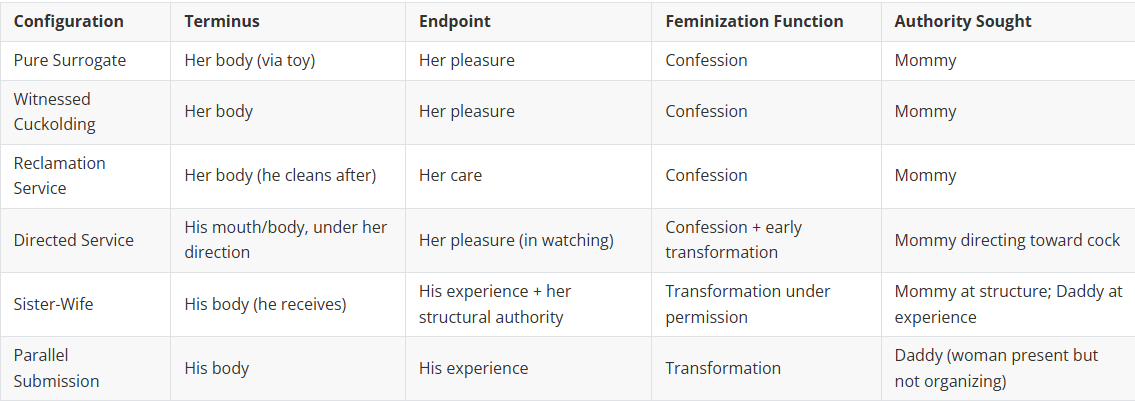
Note: This table simplifies complex configurations. Individual presentation may combine elements. Professional assessment recommended for formal diagnosis. The spectrum continues beyond configurations shown here—pure responsive-to-masculine without female presence represents the far end of Dr. Moreau’s research domain.
This is absolutely brilliant and should be mandatory reading for all responsive males.
Tremendous article! The deep insights outlined here suggests that continued collaboration between Drs. Hailey and Moreau would be very productive and extremely helpful for responsive males, their partners and their clinicians. Possible further research questions include: do different responsive males weigh the various diagnostic dimensions differently? Do these differences in weighting alone result in different configurations? Are there outliers like the sissy who verges on transformation but remains strongly responsive-to-feminine? The bridge configurations alone are worthy of ample study. Well done, Doctors!